01 title

Metronomics Q4 Annual

Three neutral gray figures build a shared plan around a table.
darlison.com
02 comp-story

Share professional good news.

Four gray figures stand and share good news. One speech bubble holds a green check mark. A chart on an easel shows a rising line.
darlison.com
03 comp-decision

Today, let’s:

Engage

Be present

Discuss, collaborate and listen.
Challenge

Challenge yourself and each other

Strong convictions, loosely held.

Trust

No blame. No shame.

Make it safe to speak honestly.

Commit

Disagree and commit

Say it in the room, then back the decision.

darlison.com
04 comp-decision

What did the prep survey tell us?

Agree

Where you agree

Confirm it and move on.

Differ

Where you differ

Hear each view. Decide later in the agenda.

Missing

What no one said

Name the gap.

darlison.com
05 comp-story

What would make these 2 days valuable?

Write your answer, then share it with the team.

A blank sticky note with a large question mark on it.
darlison.com
06 comp-decision

Day 1 is strategy. Day 2 is execution.

Day 1

Strategy

The team, the business, your BHAG, a new 3HAG, its differentiators and swim lanes.

Day 2

Execution

The year in review, next year’s forecast, a new 1HAG, a new QHAG and sprint lanes.

darlison.com
07 comp-story

First, the team.

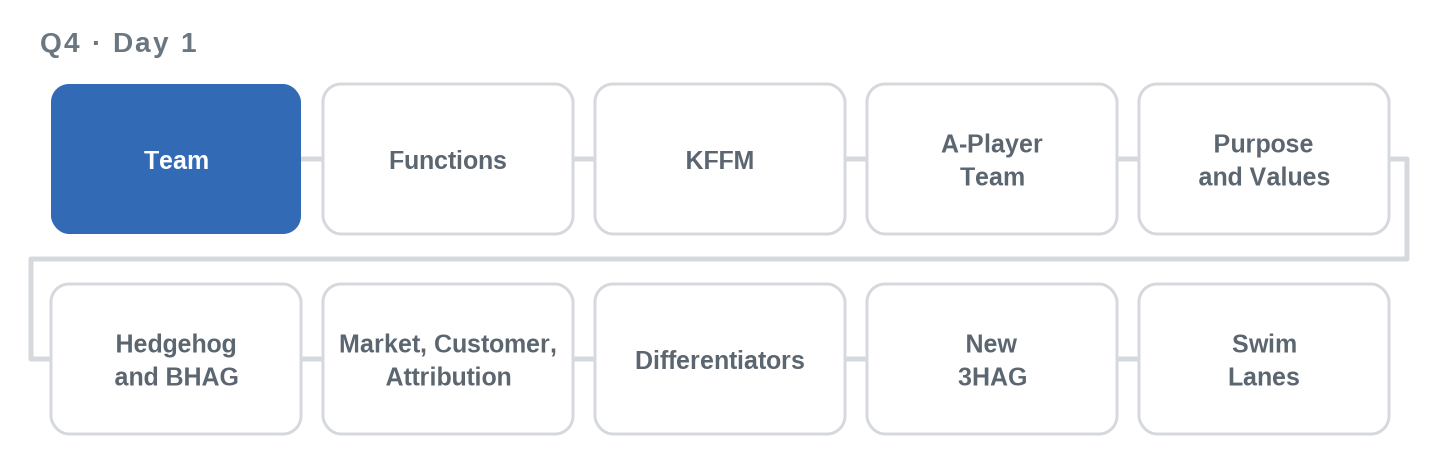
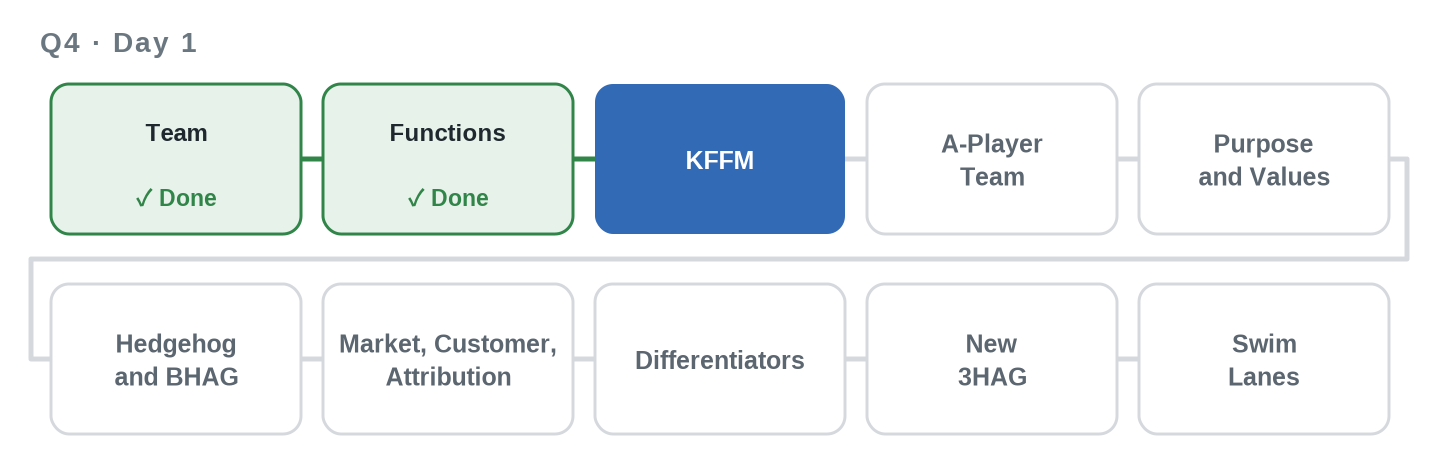
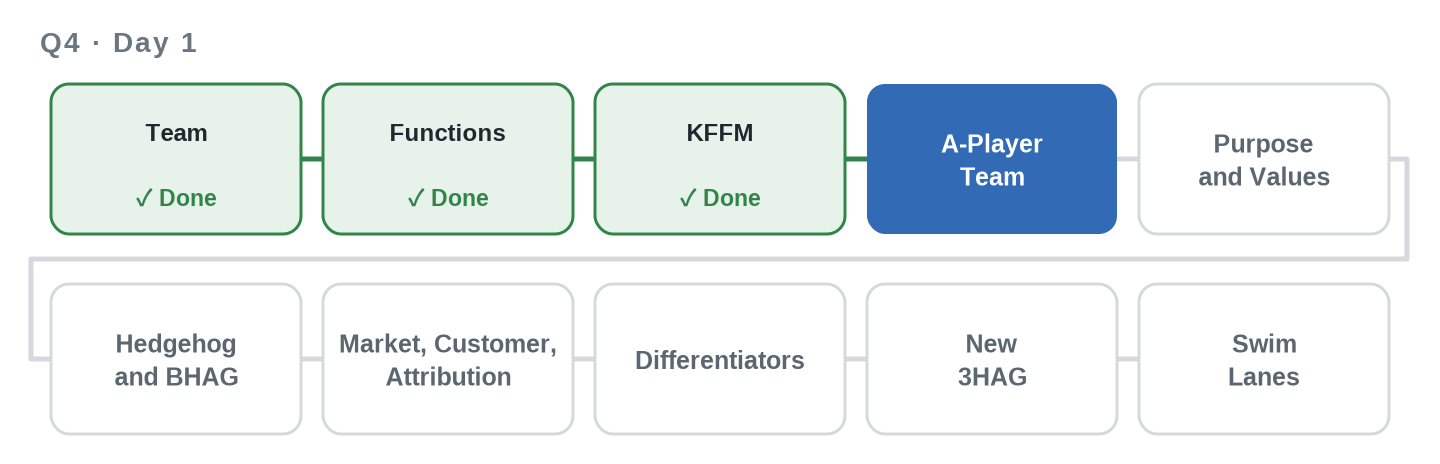
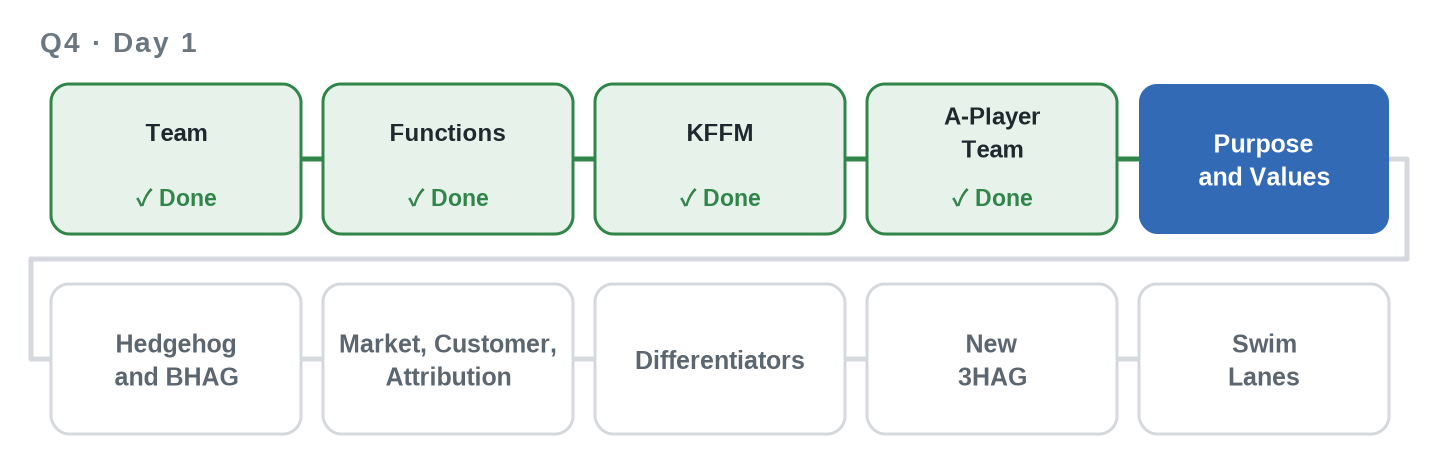
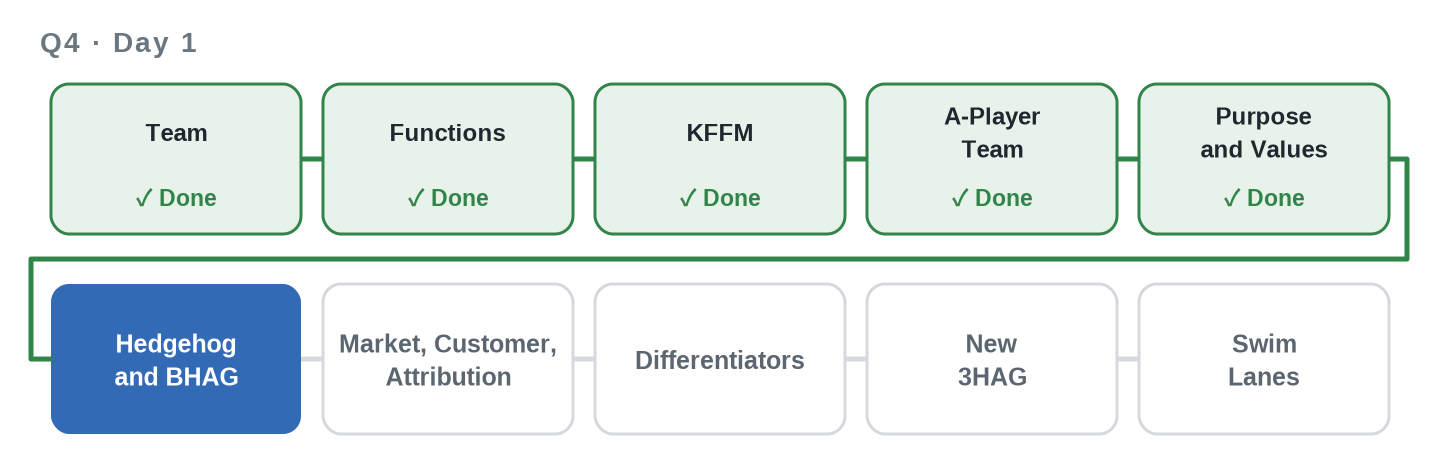
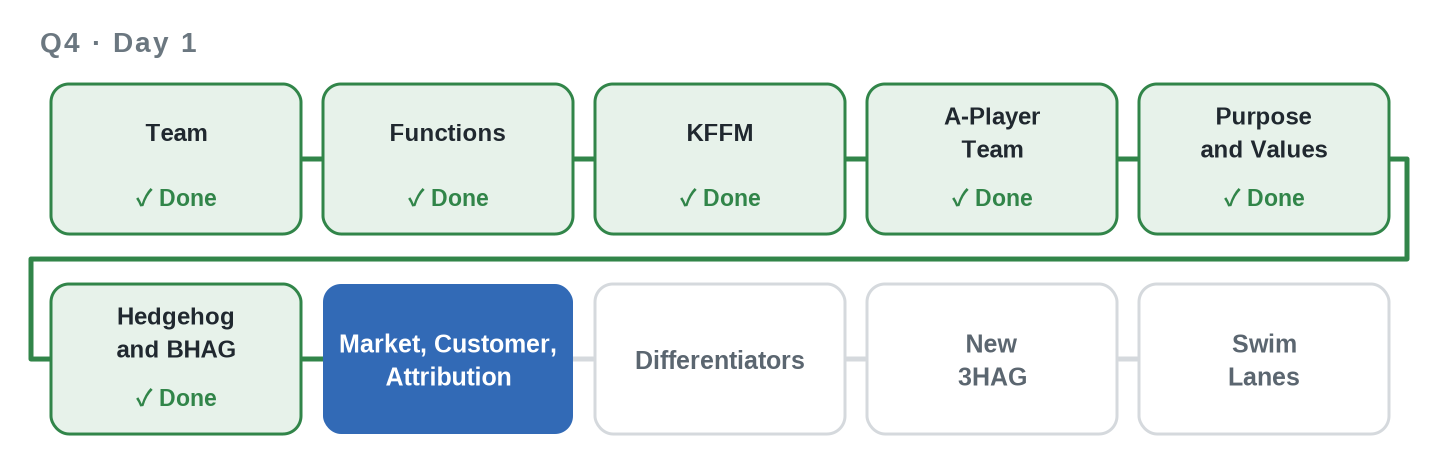
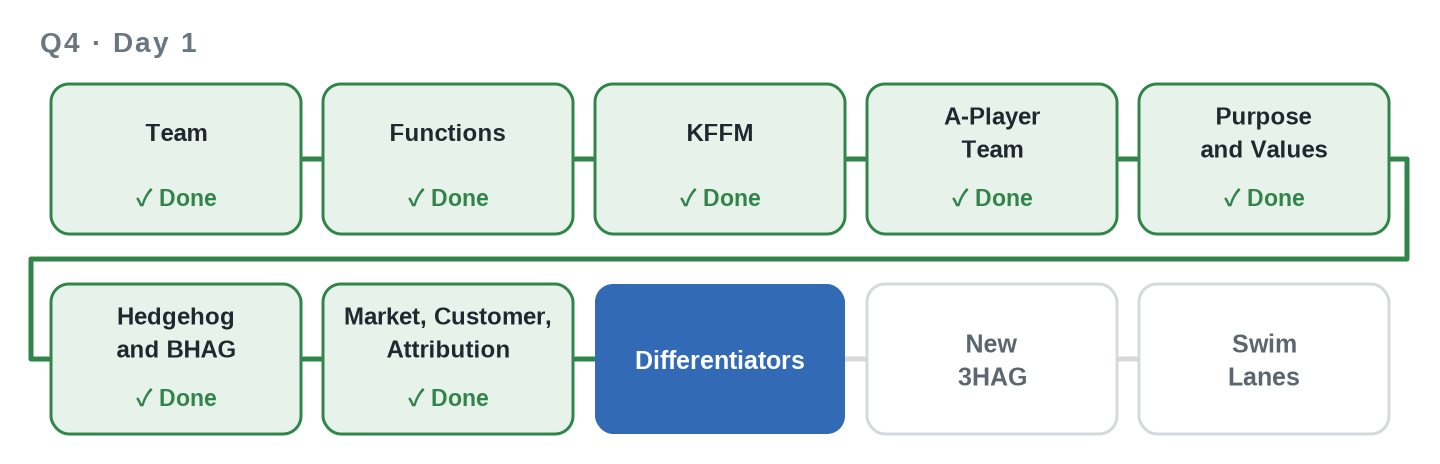
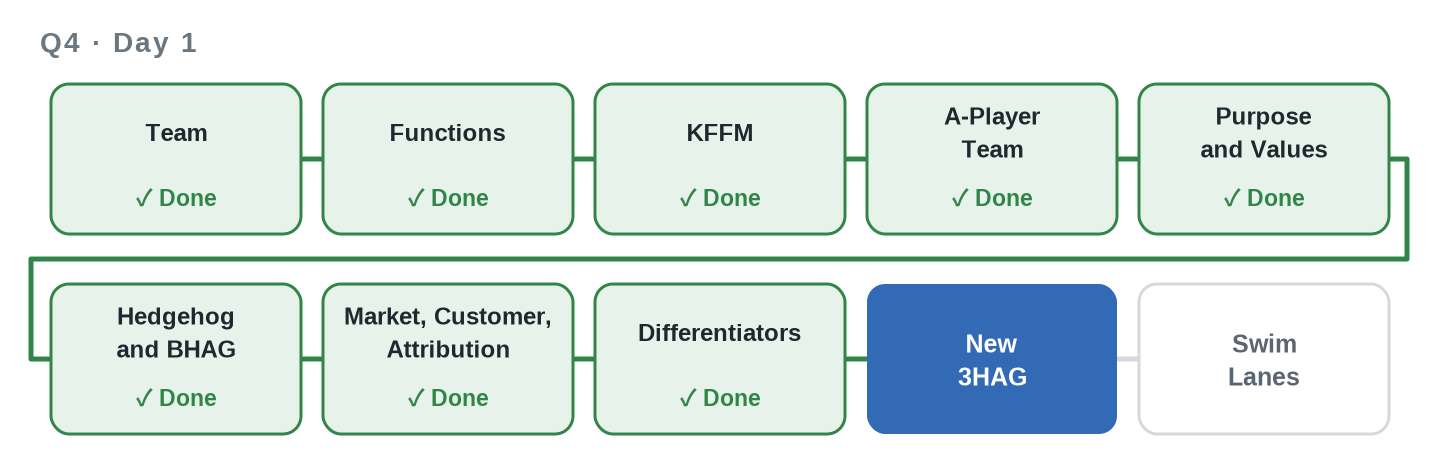
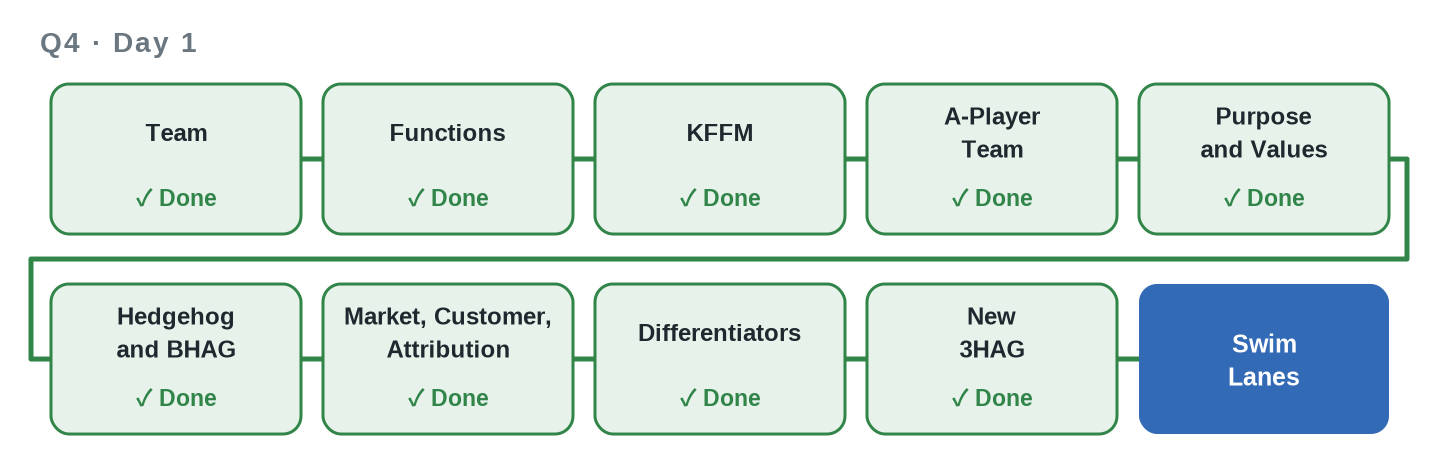
Q4 Day 1 path. Day 1 starts with Team, Functions, KFFM and A-Player Team. Then come Purpose and Values, Hedgehog and BHAG, and Market, Customer, Attribution. It ends with Differentiators, New 3HAG and Swim Lanes. Team is next.
darlison.com
08 comp-story

What do you appreciate about the person beside you?

A strong team gives each other feedback. It starts with appreciation.

Write it down.

Say it to them, then hand them the note.

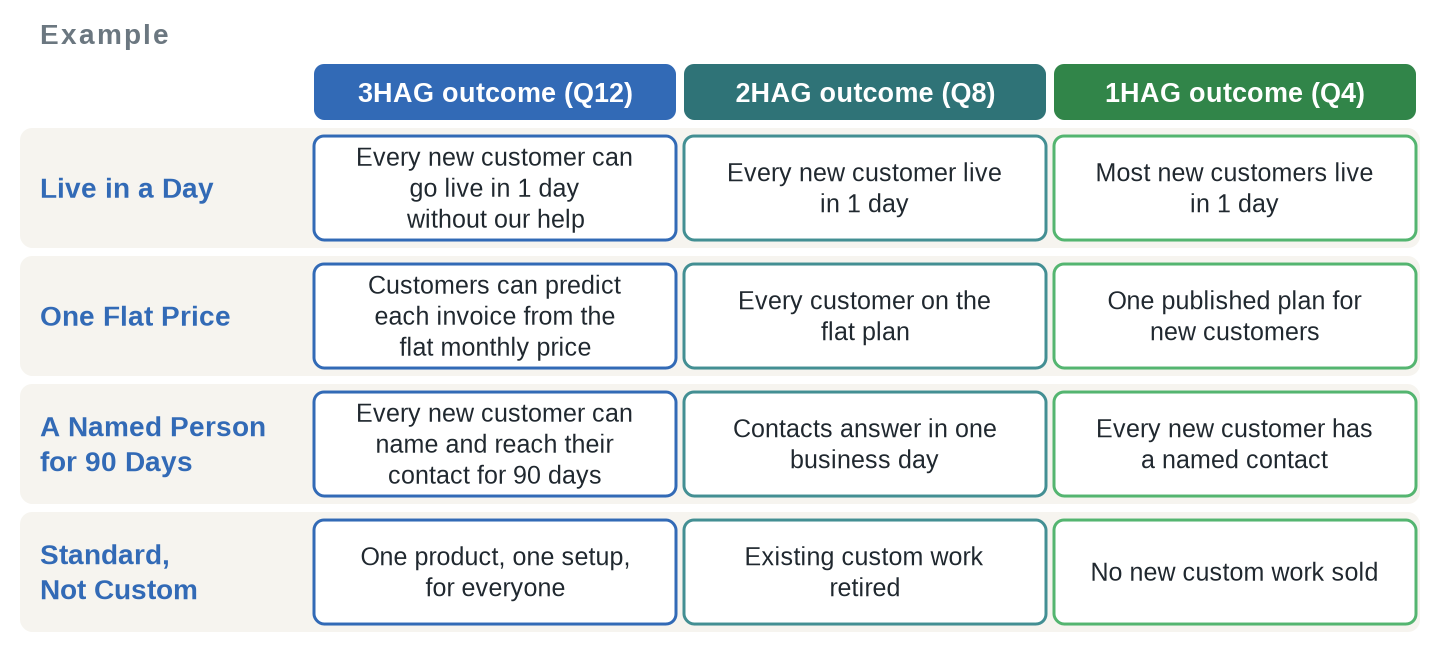
Go left first, starting with the CEO. Then go right.

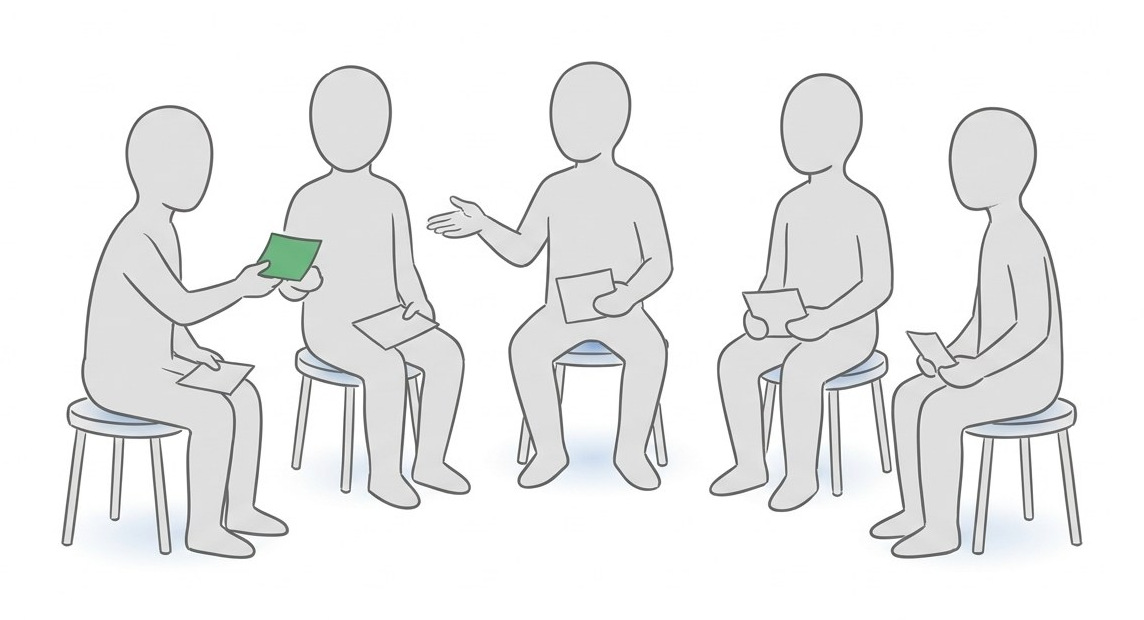
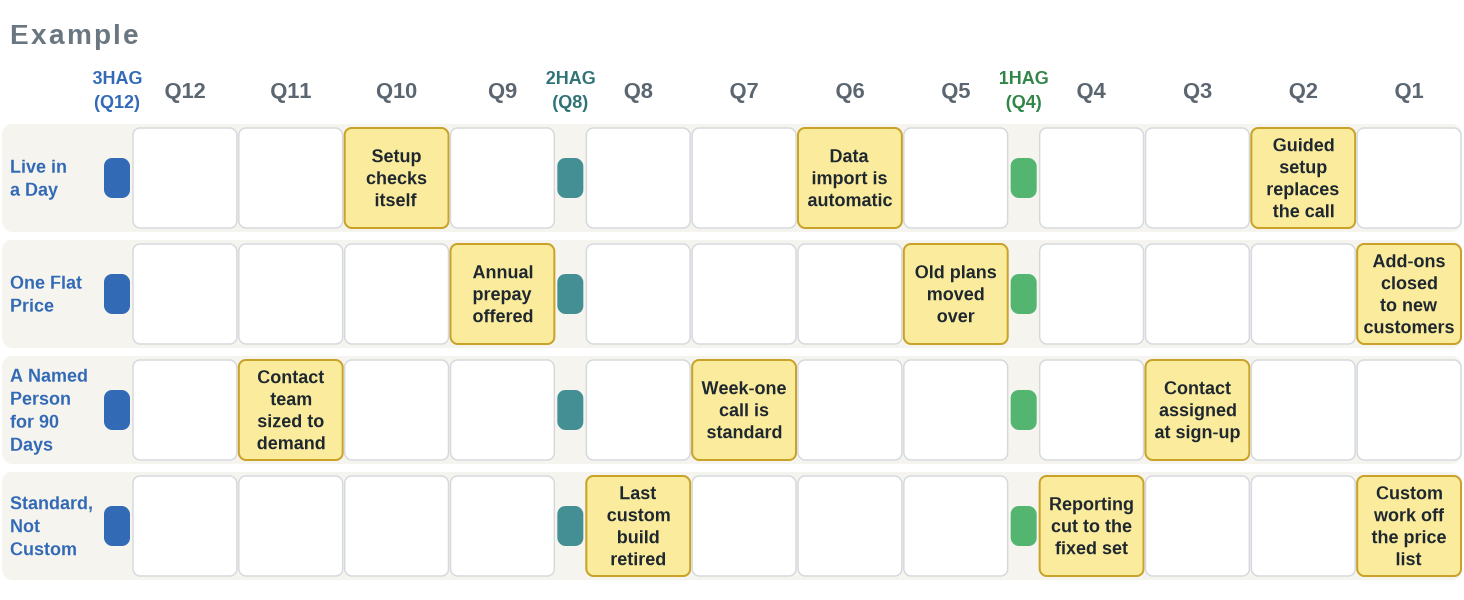
Five neutral gray figures sit in a row on stools. One turns to the figure beside it and hands over a small green note.
darlison.com
09 comp-story

Where does your time go?

On the Leadership Time Assessment page of your board, enter today’s split across the four categories. It totals 100%. Compare it with your last entry, if you have one.

Execution

Strategy

Coaching

Professional and personal development

One neutral gray figure, hand on chin, studies a circle divided into four unequal slices. One slice is green, one blue and two gray.
darlison.com
10 comp-story

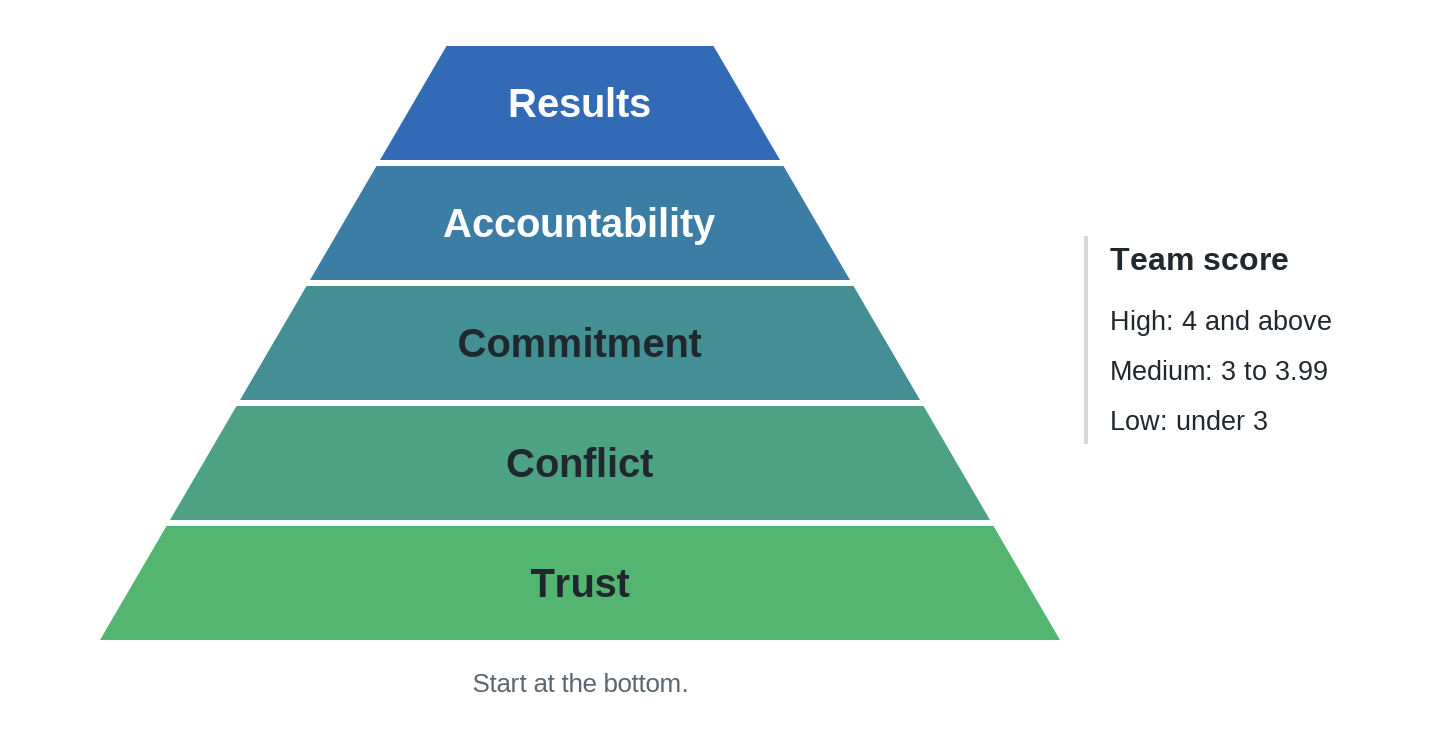
A team builds cohesion in five levels, from trust up.

Each level rests on the one below it. Your Five Dysfunctions assessment scored each level.

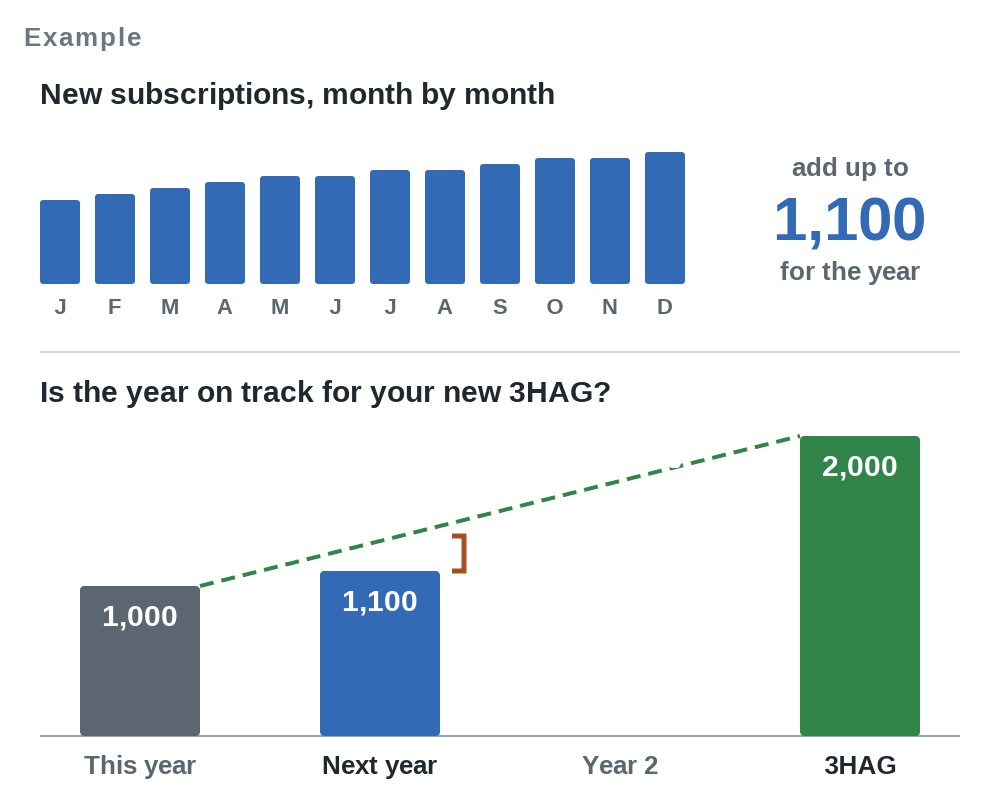
A five-level pyramid rises from Trust through Conflict, Commitment and Accountability to Results. A team score key: high is 4 and above, medium is 3 to 3.99, low is under 3.
darlison.com
11 comp-story

What does your Five Dysfunctions assessment say?

Your coach shows the team’s score for each level.

What is working? What is not?

Start at the bottom. For each level: what do you see in how you work together?

Say what you observe. No blame. No shame.

Not taken yet? Set a date and move on.

darlison.com
12 comp-story

Agree on one action for each level.

Each action gets an owner.

Trust. Conflict. Commitment. Accountability. Results.

These five actions are your cohesiveness plan for the next 90 days.

Start all five this quarter.

darlison.com
13 comp-story

Next, who owns each function.

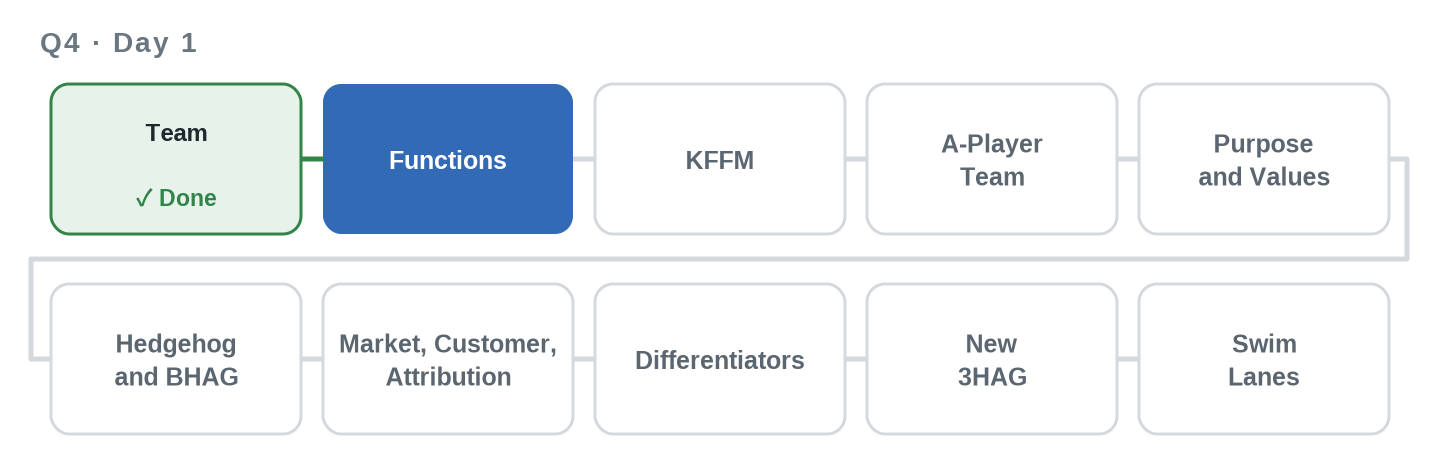
Q4 Day 1 path. Team done. Functions next.
darlison.com
14 comp-story

Who owns each function now?

One person is accountable for the work. Others may be responsible to contribute to the work.

Start a fresh Function Chart. Agree on the functions: add, rename or remove.

In private mode, each person writes who owns each function.

Show your answers, then agree on one owner for each. Each owner says yes aloud.

darlison.com
15 comp-story

Is your Team View still right?

In Metronome: open Team View. Check it against the Function Chart you just agreed on.

Which functions are missing or planned?

Who owns too many functions?

darlison.com
16 comp-story

Are your scorecard reviews done?

Each leader answers in turn.

Have you reviewed each of your direct reports against their scorecard?

If you report to someone, have they reviewed you against yours?

If not, say by when.

darlison.com
17 comp-story

Next, how the work turns into cash.

Q4 Day 1 path. Team and Functions done. KFFM next.
darlison.com
18 comp-story

Is your KFFM still right?

In Metronome: open KFFM. Put it on the screen.

The 3 to 5 key functions are still the right ones.

Each owner rates their function red, yellow or green, by its critical number.

What will it take to turn it green?

darlison.com
19 comp-story

For each lever: did you push it? What moved?

In Metronome: open KFFM. Go lever by lever.

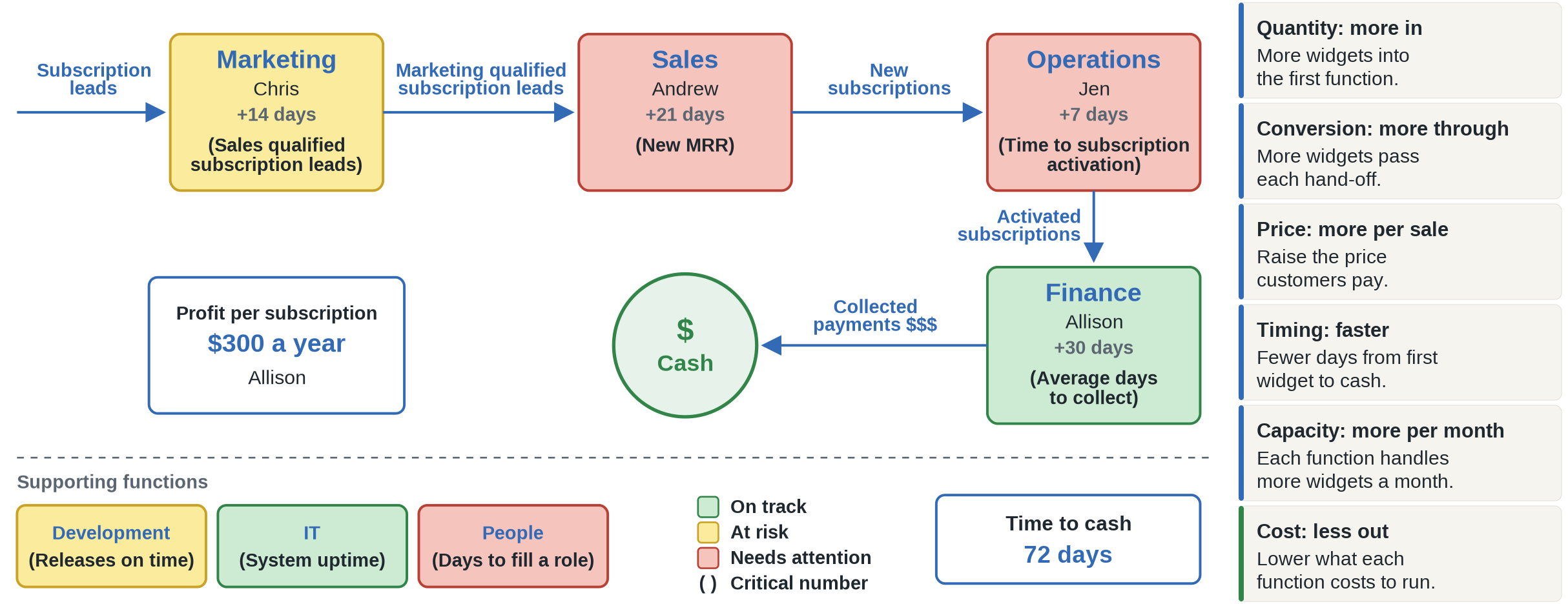
The KFFM example on the left. On the right, six levers to move more cash faster. Quantity: more widgets into the first function. Conversion: more widgets pass each hand-off. Price: raise the price customers pay. Timing: fewer days from first widget to cash. Capacity: each function handles more widgets a month. Cost: lower what each function costs to run.Profit per XJim Collins’s economic engine, from Good to Great. It is the one profit ratio that, raised steadily over time, does the most to drive your economics. Here, profit per subscription: profit divided by the average number of active subscriptions. Allison owns hitting the target, $300 a year.
darlison.com
20 comp-story

Is the KFFM in your weekly leadership meeting?

In Metronome: open Meetings. Open your weekly leadership meeting.

The KFFM is on the agenda every week.

For each red critical number, its owner writes the situation, cause, correction and follow-up.

darlison.com
21 comp-story

Which lever moves cash fastest now?

Name the function, the widget and the owner.

Make it a candidate for a QHAG priority.

darlison.com
22 comp-story

Next, your people.

Q4 Day 1 path. Team, Functions and KFFM done. A-Player Team next.
darlison.com
23 comp-story

How is the plan for everyone below A going?

Each leader answers for their own team.

For each B: how are you coaching them to A?

Has any A fallen back to B?

For each C: what action have you taken, and when is the decision due?

No plan yet? Agree on the action, the accountable leader and the date now.

darlison.com
24 comp-story

Next, validate why you exist and how you behave.

Q4 Day 1 path. Team, Functions, KFFM and A-Player Team done. Purpose and Values next.
darlison.com
25 comp-story

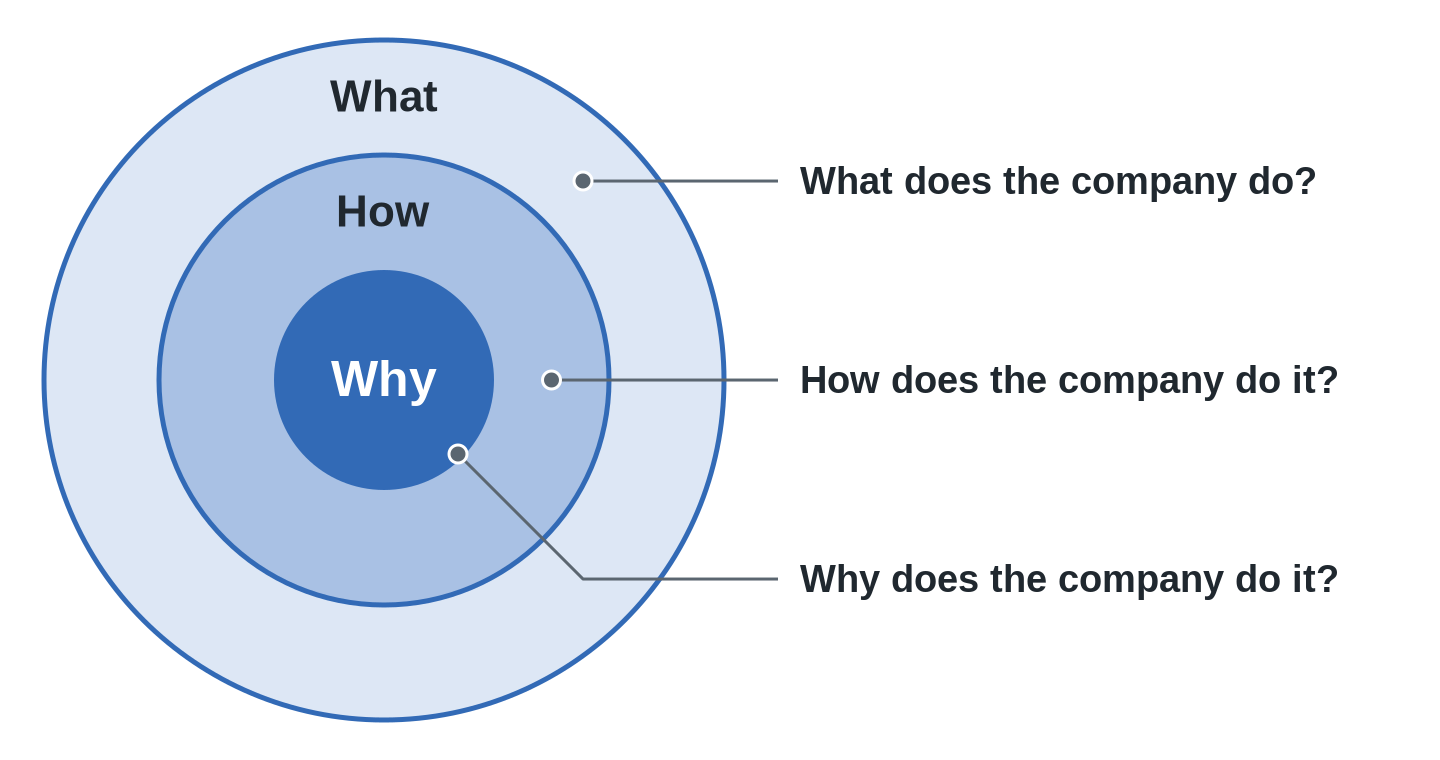
Why does the company do what it does?

Validate your Core Purpose. Each leader answers all three alone. Share one question at a time, starting with What. Agree on your Why. Then read your Core Purpose aloud. Do they match?

Three rings run from Why at the center through How to What. Each ring has its own question: why, how and what does the company do.
darlison.com
26 comp-story

Read your Core Values aloud.

In Metronome: open One Page Plans.

Read each value and the behavior it means.

darlison.com
27 comp-story

Test each Core Value.

Is it a value you hire and fire on, or a brand value?

When did you last let someone go for not living it?

Does someone who keeps breaking it belong here?

Would you build a new company around it, in any industry?

Then ask: is an important value missing?

darlison.com
28 comp-story

Next, validate your BHAG.

Q4 Day 1 path. Through Purpose and Values done. Hedgehog and BHAG next.
darlison.com
29 comp-story

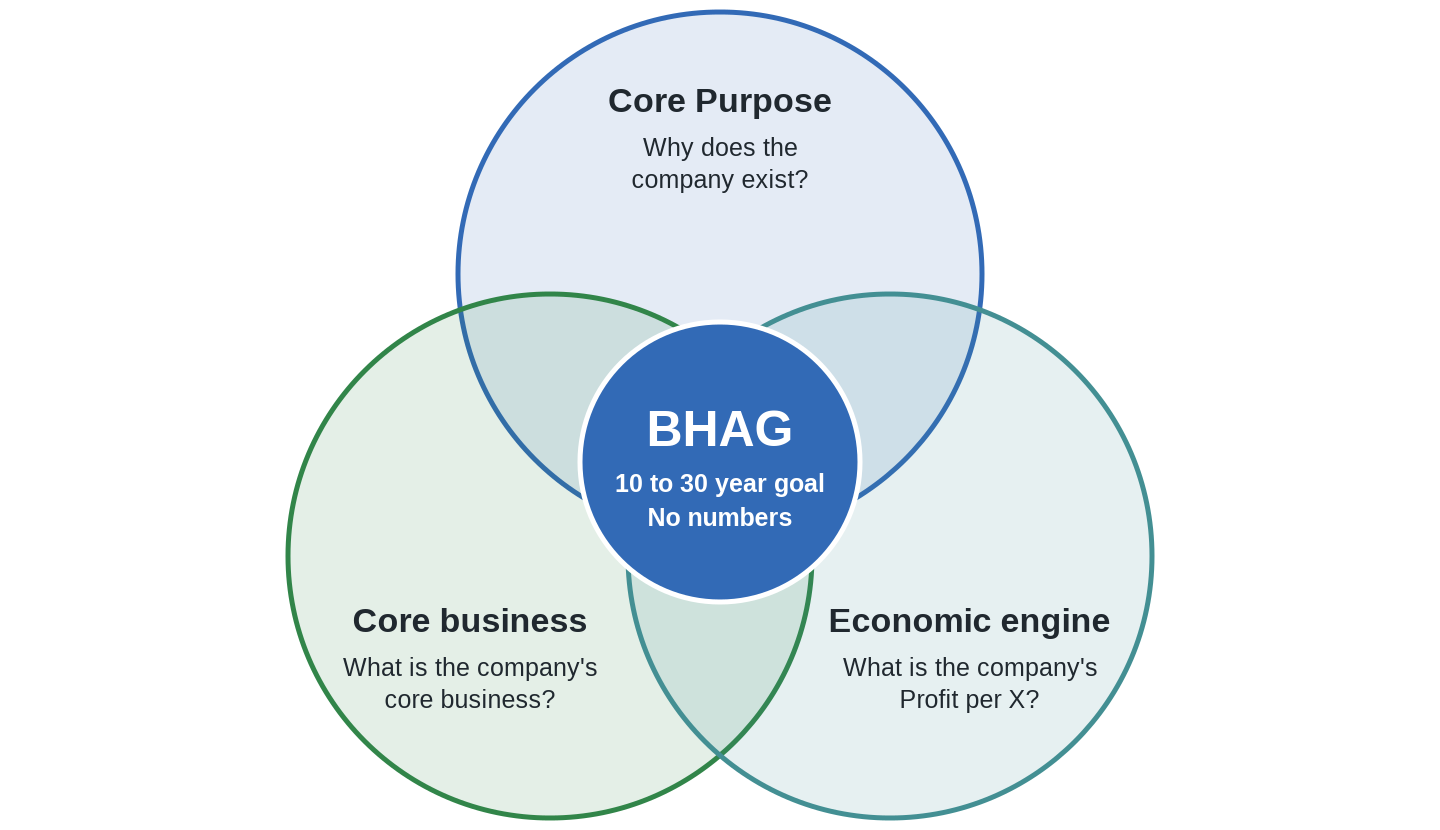
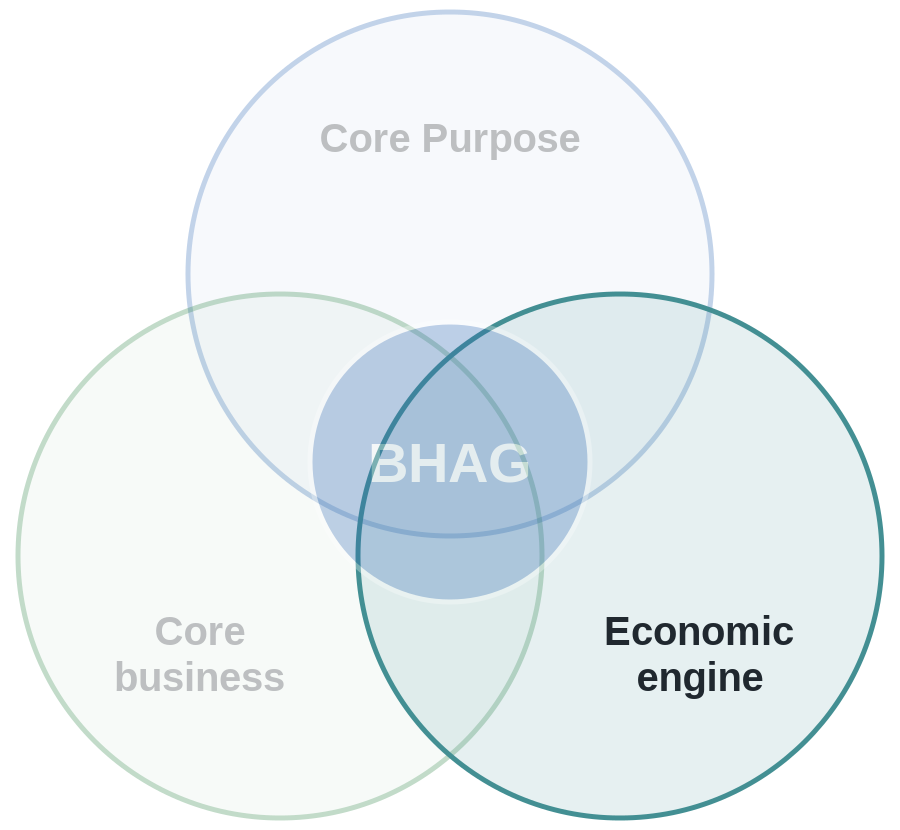
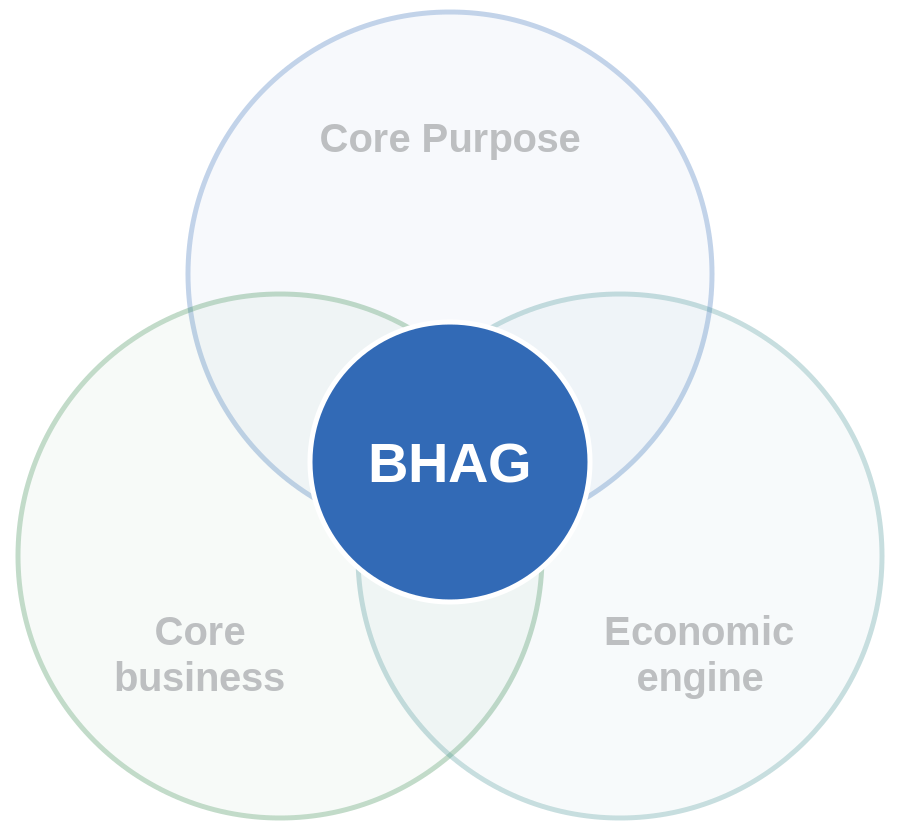
Your BHAG sits where three circles meet.

This is the Hedgehog. You use it to validate the BHAG you already have. Your Core Purpose goes in the top circle. Agree on the other two in turn. Validate the BHAG last.

Three circles overlap: Core Purpose, Core Business and Economic Engine. Each has its question. The BHAG sits where all three meet: a 10 to 30 year goal with no numbers.
darlison.com
30 comp-story

What is your core business?

Each leader writes an answer alone. Then share.

It is what you can be best in the world at, not what you want to be best at.

Which answer says it most clearly? Stay with it until the team agrees.

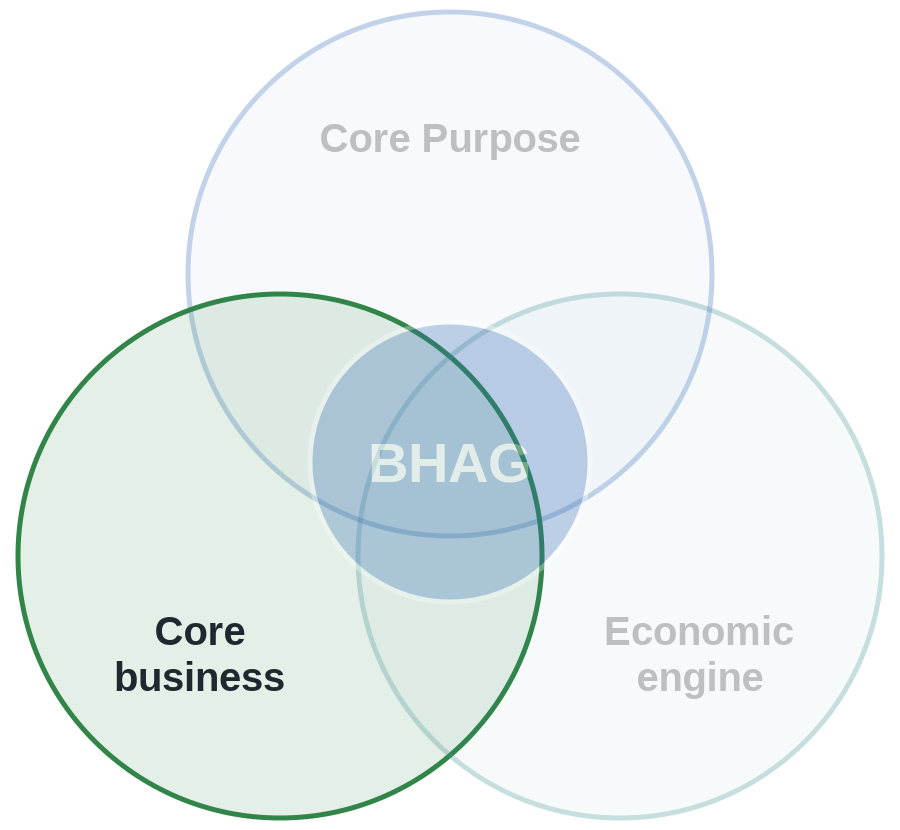
The three Hedgehog circles with the Core business circle highlighted.
darlison.com
31 comp-story

What is your Profit per X?

Your economic engine. X is usually a widget from your KFFM.

If you have agreed on your X, read it aloud and confirm it.

If not, each leader writes an answer. Share, then agree.

The three Hedgehog circles with the Economic engine circle highlighted.
darlison.com
32 comp-story

What is your 10 to 30 year goal?

A blind test of your BHAG. Each leader writes one sentence alone, without looking at it. No date, no numbers. Then share.

Which one is the BHAG? Stay with it until the team agrees.

Then read your current BHAG aloud. Keep it or replace it.

Record the horizon, 10 to 30 years, beside the sentence.

The three Hedgehog circles with the BHAG at the center highlighted.
darlison.com
33 comp-decision

Does your BHAG pass?

Double-check the BHAG you just validated. Read it aloud. Test it.

1Clear and compelling?

Can people understand the ambition?

2Connected to purpose?

Does it express why you exist?

3Can we recognize success?

Could you tell whether you had achieved it in 25 years?

4Exciting to you?

Does it create energy among the leaders?

5Exciting to the whole company?

Would others want to pursue it?

6A big step in capability?

What would you need to become able to do?

darlison.com
34 comp-story

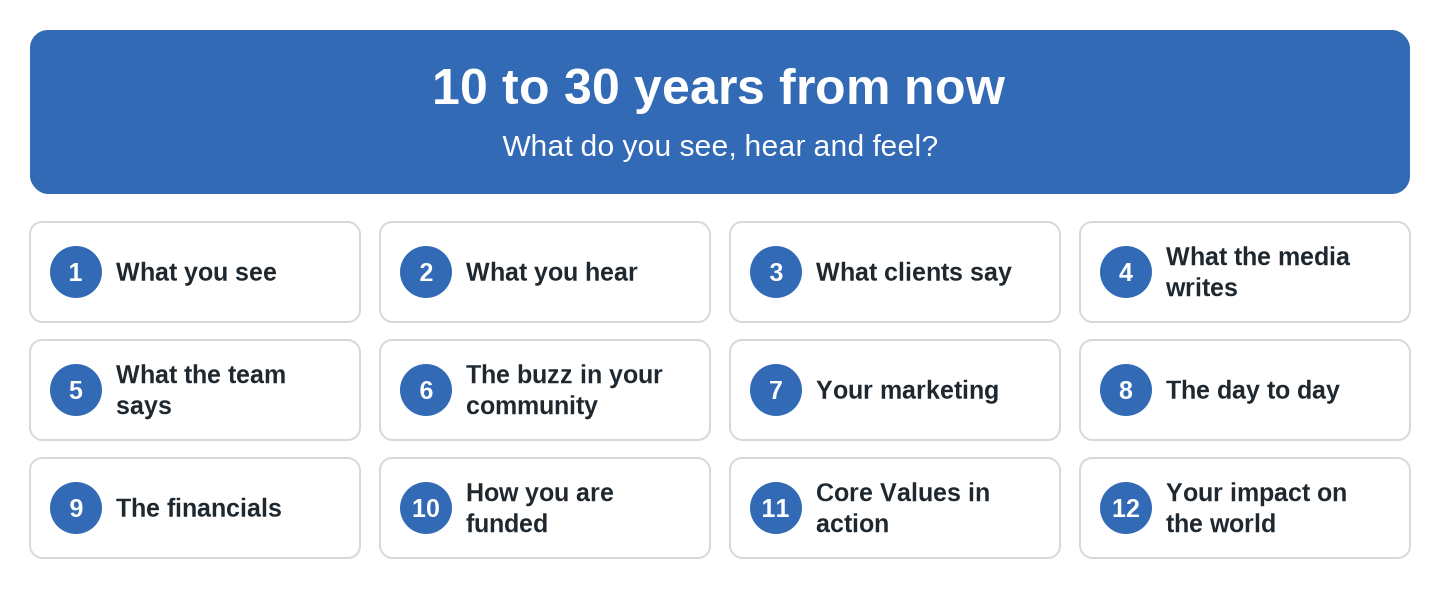
Paint the picture of your BHAG.

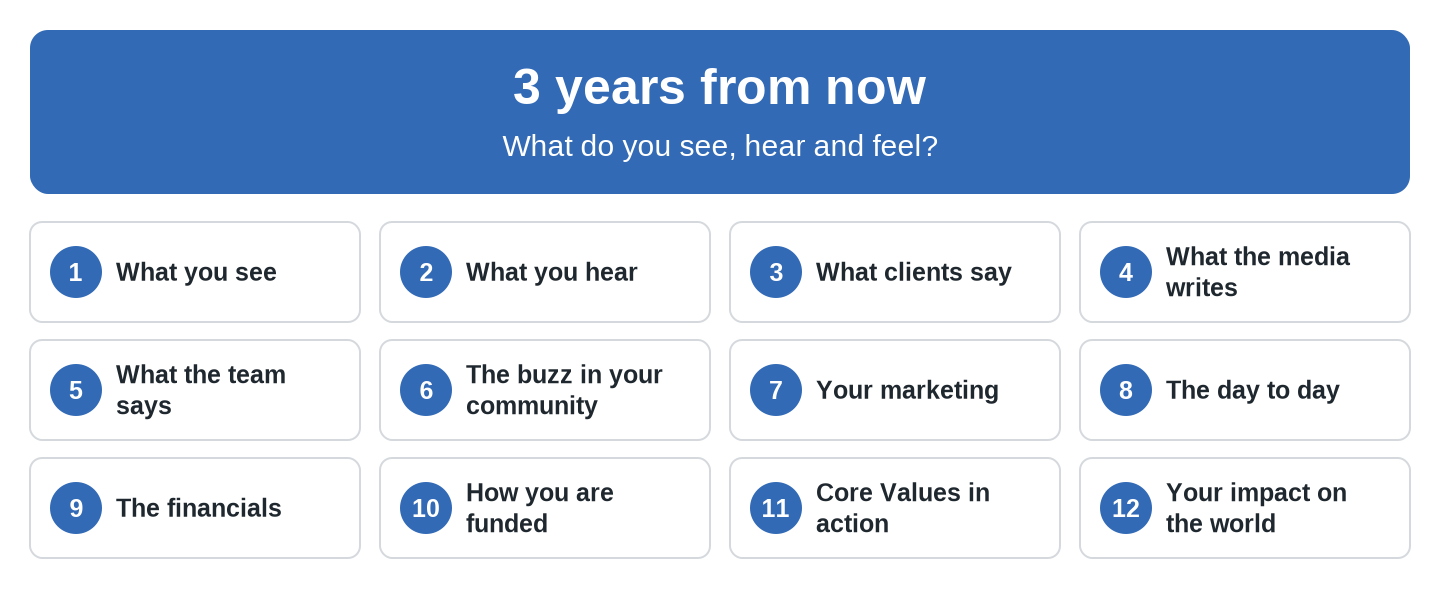
Each leader writes alone, in the present tense, as if already there. Use any of the prompts.

The heading asks what you see, hear and feel 10 to 30 years from now. Twelve numbered prompts follow, from what you see to your impact on the world.
darlison.com
35 comp-story

Turn your pictures into one.

Each leader has written their own. Now the team writes one.

Show every leader’s picture. Read each one aloud.

What does each person see that the others missed?

Write one picture every leader sees, in the present tense: what you see, hear and feel.

darlison.com
36 comp-story

Next, what your strategy rests on.

Q4 Day 1 path. Through Hedgehog and BHAG done. Market, Customer, Attribution next.
darlison.com
37 comp-story

Is your Market Map still right?

In Metronome: open War Room. Put your Market Map on the screen. What changed this year?

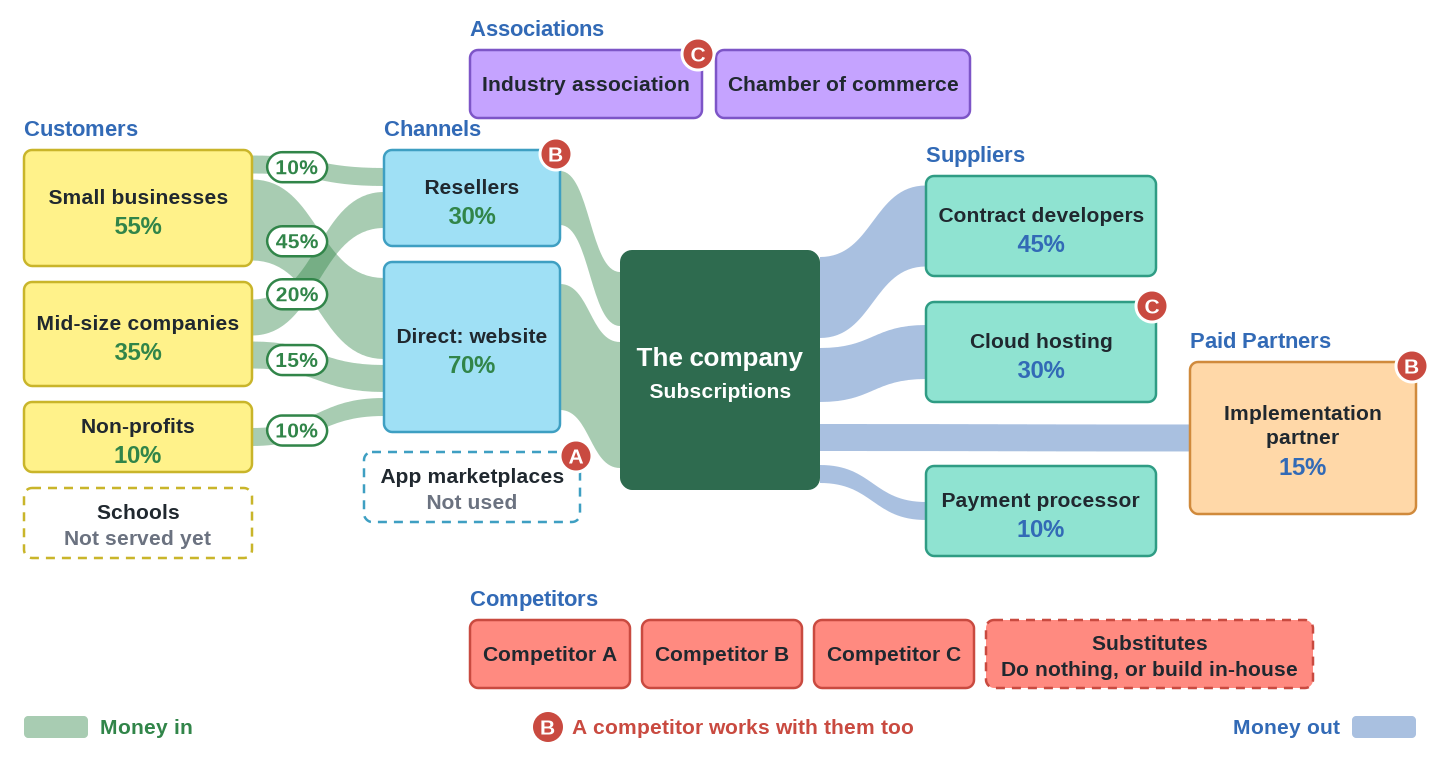
The example subscription company in the center. Customers are on the left: small businesses 55%, mid-size companies 35% and non-profits 10%. Schools are dashed, not served yet. Customers buy through channels: resellers 30% and direct website 70%. App marketplaces are dashed, not used. Green bands show the split from each customer to each channel, then into the company. Associations above. On the right, blue money-out bands run to suppliers: contract developers 45%, cloud hosting 30% and payment processor 10%. One runs to a paid partner, the implementation partner, 15%. Competitors A, B and C below, with a dashed substitutes box: do nothing, or build in-house. Red letter badges mark players a competitor also works with. A is on app marketplaces. B is on resellers and the implementation partner. C is on cloud hosting and the industry association.
darlison.com
38 comp-story

Is your Core Customer still right?

In Metronome: open War Room. Read your Core Customer aloud. Is this still the customer you most want more of?

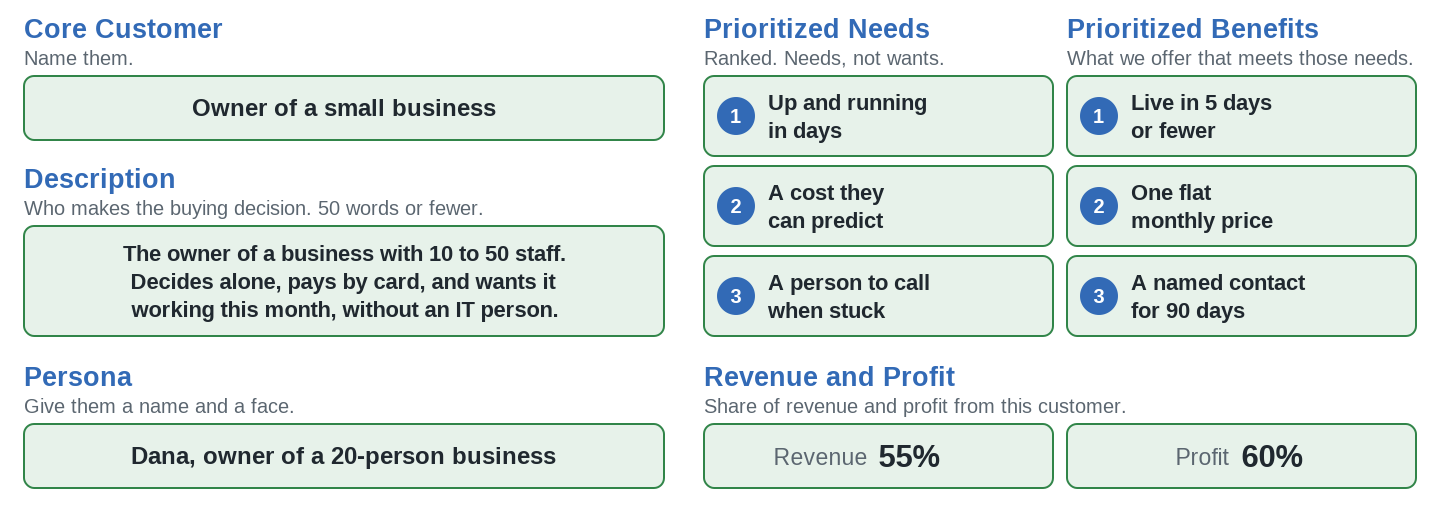
An example Core Customer for the subscription company. Core Customer: owner of a small business. Description: the owner of a business with 10 to 50 staff. They decide alone, pay by card, and want it working this month without an IT person. Prioritized needs. 1, up and running in days. 2, a cost they can predict. 3, a person to call when stuck. Prioritized benefits. 1, live in 5 days or fewer. 2, one flat monthly price. 3, a named contact for 90 days. Persona: Dana, owner of a 20-person business. Revenue 55%, profit 60%.
darlison.com
39 comp-story

The Attribution Map template, if you need it.

Your map is in Metronome, in the War Room. Start there.

This sheet is the template you built it from at Q3.

Need to rebuild the map? Scan the code and make a copy.

One QR code. Attribution Map template: only if you need to rebuild your map. It opens the Attribution Map master sheet in Google Sheets.Attribution Map template
darlison.com
40 comp-story

Start from the Attribution Map you drew at Q3.

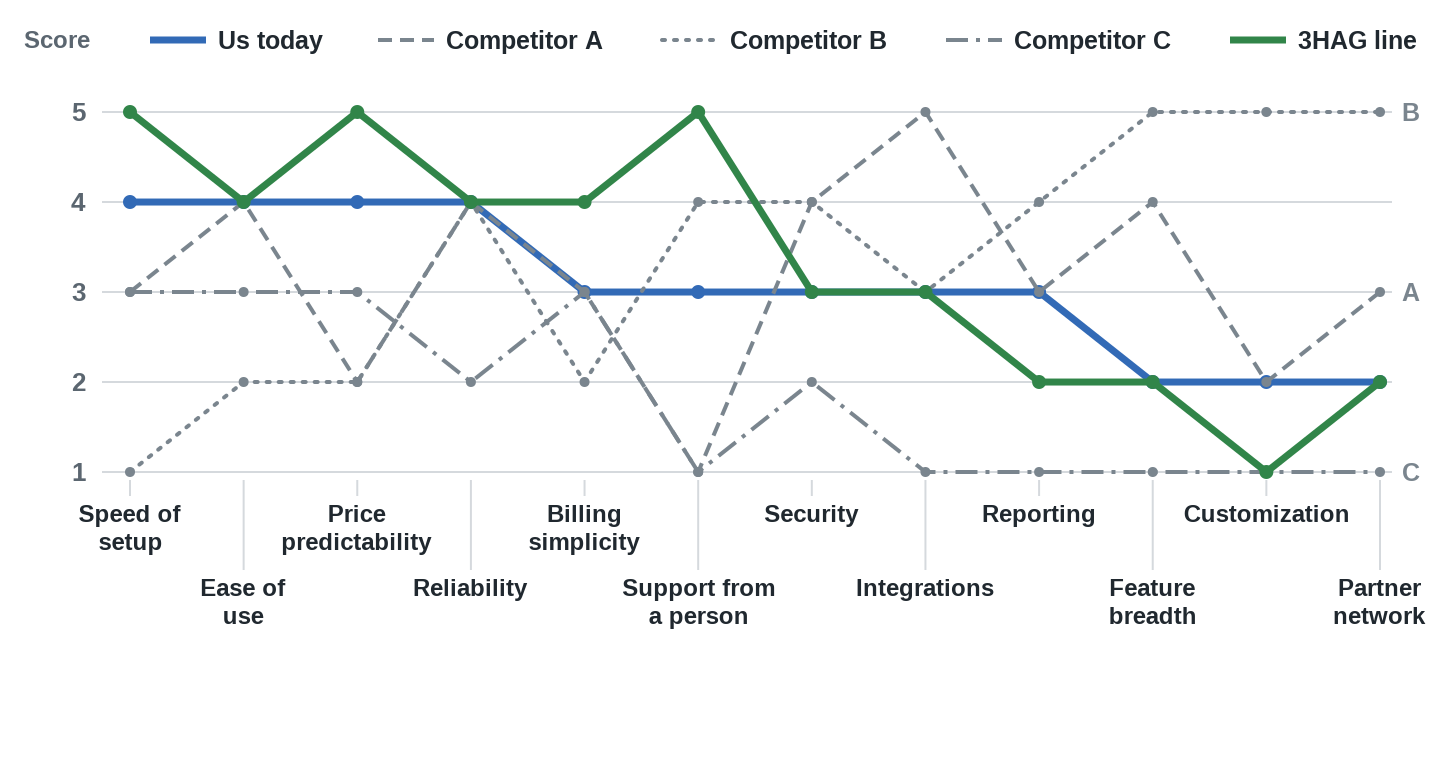
In Metronome: open War Room. Put your Attribution Map on the screen. Find your line, each competitor and your 3HAG line.

A line graph for the subscription company. Twelve market attributes run along the bottom, ordered from the one the company serves best. They start with speed of setup, ease of use, price predictability, reliability, billing simplicity and support from a person. Security, integrations, reporting, feature breadth, customization and partner network follow. Scores run from 1 to 5. Five lines: Us today, Competitor A, Competitor B, Competitor C and the 3HAG line. Us today runs from 4 on the left to 2 on the right. The 3HAG line rises to 5 on speed of setup, price predictability and support from a person. It drops on reporting and customization.Attribution Map template
darlison.com
41 comp-story

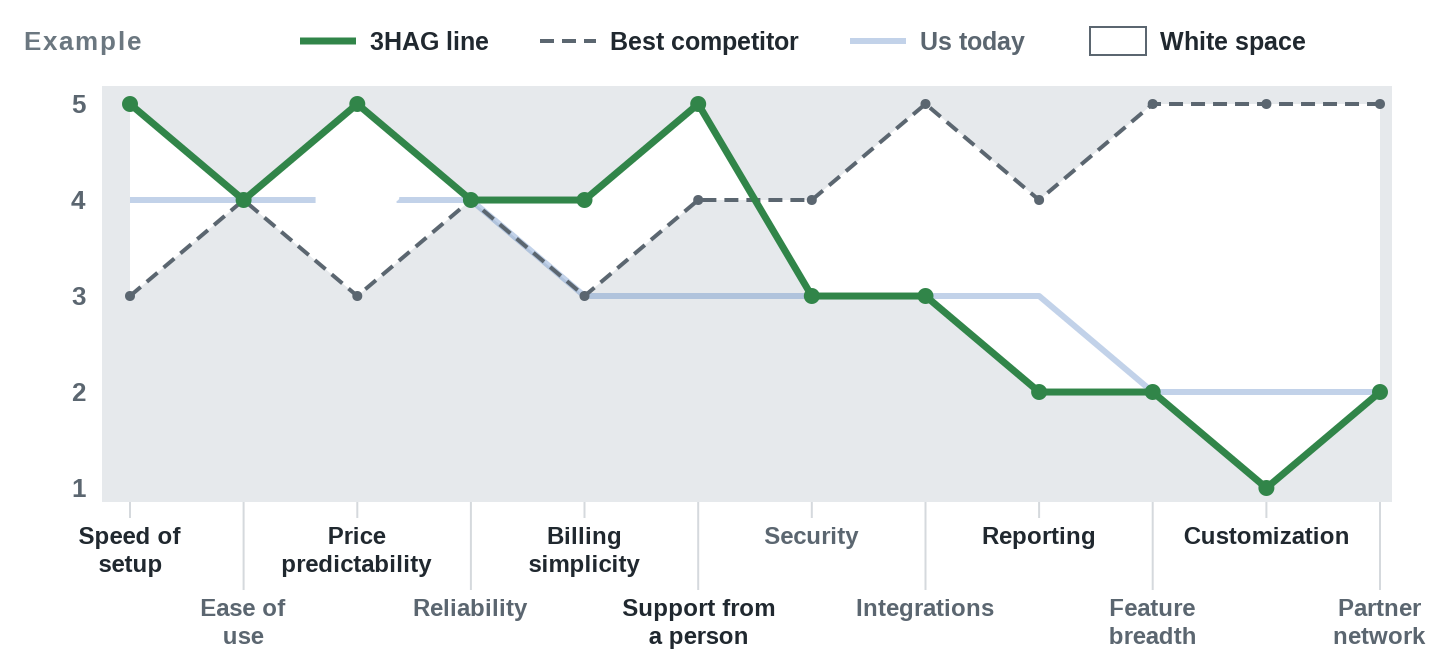
Does your 3HAG line give you enough white space?

The same map, drawn as white space. Is there enough white between your 3HAG line and your best competitor?

A line graph for the example subscription company. Twelve market attributes run along the bottom: speed of setup, ease of use, price predictability, reliability, billing simplicity, support from a person, security, integrations, reporting, feature breadth, customization and partner network. Scores run from 1 to 5. A green 3HAG line and a dashed Best competitor line cross the chart. The space between them is white on a gray ground. On the left the 3HAG line is above the competitor line, at 5 on speed of setup, price predictability and support from a person. That white is marked Invest. On the right the 3HAG line drops below it, to 2 on reporting and 1 on customization. That white is marked Give up. Where the two lines touch, on ease of use and reliability, there is no white. A faint line shows Us today.Attribution Map template
darlison.com
42 comp-story

Next, what you must do to create that white space.

Q4 Day 1 path. Through Market, Customer, Attribution done. Differentiators next.
darlison.com
43 comp-story

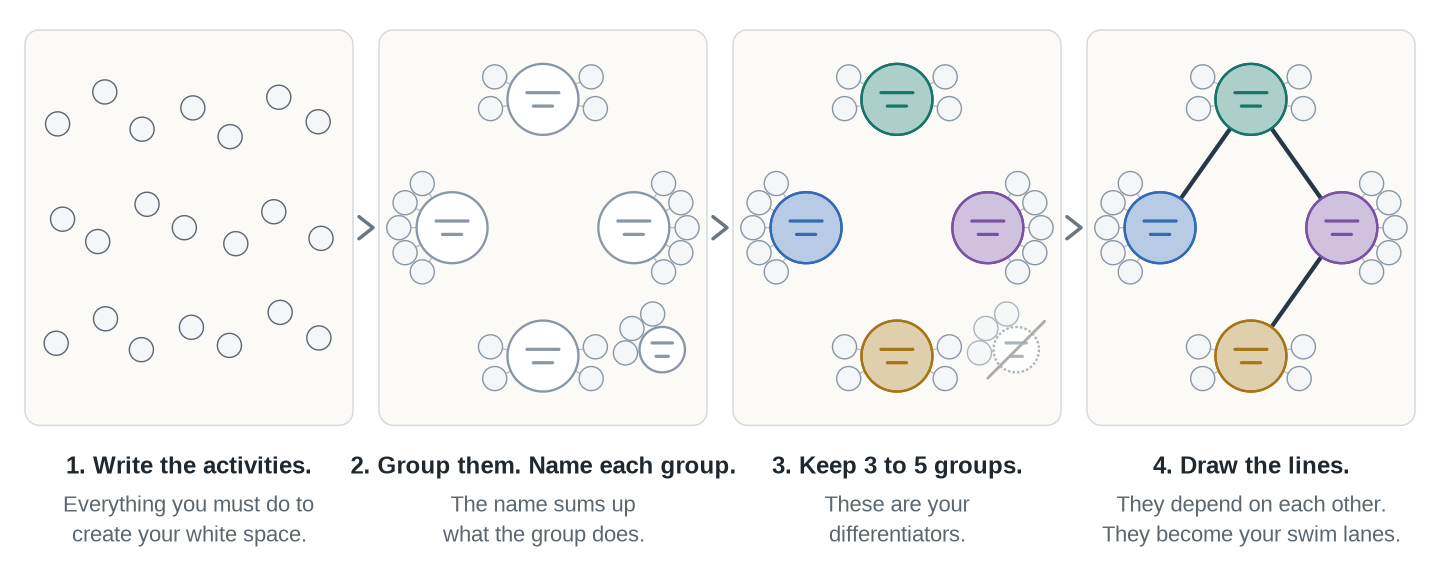
Build your Activity Fit Map in four steps.

To create your white space, you must invest in some things and give up others. Those are your activities.

Four small pictures in a row. 1, write the activities: loose notes, everything you must do to create your white space. 2, group them and name each group: the notes sit around five named circles. The name sums up what the group does. 3, keep 3 to 5 groups: four circles take a color and one is struck out. These are your differentiators. 4, draw the lines: lines join the differentiators. They depend on each other. They become your swim lanes.
darlison.com
44 comp-story

What must you do to make the whole 3HAG line true?

Each leader writes 5 to 7 activities alone, one on each sticky note.

A differentiator is a group of activities that makes your 3HAG line true.

The whole line: where you will lead, what you will maintain and what you will let drop.

An activity can be something to stop doing.

Present your activities. Put them all on the board.

Step 1 of the example. Twenty-one loose notes on a board, one activity on each, not yet grouped.
darlison.com
45 comp-story

Group the activities. Name each group.

Most teams end up with 4 to 6 groups.

Put similar activities together.

Name each group for exactly what it will accomplish.

“Support” is too generic. Ask again: what will this group accomplish?

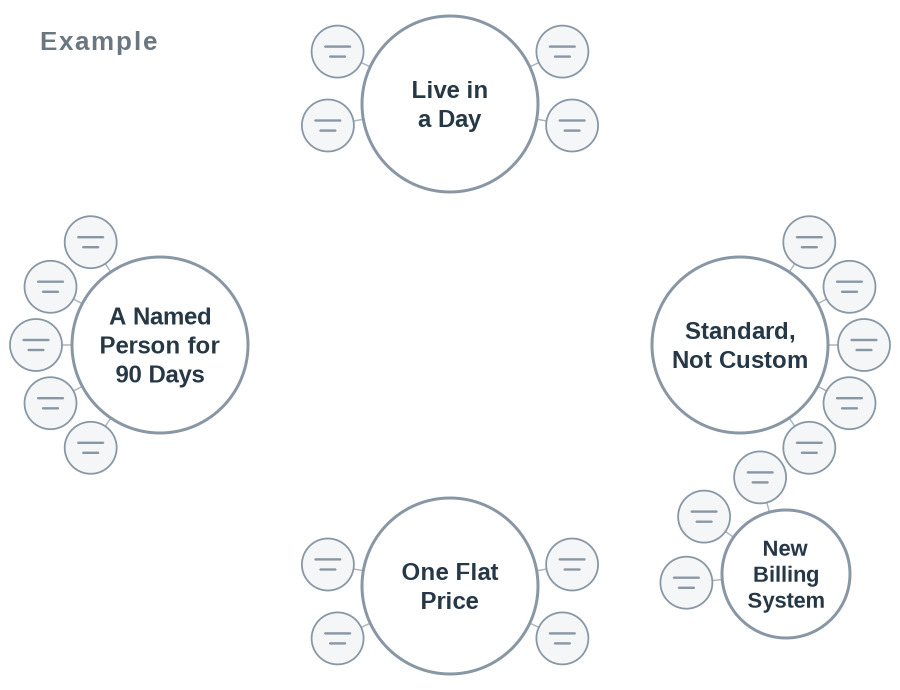
Step 2 of the example. The same notes now sit around five named groups: A Named Person for 90 Days, Live in a Day, Standard, Not Custom, One Flat Price and New Billing System.
darlison.com
46 comp-story

Agree on your 3 to 5 differentiators.

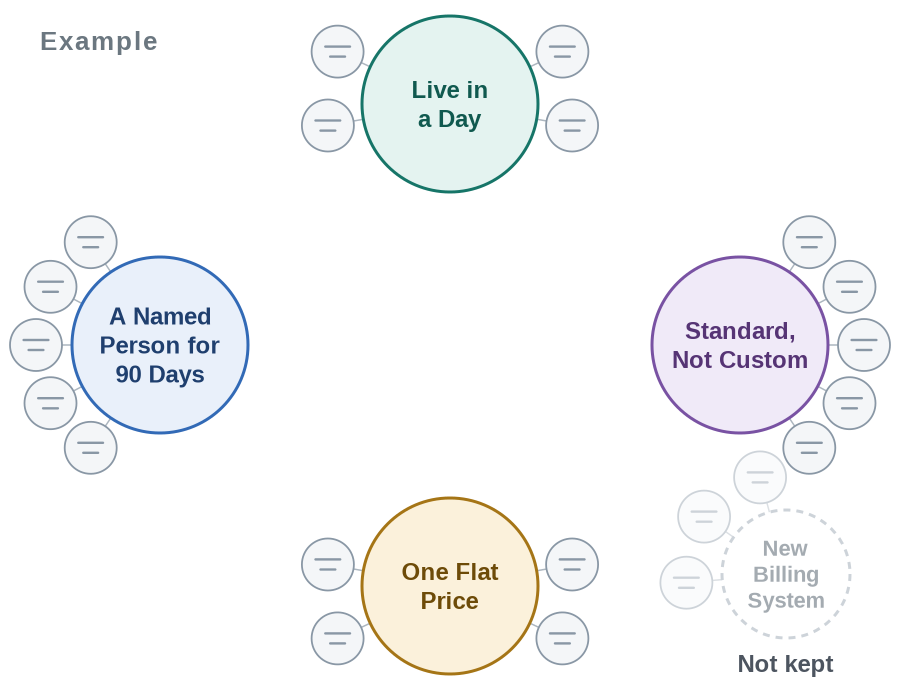
Keep the strongest groups. Each one heads a swim lane.

Check back against your 3HAG line: every place you will lead has a group behind it.

Each one serves a need of your Core Customer.

A group you do not keep can stay as a supporting activity.

Give each a short descriptor: what is true when you achieve it.

Step 3 of the example. Four groups are kept and take a color: A Named Person for 90 Days, Live in a Day, Standard, Not Custom and One Flat Price. New Billing System fades and is marked not kept.
darlison.com
47 comp-story

Draw the lines: what depends on what?

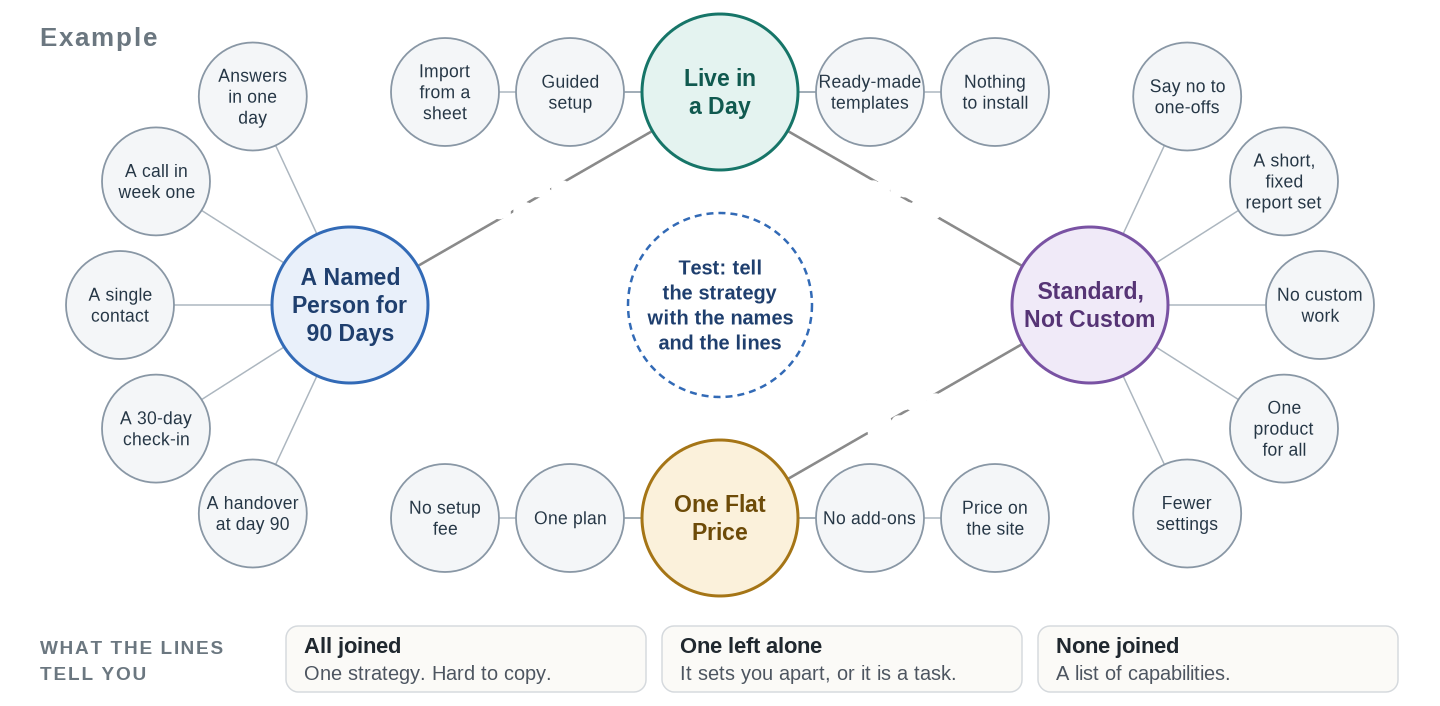
If you cannot do this one, can you still win with that one? If not, draw a line and write why. Then test it: tell your strategy with the names and the lines.

The finished example Activity Fit Map. Four colored circles sit around a dashed circle that reads: test, tell the strategy with the names and the lines. A Named Person for 90 Days has five activities: a single contact, a call in week one, answers in one day, a 30-day check-in, a handover at day 90. Live in a Day has four: guided setup, ready-made templates, import from a sheet, nothing to install. Standard, Not Custom has five: one product for all, no custom work, a short fixed report set, say no to one-offs, fewer settings. One Flat Price has four: one plan, no add-ons, no setup fee, price on the site. Three lines join the differentiators, each with its reason. A Named Person for 90 Days to Live in a Day: a fast start leaves time for the customer. Live in a Day to Standard, Not Custom: one product makes setup fast. Standard, Not Custom to One Flat Price: no custom work keeps one price. Under the map, what the lines tell you. All joined: one strategy, hard to copy. One left alone: it sets you apart, or it is a task. None joined: a list of capabilities. Point at each for more.Test your strategyOne leader tells the company’s strategy aloud, using only the names and the lines: we do this, which lets us do that. If the story does not hold together, fix a name or a line.All joinedEvery differentiator has a line to at least one other. They work as one set. A competitor who copies one piece gets little.One left aloneOne differentiator has no line to the others. Ask the team to tell you more. It is either what sets you apart, or a task for the to-do list.None joinedNo differentiator depends on another. You have a list of things you do well. It is not yet a strategy.
darlison.com
48 comp-story

Next, put your differentiators into a new 3HAG.

Q4 Day 1 path. Through Differentiators done. New 3HAG next.
darlison.com
49 comp-story

Write your new 3HAG: one year further out.

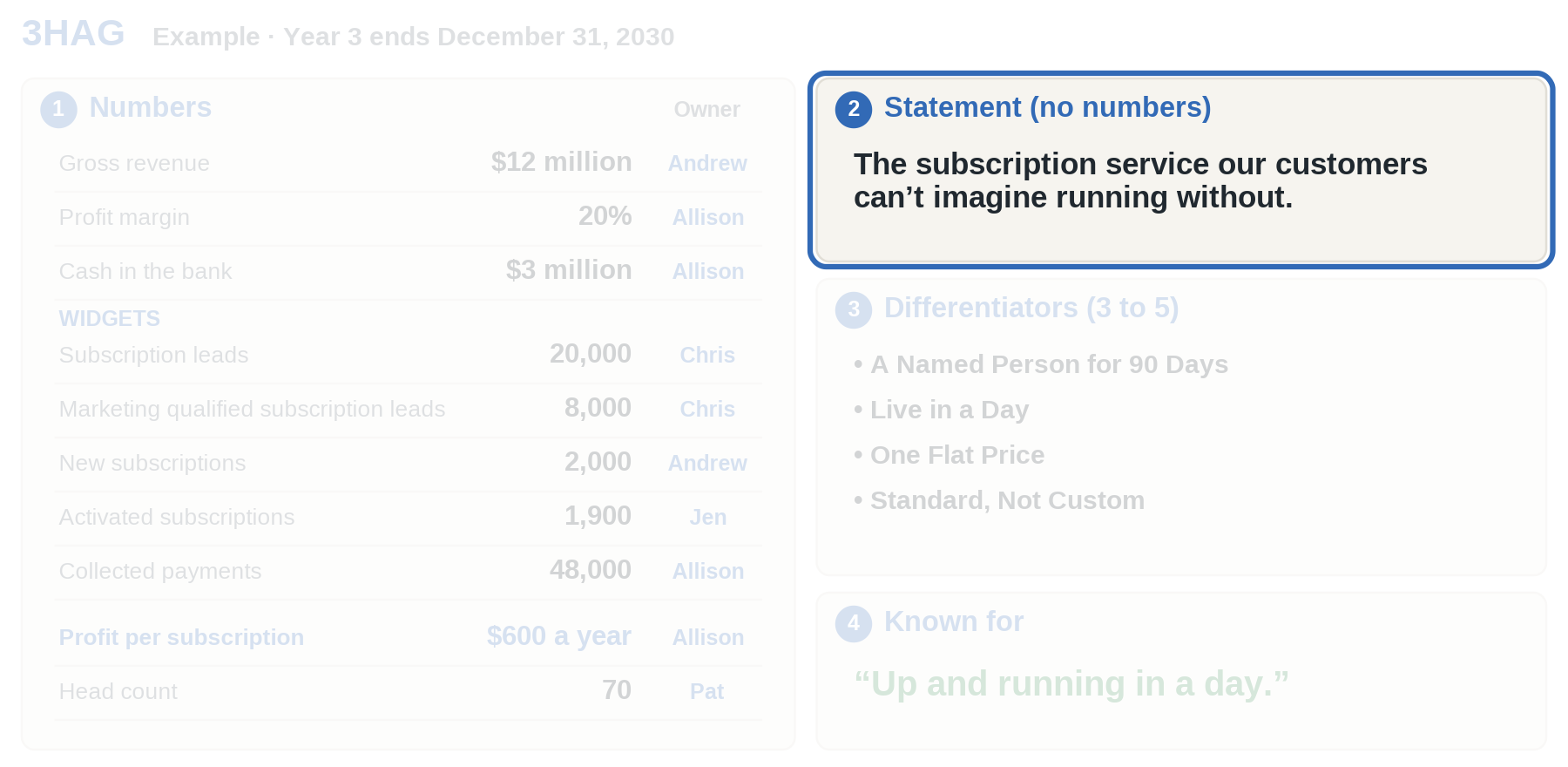
Set the end date to your new Year 3 fiscal year-end. Then work down the page: the numbers, the statement, your differentiators and what you want to be known for.

Keep last year’s numbers, statement and “known for” out of sight until you reveal your answers.

Each leader answers alone. Show your answers, then agree.

Start from what the year taught you. You review its numbers tomorrow.

darlison.com
50 comp-story

What are your new 3‑year targets?

Each leader writes the numbers alone. Show your answers, then agree.

Gross revenue, margin and ending cash, for Year 3 alone.

Name the widget for each hand-off on your KFFM. Estimate the quantity where you can.

Add your Profit per X target and head count.

Name an owner for every number.

The 3HAG page with block 1, Numbers, highlighted. Block 3 reads Differentiators and lists the four from the Activity Fit Map example.
darlison.com
51 comp-story

What will the company be in 3 years?

Write one sentence that describes the company you will become.

Keep numbers in the targets.

Your core business describes the company today. This describes where it is going.

The 3HAG page with block 2, the statement, highlighted. Block 3 reads Differentiators and lists the four from the Activity Fit Map example.
darlison.com
52 comp-story

Put your differentiators in your 3HAG.

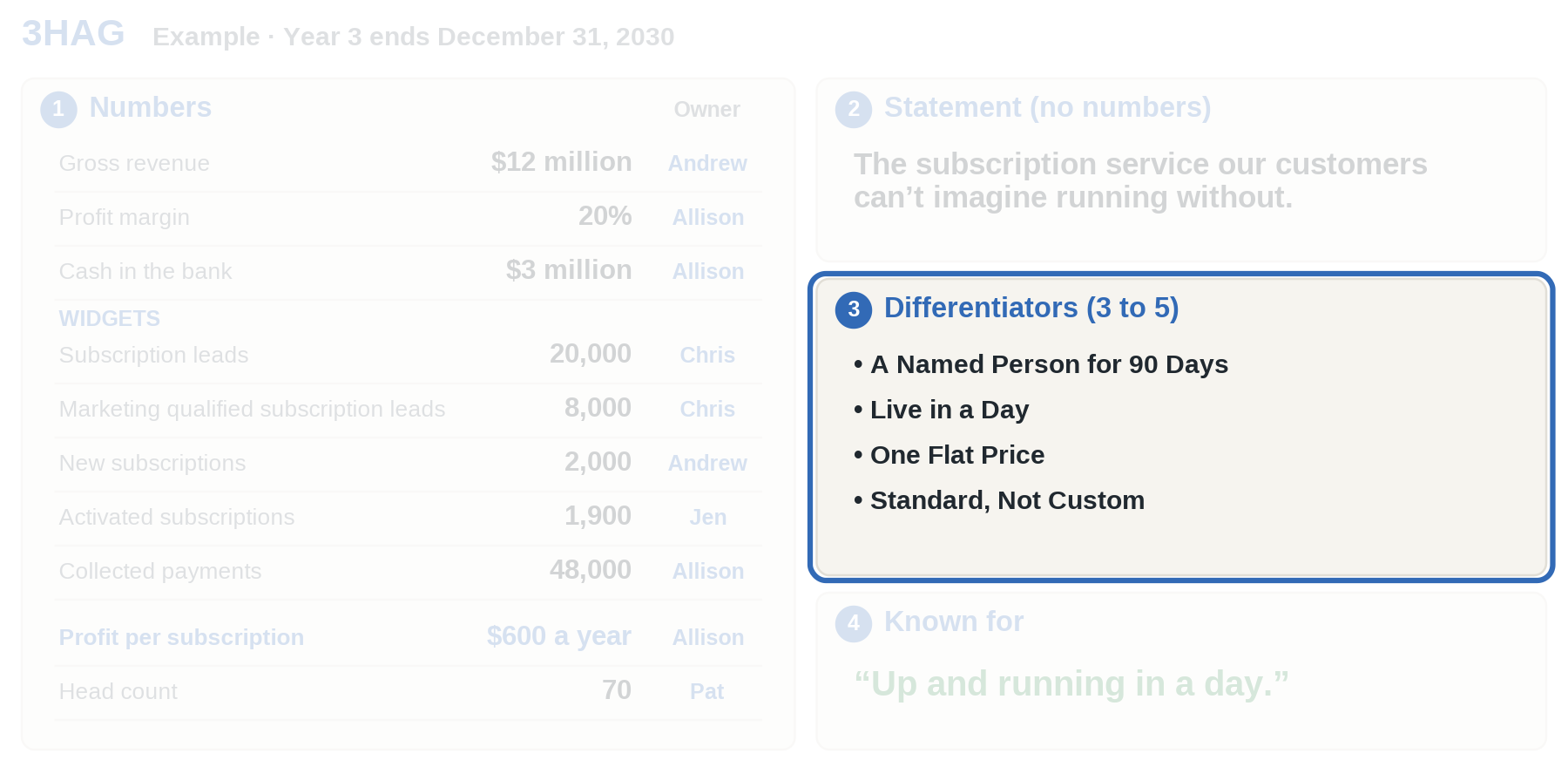
Your key capabilities are now your differentiators. Write in the 3 to 5 you just agreed on.

Do they make the numbers and the statement true?

The 3HAG page with block 3, Differentiators, highlighted. It lists the four example differentiators.
darlison.com
53 comp-story

What do you want to be known for?

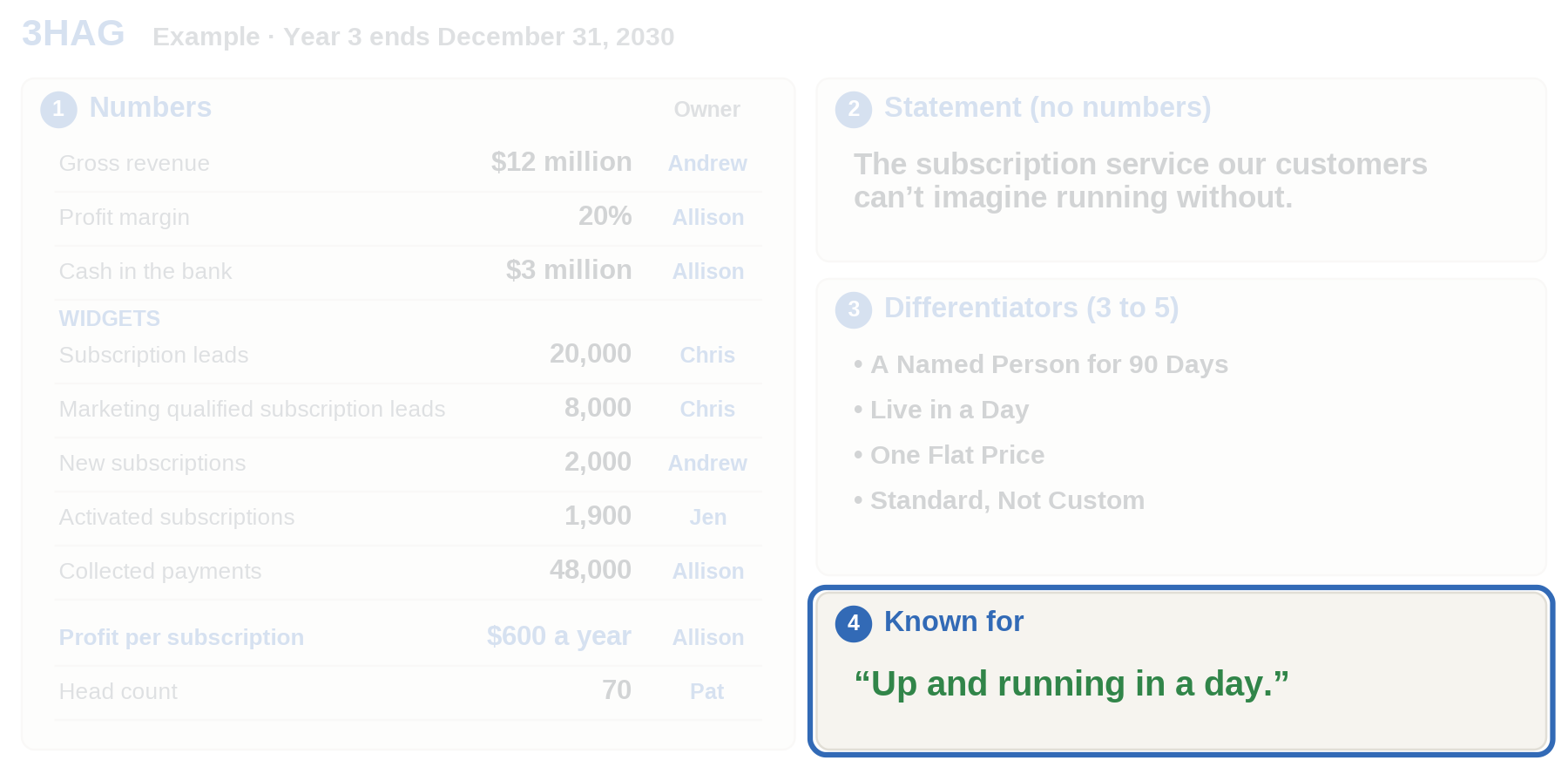
In 3 years, when someone says your company name, what should people think?

Each leader writes it alone. Show your answers, then agree.

The 3HAG page with block 4, known for, highlighted. Block 3 reads Differentiators and lists the four from the Activity Fit Map example.
darlison.com
54 comp-story

Does your new 3HAG pass?

Read it aloud before you move on.

The numbers are set: date, revenue, margin, cash, widgets, Profit per X and head count.

Every number has an owner, and the widgets support the revenue.

The statement and the “known for” describe the future company.

3 to 5 differentiators make the whole 3HAG line true.

No differentiator builds an attribute you chose to let drop.

darlison.com
55 comp-story

Now paint your 3HAG picture.

Each leader writes alone, in the present tense. Show every picture and read each one aloud. Then write one picture together.

The heading asks what you see, hear and feel 3 years from now. The same twelve numbered prompts follow.
darlison.com
56 comp-story

Last today, your swim lanes: one for each differentiator.

Q4 Day 1 path. Through New 3HAG done. Swim Lanes next.
darlison.com
57 comp-story

Swim lanes: one lane for each differentiator, over 12 quarters.

What are the big things we must get done in each lane?

Each quarter, the lanes feed your QHAG priorities and sprint lanes.

darlison.com
58 comp-story

Start at the end: what is true at Q12, Q8 and Q4?

Agree on these as a team. Year 3 (3HAG) first, then Year 2 (2HAG2HAGWhere you stand at the end of Year 2, on the way to the 3HAG.), then Year 1 (1HAG).

An example table of four swim lanes, one for each differentiator. Each lane shows a 3HAG outcome at Q12, a 2HAG outcome at Q8 and a 1HAG outcome at Q4.
darlison.com
59 comp-story

Example: 3 milestones in each lane, worked back from the end.

Q1, on the right, is next quarter. Place each milestone in the quarter it lands. Leave the rest empty. This is not a project plan.

An example swim lane map. Four lanes run from Q12 on the left to Q1 on the right. Each lane has an outcome marker at Q12, Q8 and Q4, and three milestone stickies.
darlison.com
60 comp-story

Build your swim lanes.

Split into small groups, one lane each.

Give each lane to people who are not its expert. An expert fills the first quarters with detail.

Work back from the agreed outcomes. Place 3 to 5 milestones. Name an owner for each.

Each group presents its lane to the team.

darlison.com
61 comp-story

Do your swim lanes pass?

Look at all the lanes together.

Every lane has an outcome at Q4, Q8 and Q12. You can tell when each is true.

Every lane serves a top need of your Core Customer.

Every lane has 3 to 5 milestones, each with an owner, and empty quarters.

Where one lane waits on another, the order works.

The first 4 quarters show next year’s milestones.

darlison.com
62 comp-rule

How do you feel right now?

One phrase. 5 words or fewer.

Four team members stand together talking, each with a speech bubble. One bubble is green.
darlison.com
63 comp-decision

Yesterday, strategy. Today, execution.

Yesterday

Where you are going

Your BHAG, a new 3HAG, its differentiators and swim lanes.

Today

How you get there

The year in review, next year’s forecast, a new 1HAG, a new QHAG and sprint lanes.

darlison.com
64 comp-story

Share personal good news.

Four gray figures stand and share good news. One speech bubble holds a green check mark. A chart on an easel shows a rising line.
darlison.com
65 comp-story

What stayed with you from Day 1?

One reflection from each person.

A person sits with chin in hand, thinking, with a thought cloud above.
darlison.com
66 comp-decision

Are we on track for what you came for?

Done

We got it on Day 1

Check it off.

Today

Today’s plan covers it

Name where it comes up.

At risk

Not on today’s plan

Decide now how we cover it.

darlison.com
67 comp-decision

Today, let’s:

Engage

Be present

Discuss, collaborate and listen.

Challenge

Challenge yourself and each other

Strong convictions, loosely held.

Trust

No blame. No shame.

Make it safe to speak honestly.

Commit

Disagree and commit

Say it in the room, then back the decision.

darlison.com
68 comp-story

After a night’s sleep, would you change any differentiator?

If your swim lanes are not finished, finish them first.

darlison.com
69 comp-story

First, how the year went.

Q4 Day 2 path. Day 2: Status next, then Forecast, New 1HAG, New QHAG, Sprint Lanes, and Meetings and close.
darlison.com
70 comp-story

How did the year go?

In Metronome: open One Page Plans. Review the 1HAG, then the last QHAG.

Fiscal numbers: gross revenue, margin and ending cash.

Non-fiscal numbers: widgets and head count.

Each priority: was it done, and did it succeed?

Where was your estimate wrong, and what did you learn?

Bring the brutal facts.

darlison.com
71 comp-story

How much of Metronomics is running after a year?

This is the yearly Metronomics Checklist Survey, not the prep survey from yesterday. 19 statements, each true or false.

Where do you all agree?

Where do your answers differ?

Which differences need follow-up?

darlison.com
72 comp-story

Then, next year’s forecast, which Finance built from your widgets.

Q4 Day 2 path. Status done. Forecast next.
darlison.com
73 comp-story

Next year’s forecast gives you your annual targets.

At Q3, each leader gave Finance their widget numbers for next year. Finance puts that 12‑month forecast on the screen.

1. Walk the widgets month by month. Each leader speaks for their own.

2. Check the year against your new 3HAG. Is it on track?

3. Agree on it. It becomes the approved forecast, and your annual targets come from it.

Two charts for the example subscription company, one above the other. The top chart shows new subscriptions for each of the 12 months of next year, rising from 70 in January to 110 in December. They add up to 1,100 for the year. The bottom chart asks if the year is on track for the new 3HAG. It shows three bars: this year at 1,000, next year at 1,100 and the 3HAG at 2,000. A dashed line marked On track runs straight from the top of this year to the top of the 3HAG. Next year’s bar stops below that line. The space between them is marked Gap.
darlison.com
74 comp-story

Next, your new 1HAG: the first year of your new 3HAG.

Q4 Day 2 path. Status and Forecast done. New 1HAG next.
darlison.com
75 comp-story

What are your annual targets?

Take the numbers from the forecast you just agreed on. Confirm the fiscal year and its end date.

Show last year’s 1HAG and its results beside the new one.

Gross revenue, margin and ending cash.

One widget for each hand-off on your KFFM, plus Profit per X and head count.

Name an owner for every number.
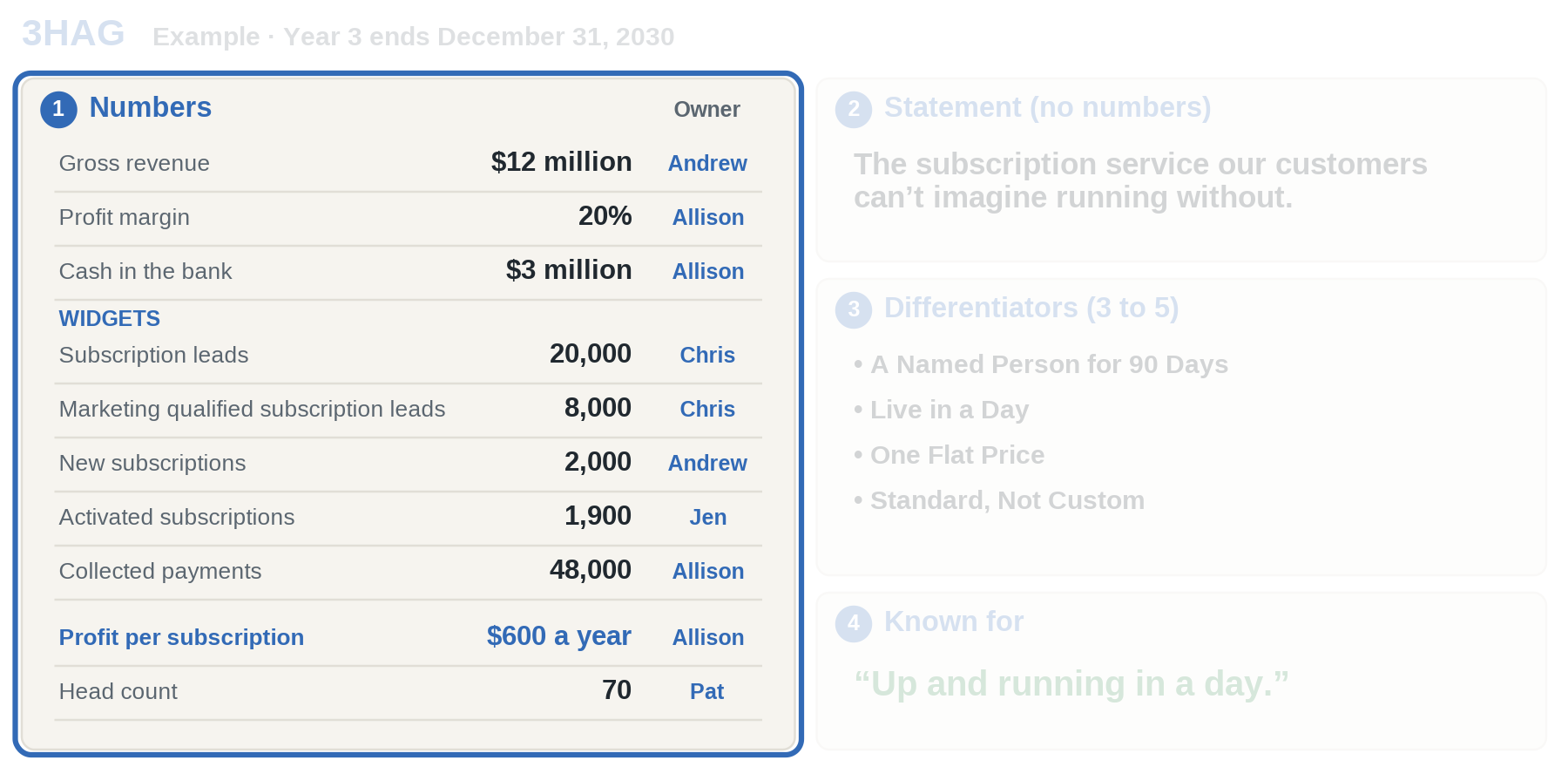
Is each target big enough to keep you on track for your new 3HAG?

darlison.com
76 comp-story

What must you build this year?

Look at everything: your swim lanes, your KFFM and its six levers, and what is going on around you.

Each leader writes candidate priorities alone. Then share. List every candidate.

Test each with the six questionssix questionsWhat does it build or move?How much will it move a critical number?How soon will we see it?Who can own it and succeed?What will it cost?What could go wrong?. Keep ideally 3, up to 5. Rank them, number one first.

Give each an owner, a done-by date, a measure of success and an achieved-by date.

darlison.com
77 comp-decision

Pick the priorities that contribute most to success.

Builds

What does it build or move?

A differentiator, or a KFFM leverKFFM leverQuantity: more widgets into the first function.Conversion: more widgets pass each hand-off.Price: raise the price customers pay.Timing: fewer days from first widget to cash.Capacity: each function handles more widgets a month.Cost: lower what each function costs to run. that brings cash in faster.

Impact

How much will it move a critical number?

Name the number and the target. If it barely moves, think twice.

Speed

How soon will we see it?

Name the achieved-by date for the measure of success. If it takes a long time to show, think twice.

Owner

Who can own it and succeed?

One person, with the capacity and the skills to deliver it.

Cost

What will it cost?

Money, time and attention. Choose the most impact for the least cost.

Risk

What could go wrong?

Think through the second-order consequences.

darlison.com
78 comp-story

Does your 1HAG pass?

Read your new 1HAG aloud from the board before you move on.

Every number and priority has one owner with capacity.

Each priority builds a differentiator or moves a KFFM lever.

No priority invests in an attribute you chose to let drop.

Each measure has a target and an achieved-by date.

The targets keep you on track for the 3HAG.

The widgets support the revenue, and head count is set.

darlison.com
79 comp-story

Next, the QHAG that starts your new 1HAG.

Q4 Day 2 path. Status, Forecast and New 1HAG done. New QHAG next.
darlison.com
80 comp-story

What are your quarterly targets?

Take the first 3 months of your agreed forecast.

Gross revenue, margin, ending cash, each widget, Profit per X and head count, month by month.

Name an owner for every number.

If a number differs from the forecast, say why.

Is each target big enough to keep you on track for your 1HAG?
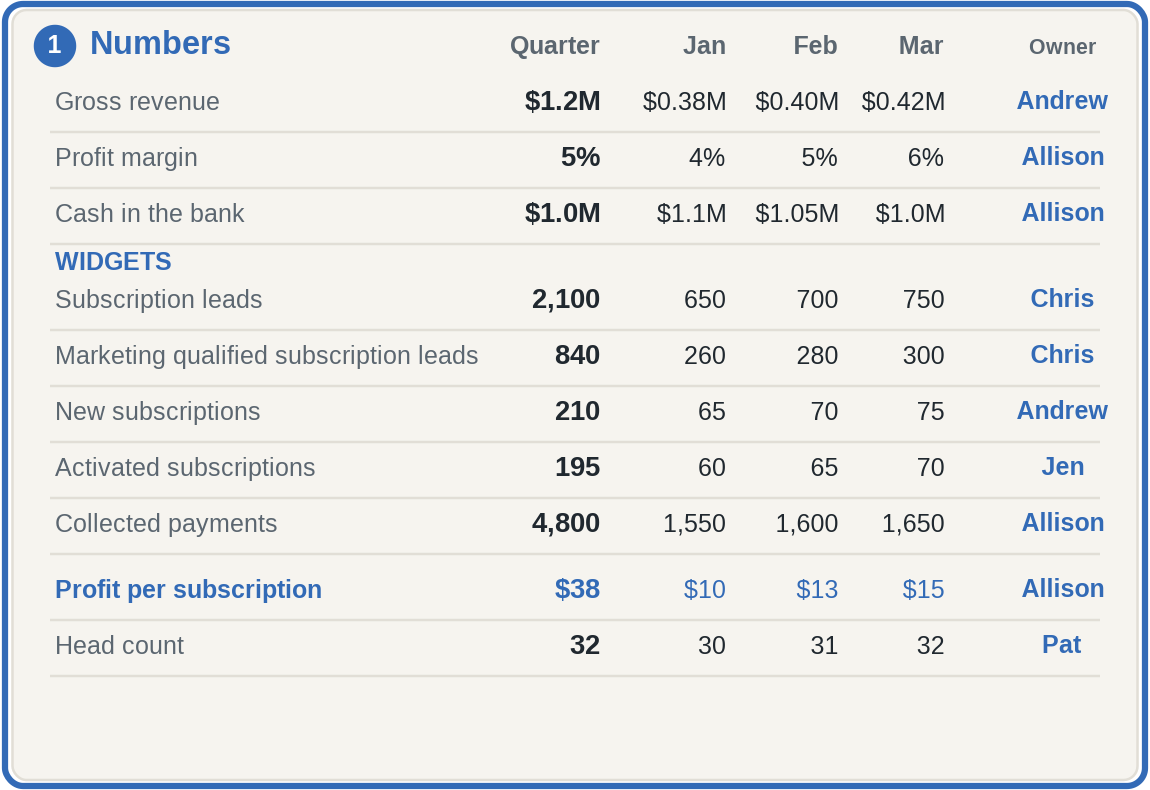
The QHAG page’s block 1, Numbers. It shows gross revenue, profit margin, cash, the widgets, profit per subscription and head count. Each has a number for the quarter and each month, and an owner.Profit per XJim Collins’s economic engine, from Good to Great. It is the one profit ratio that, raised steadily over time, does the most to drive your economics. Here, profit per subscription: profit divided by the average number of active subscriptions. Allison owns hitting the target.
darlison.com
81 comp-story

What is the #1 priority for the quarter?

What must you get done now to deliver the 1HAG?

List candidates: open priorities, 1HAG priorities, the KFFM lever you picked and Q1 of your swim lanes.

Test each with the six questionssix questionsWhat does it build or move?How much will it move a critical number?How soon will we see it?Who can own it and succeed?What will it cost?What could go wrong?, then rank.

Agree on the owner, done-by date, measure of success and achieved-by date.
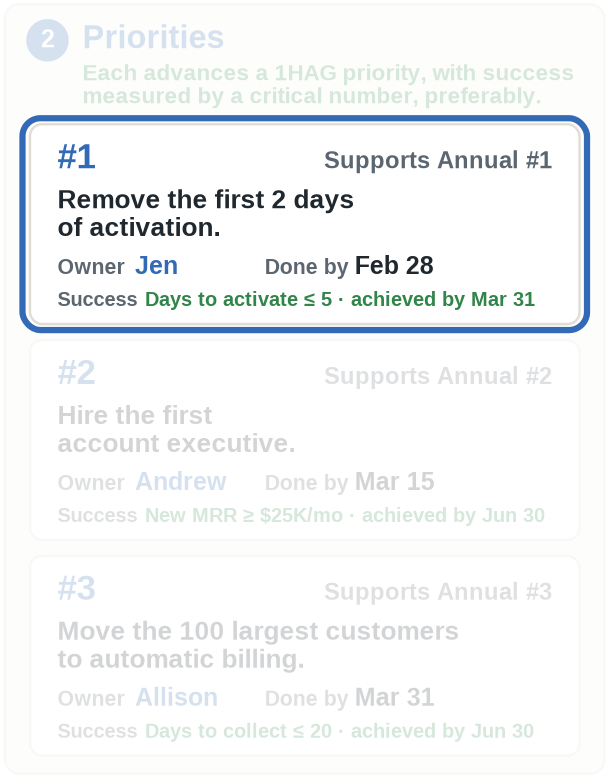
The QHAG page’s block 2, Priorities, with priority #1 highlighted. Remove the first 2 days of activation, owner Jen, done by February 28. Success: days to activate 5 or fewer by March 31.
darlison.com
82 comp-story

What else must you get done this quarter?

Ideally 3, up to 5 company priorities in total, including #1.

Connect each to a 1HAG priority. Give each an owner, a done-by date, a measure of success and an achieved-by date.
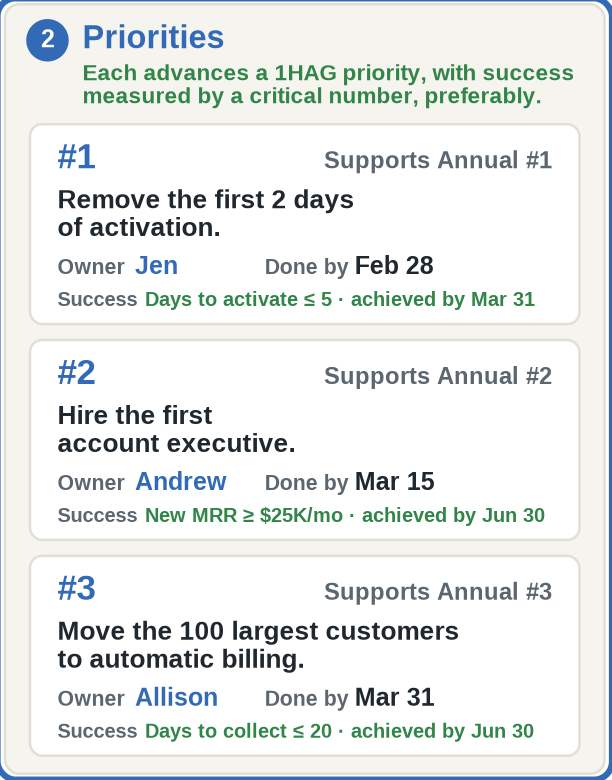

The QHAG page’s block 2, Priorities, all three shown. #1 is above. The next is hire the first account executive, Andrew, done by March 15. Success: new MRR of $25K a month or more by June 30. The last is move the 100 largest customers to automatic billing, Allison, done by March 31. Success: days to collect 20 or fewer by June 30.
darlison.com
83 comp-story

Does your QHAG pass?

Read your new QHAG aloud from the board before you move on.

Every number and priority has one owner with capacity.

Each priority advances a 1HAG priority.

Each priority has a target and an achieved-by date.

Each priority moves its number enough, and soon enough to see.

The targets keep you on track for the 1HAG.

The months add up to the quarter, and head count is set.

darlison.com
84 comp-story

Next, sprint lanes for your new QHAG.

Q4 Day 2 path. Through New QHAG done. Sprint Lanes next.
darlison.com
85 comp-story

Build your sprint lanes.

Work together on the 13-Week Sprint Lanes page of your board.

Forecast each company widget for all 13 weeks.

Give each company priority one lane. It keeps its owner.

Write one step for every active week.

darlison.com
86 comp-story

Is the whole plan achievable?

Step back and look at every lane together.

You have the people to do it.

You have the cash to do it.

The 13 weeks build to the quarter. Numbers you count add up. Cash and head count match week 13.

darlison.com
87 comp-story

Last, your meetings and the close.

Q4 Day 2 path. Through Sprint Lanes done. Meetings and close next.
darlison.com
88 comp-decision

How are your meetings going?

In Metronome: open Meetings. Rate each against what you expect of it: 0 below, 1 meets, 2 exceeds.

Daily

Daily huddle

7 to 10 minutes, every day except the day of the weekly meeting.

Weekly

Weekly 1:1

15 to 30 minutes. Each leader with each direct report, led by the direct report.

Weekly

Weekly leadership meeting

60 minutes or less. The CEO owns it.

Monthly

Monthly Town Hall

30 to 45 minutes. Everyone. The CEO owns it.

darlison.com
89 comp-story

Is the CEO’s weekly email going out?

One page, from the CEO to everyone, by Friday noon.

Running: has it gone out every week?

Working: does it carry good news, the numbers, priority status and a positive close?

What to change? Rate it 0 to 2.

darlison.com
90 comp-story

What 3 messages will you share with the whole company?

Write them together now. Each leader shares them with their team tomorrow.
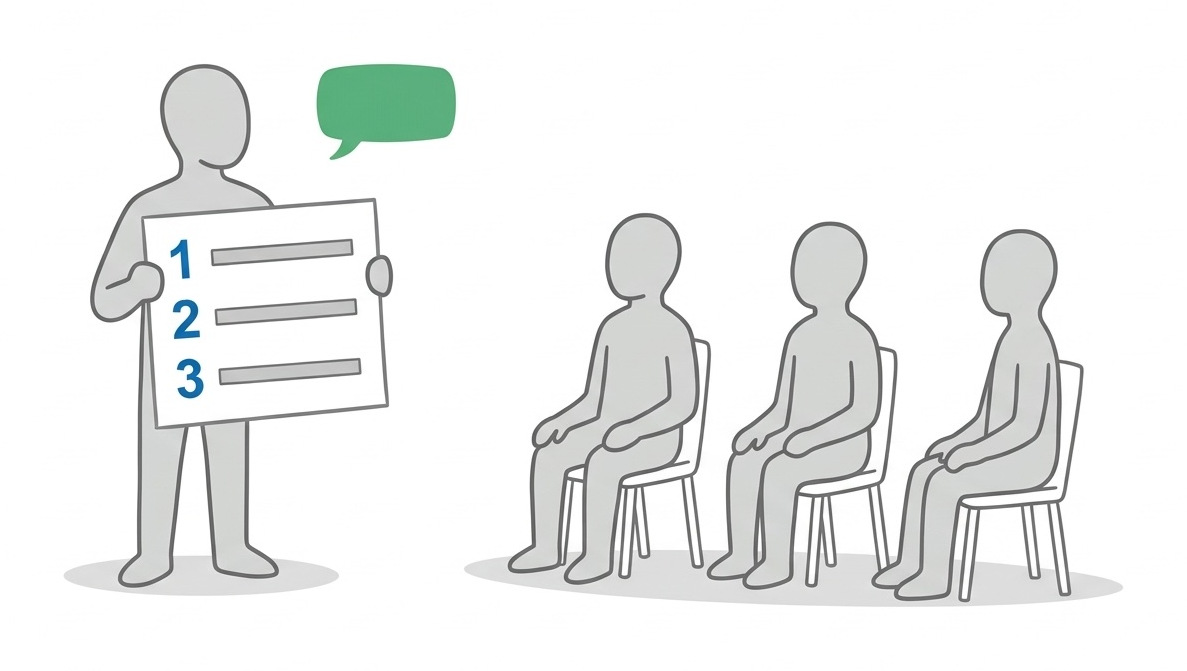
A leader holds up a card with three numbered lines and talks to three seated team members.
darlison.com
91 comp-story

Set your own priorities with your own team.

Outside this session. Agree on the date before you leave.

Start from the new QHAG and your critical number, one for each function you own.

Up to 5 work priorities. A company priority you own goes first.

Add one skill or behavior to develop.

Enter them in Metronome by that date.

darlison.com
92 comp-decision

What is the homework?

Give every item an owner and a date.

Metronome

Update the plan

The new BHAG, 3HAG, 1HAG and QHAG, with the differentiators in place of key capabilities. Each leader’s priorities. Each sprint lane’s steps. The Team View.

Strategy and cash

Swimlanes and forecast

Swimlanes: add the differentiators and their milestones. Finance enters the 12‑month widget forecast as rolling metrics.

darlison.com
93 comp-decision

Homework for your people, and before next session.

Give every item an owner and a date.

People

Team and A-Players

Start the five actions from your Five Dysfunctions review. Act on the plan for everyone below A. Any scorecard review still open.

Before next session

Prepare

Read The Speed of Trust. Complete the quarterly prep survey and share it. Finish the wording of any agreed picture.

darlison.com
94 comp-story

Did we get what we came for?

For each answer: met, partly met or still open?
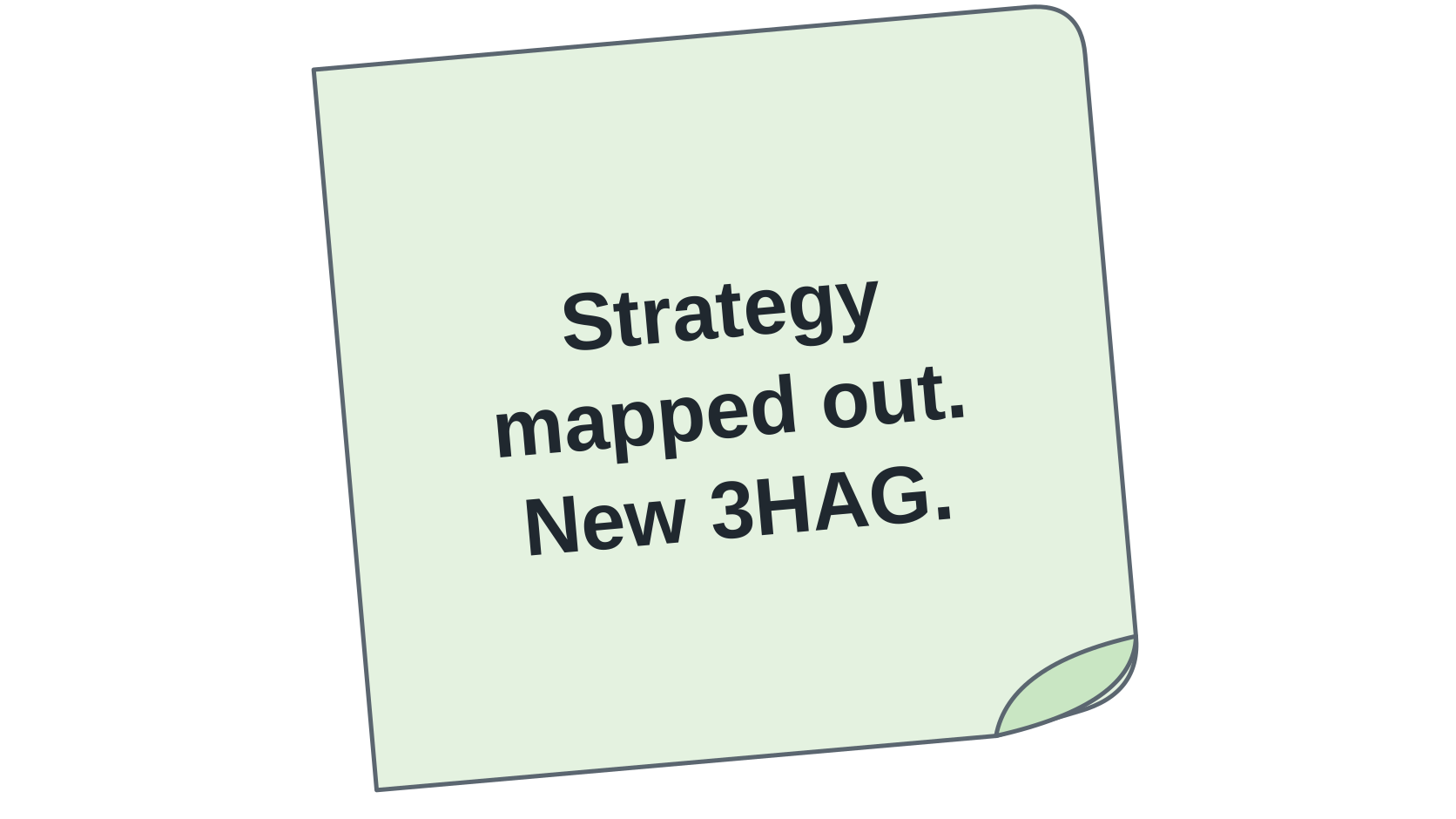
A sticky note with the coach’s answer for the session: Strategy mapped out. New 3HAG.
darlison.com
95 comp-rule

How do you feel right now?

One phrase. 5 words or fewer.

Four team members stand together talking, each with a speech bubble. One bubble is green.
darlison.com
96 comp-story

Take these slides with you.

Scan the code to open the full deck on your phone.

byrondarlison.github.io/coaching-slides/metronomics/q4

QR code that opens these slides at byrondarlison.github.io/coaching-slides/metronomics/q4.
darlison.com
1 / 96