Raised venture capital
I thought money was the problem.
Failed in a year
Metronomics Coach
I built and sold a technology company after scaling it with the Metronomics operating system.
Now I coach founders to do in 3 years what took me 33.

Born in Australiaage 0

Moved to Canada. Grew up in Markham.age 2

Moved to Mississaugaage 14
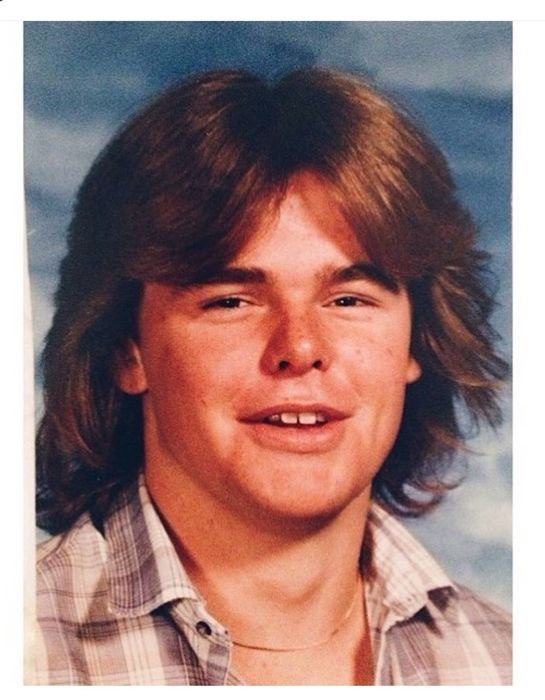
Finished high school with HAIR!age 19

Struck out on my own and took a gap yearage 19

Ryerson, 1982 to 1986: studied business, student union treasurer then vice president, ran the school newspaperage 20

Travelled in Central Americaage 25

Ran IT at a computer rental companyage 26

Married for the first timeage 27

Started a software company that in time became Rise Visionage 27

Unfortunately the marriage didn’t work. Divorced.age 29

Met my wife. Got it right the second time.age 32

First child bornage 33
First attempt to scale the company: raised venture capitalage 34

Second child bornage 35

Joined Strategic Coachage 35
Venture capital didn’t scale us. That attempt failed within a year.age 35
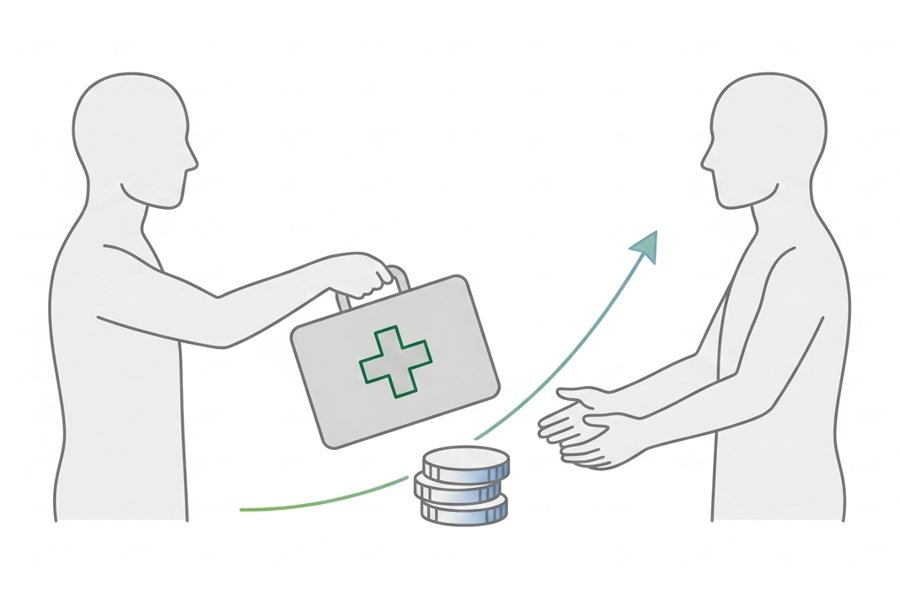
Sold the healthcare software business to a Winnipeg companyage 35
Kept the trading-floor display software, which became Rise Visionage 35
Was meant to run the healthcare company. A disaster. Resigned, wrote off my stake and took a year off.age 36
Turned the display software into its own businessage 37

Third child bornage 38
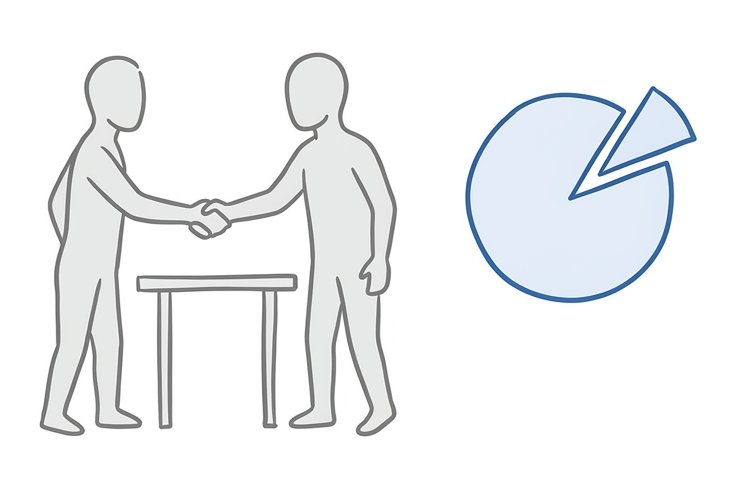
Took on a minority partnerage 38

Second attempt to scale: sold 49% of the company to Adaptive Micro Systems, a Milwaukee LED sign makerage 39
The partnership didn’t scale us either. Bought back the 49%.age 41
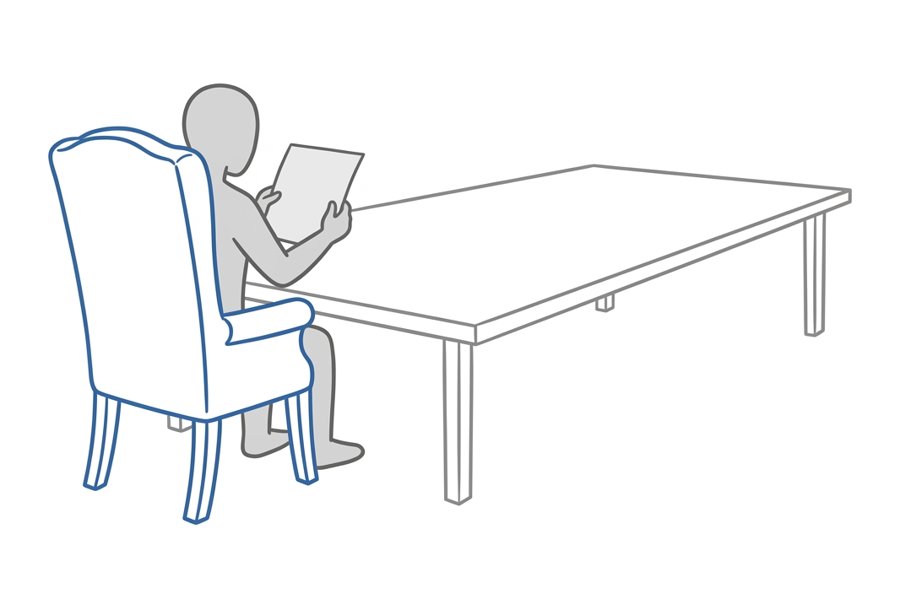
Third attempt to scale: hired a president to run the companyage 42
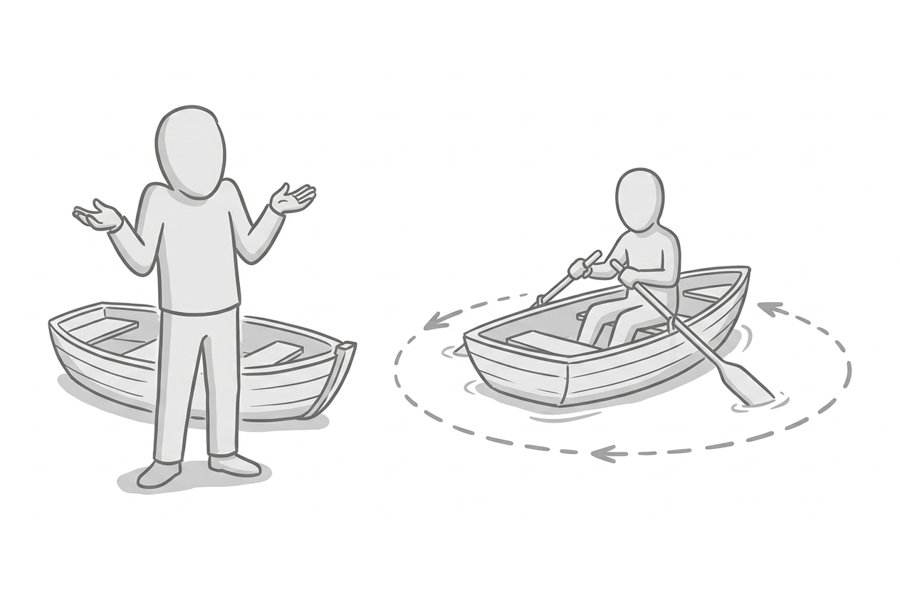
Hiring a president failed within a year. There was no system for a president to run.age 43
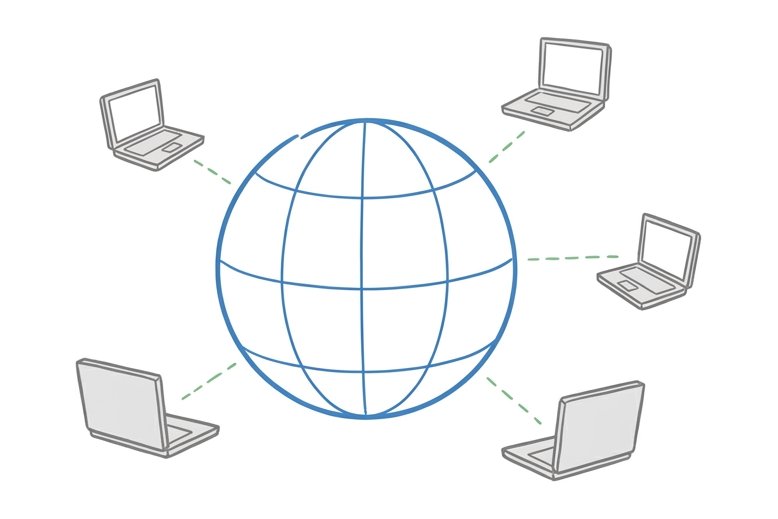
Company went fully remote, years before it was standard practiceage 46

Started trail ridingage 46

Camp Wanapitei, 2009 to 2016: all three kids went, and my oldest son did a 52-day Arctic canoe trip in 2013age 47

Running software development with Scrumage 47

Planning with Robert Fritz’s structural tension modelage 47

Started ski racing. Way too late in life.age 48
My oldest son joined. Became Product Owner, later Head of Marketing, then CRO.age 53

Selling to anyone with a screen: over 110 countries and 100 industriesage 54
Scrum Inc. training in Boston for me and the teamage 54


Fourth attempt to scale: tried to implement Scaling Up and Topgrading on our own. Partially successful.age 55

Fifth attempt: gave up doing it on my own, hired a coach and installed Metronomics. This one worked.age 56

Finally got focused: only K-12 schools in North Americaage 56
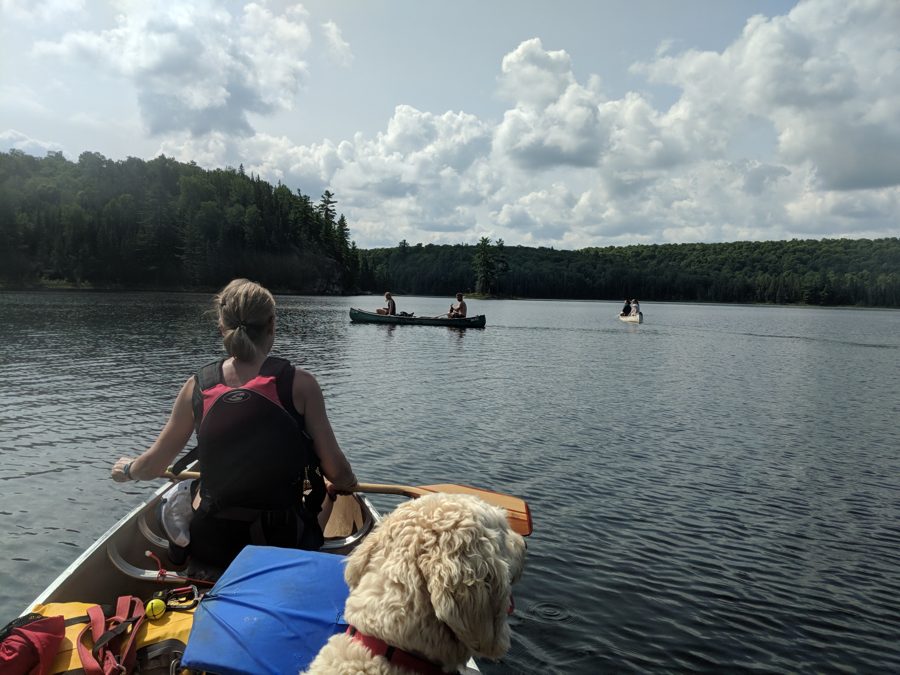
Canoe trip: Kukagami Lake loop, with my wifeage 56

Took up whitewater canoeing with my wife, after the kids’ years at Camp Wanapiteiage 57
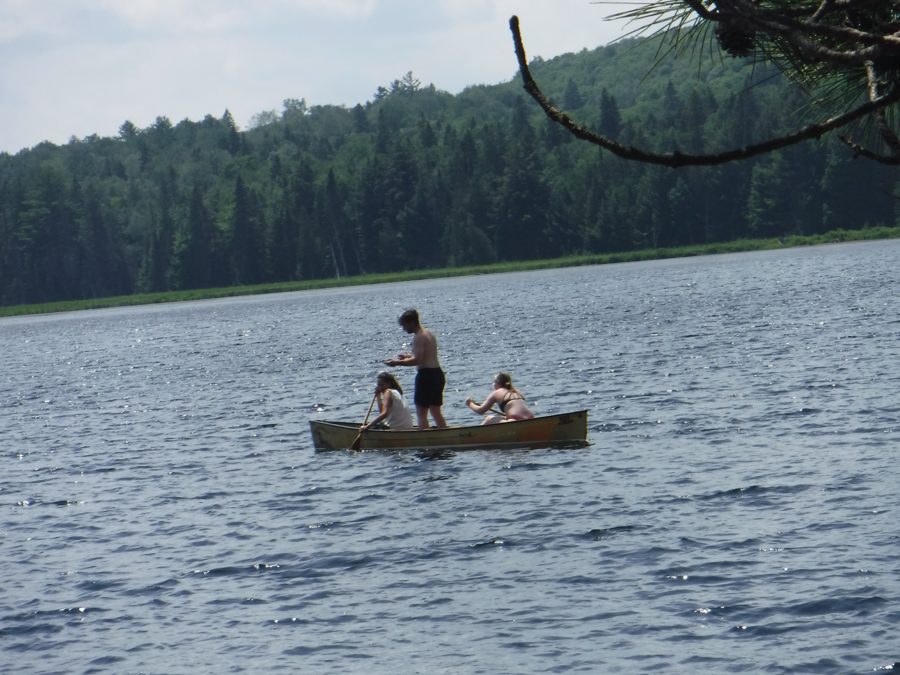
Canoe trip: Algonquin, from Lake Opeongoage 57

Canoe trip: Temagami, with my wife and friendsage 57
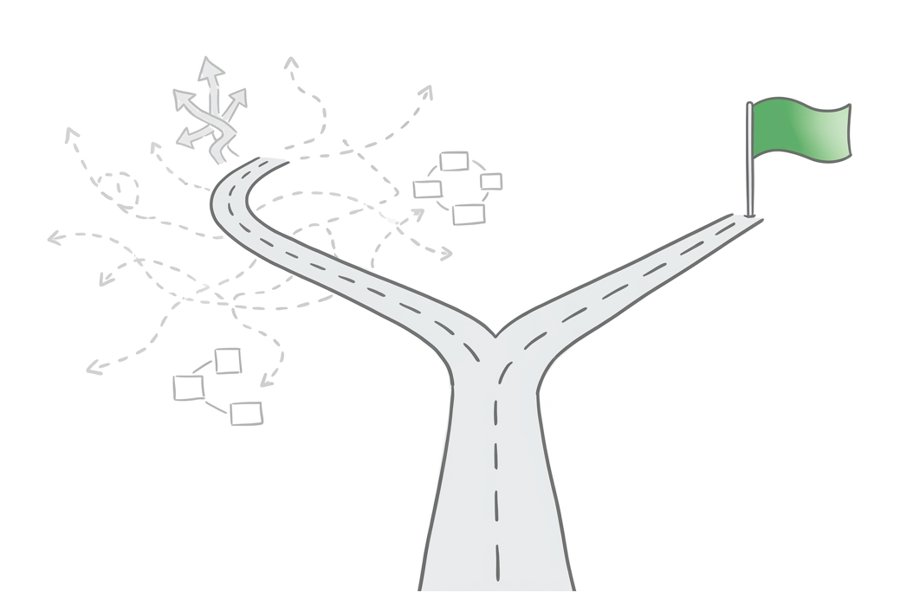
Bought out the minority partner, because we could not agree on a singular customer focusage 58

Joined EO Torontoage 58
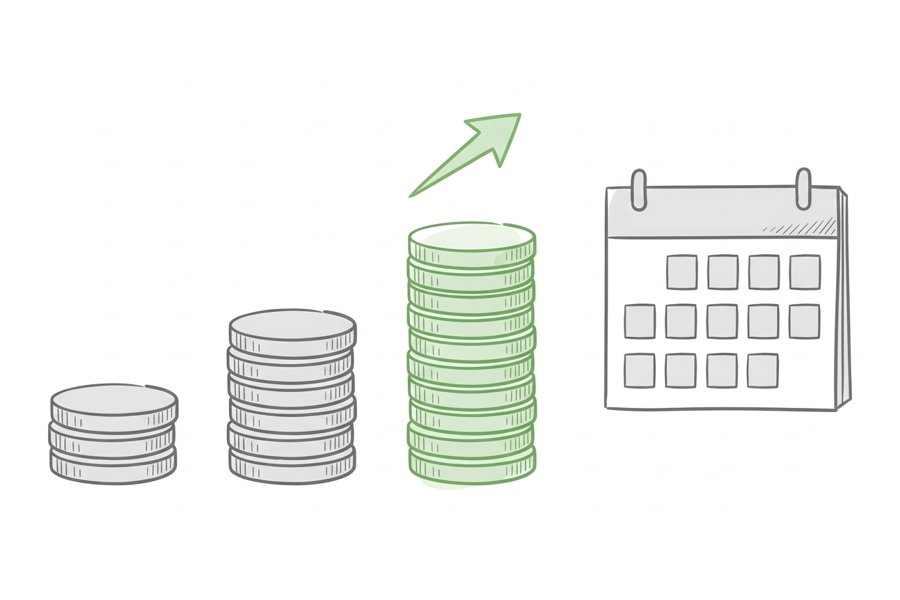
Built a cash reserve of one year of operating expensesage 58

Adopted StoryBrand: brandscripts for our one customerage 58

Adopted Basecamp’s Shape Up for software developmentage 58
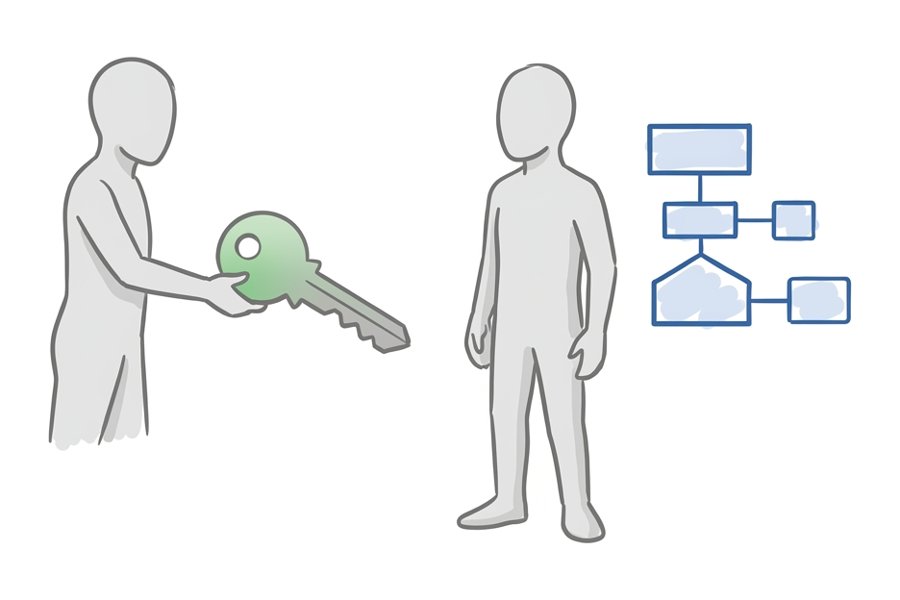
Stepped down as CEO and handed day-to-day operations to my COOage 59

Canoe trip: Dumoineage 59

Canoe trip: Algonquin, with my EO forumage 59
Sold Rise Vision to a global display manufacturer, after profits grew 10xage 60

Took the next 2 years offage 60

Canoe trip: Upper Missinaibiage 60

Canoe trip: Petawawa with familyage 60

Canoe trip: French River, with my EO forumage 60

Took up gravel bikingage 61
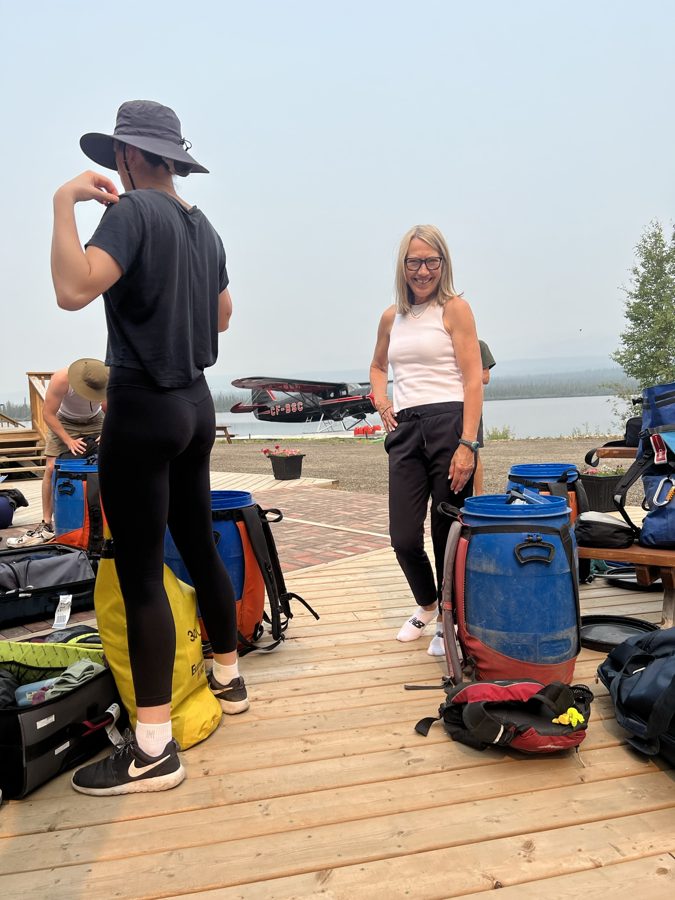
Canoe trip: Keele River, Northwest Territoriesage 61

Canoe trip: Lower Madawaska, with familyage 61

Did not like retirement. Started coaching founders and the Entrepreneurs’ Organization Accelerator program.age 62

My oldest son marriedage 62

Took up golf. What a disaster.age 62
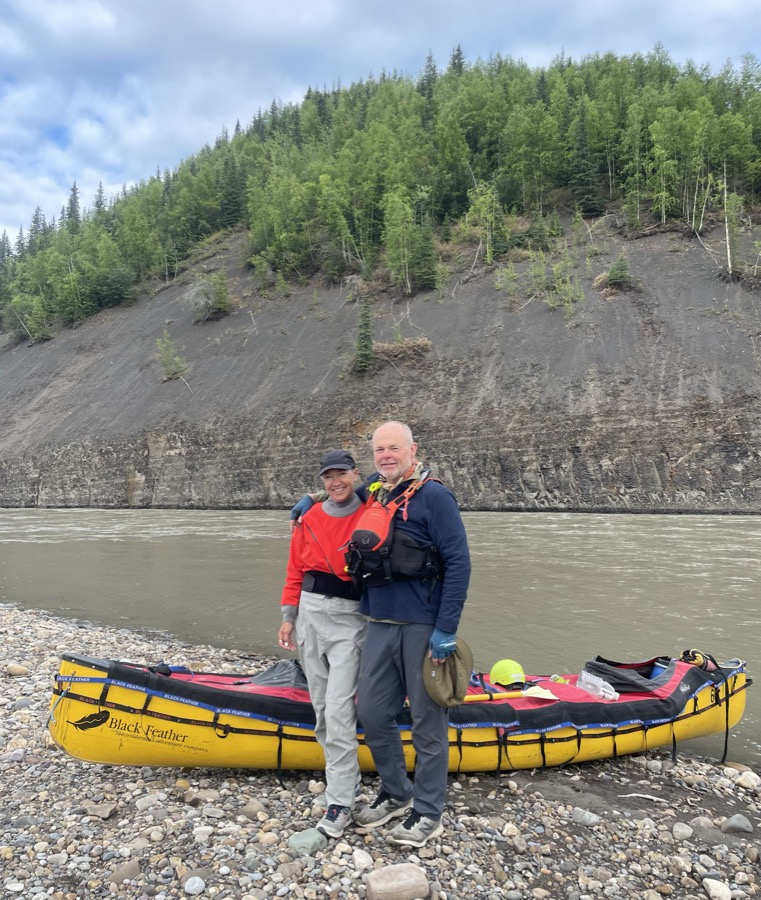
Canoe trip: Snake River, Yukonage 62
Metronomics Coachage 64
EO Toronto Accelerator Coach and Mentorship Chairage 64
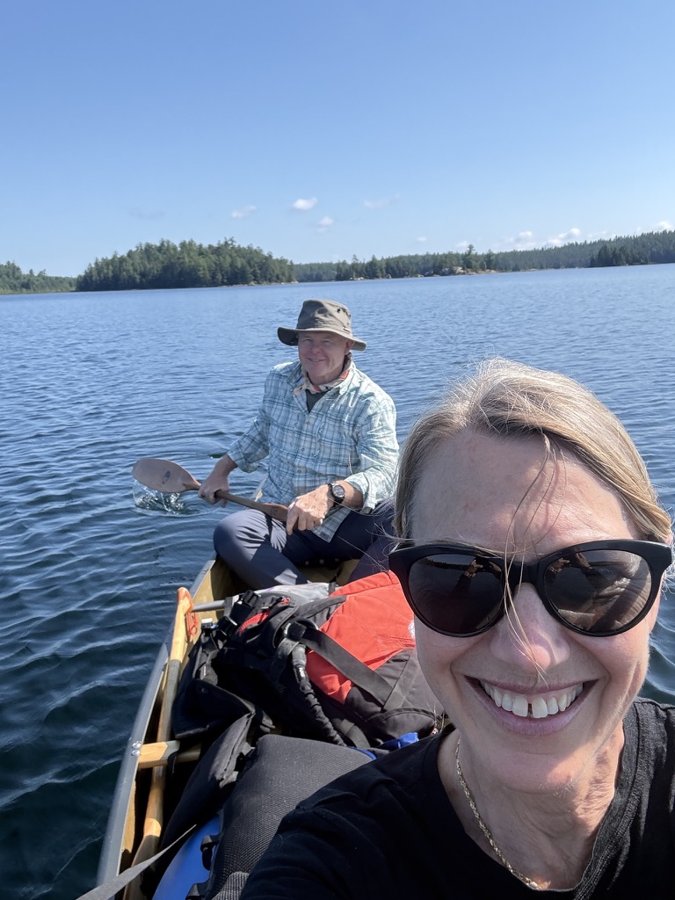
Canoe trip: Temagami fly-in with my wifeage 64

Went to the home of golf in Scotland. Still a disaster.age 64

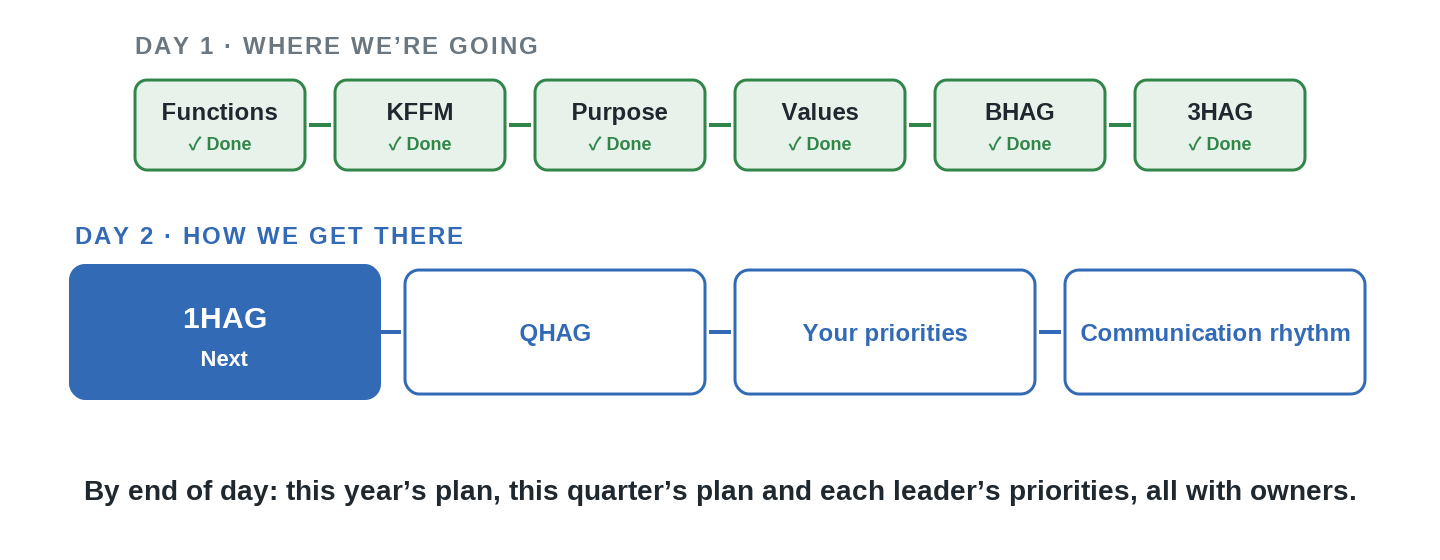
Write your answer, then share it with the team.

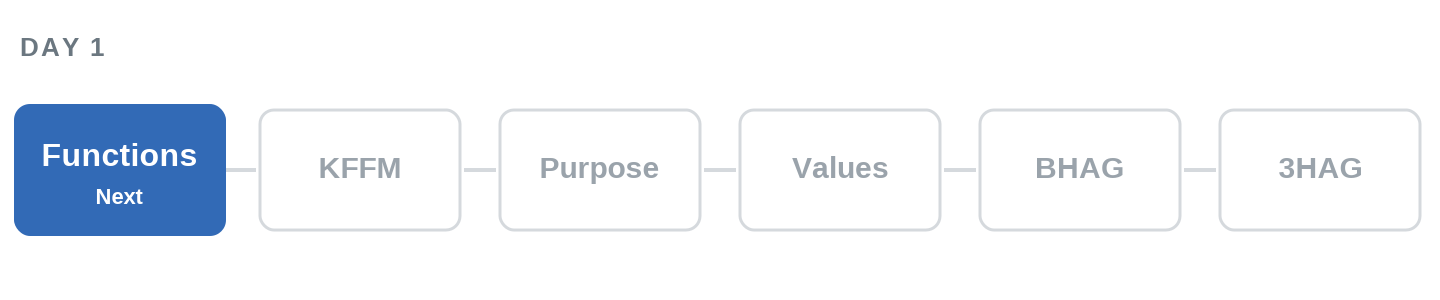
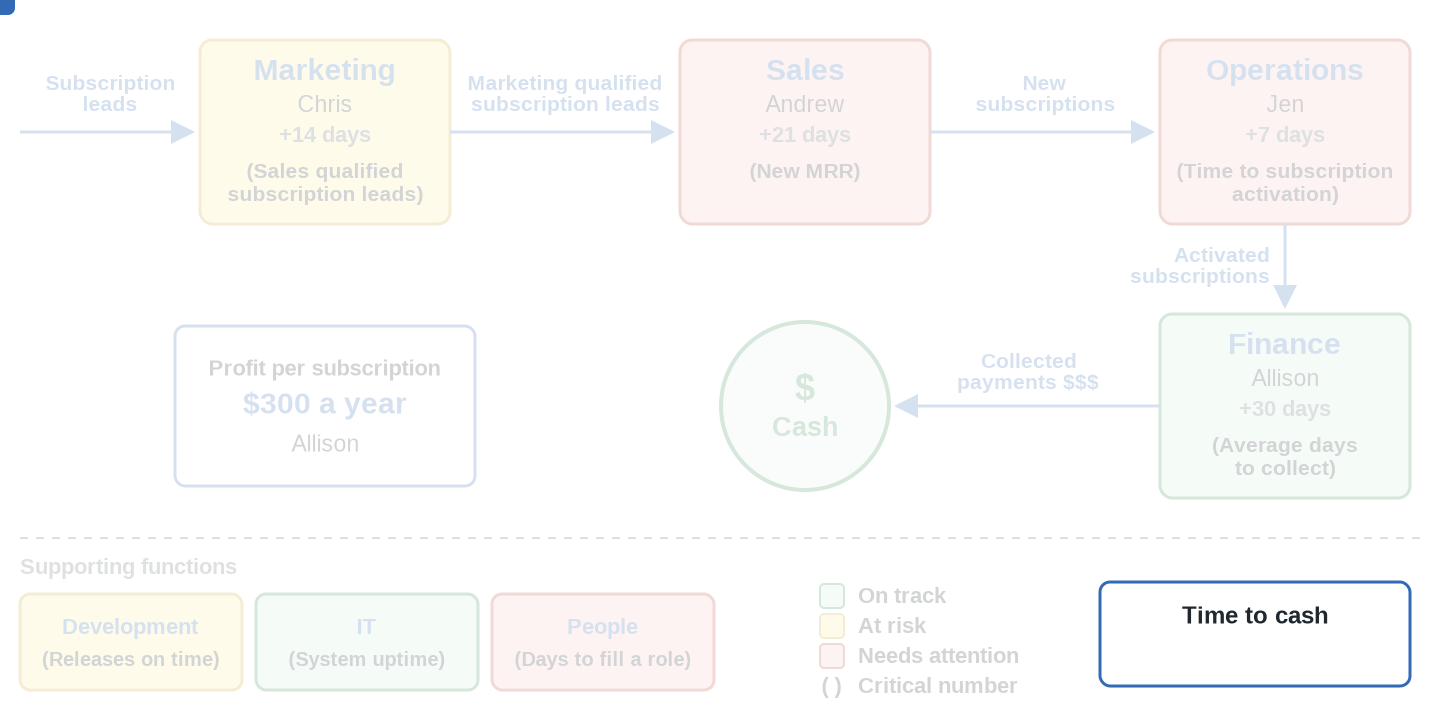
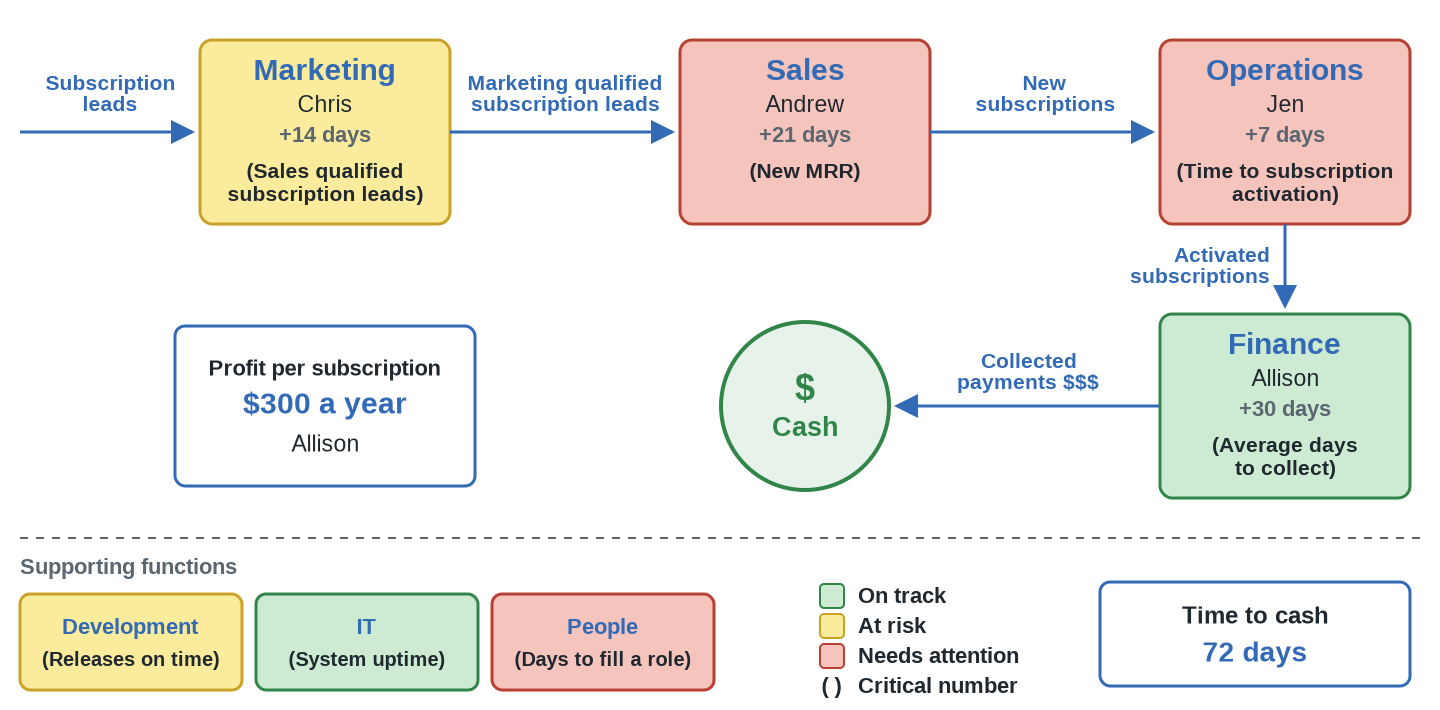
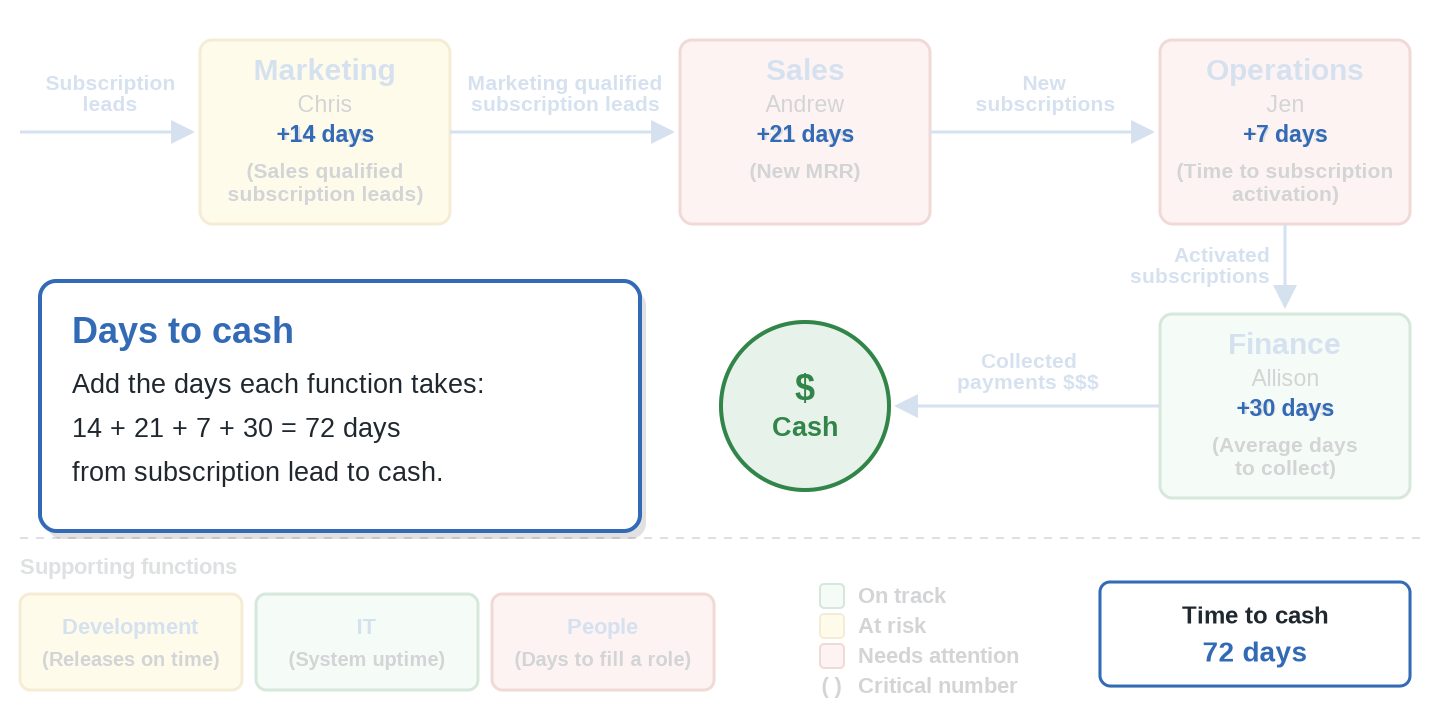
List the work the company must perform to operate successfully.
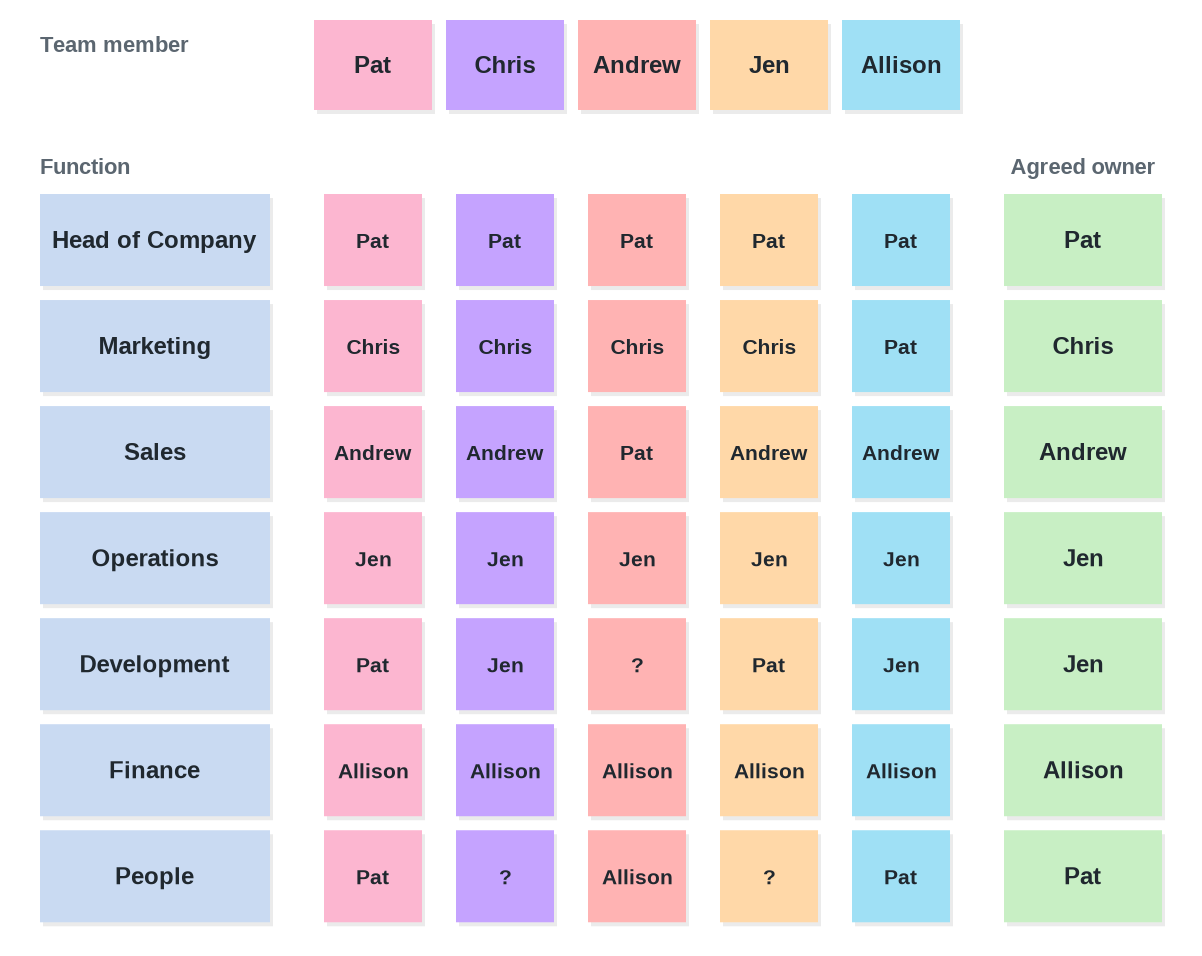
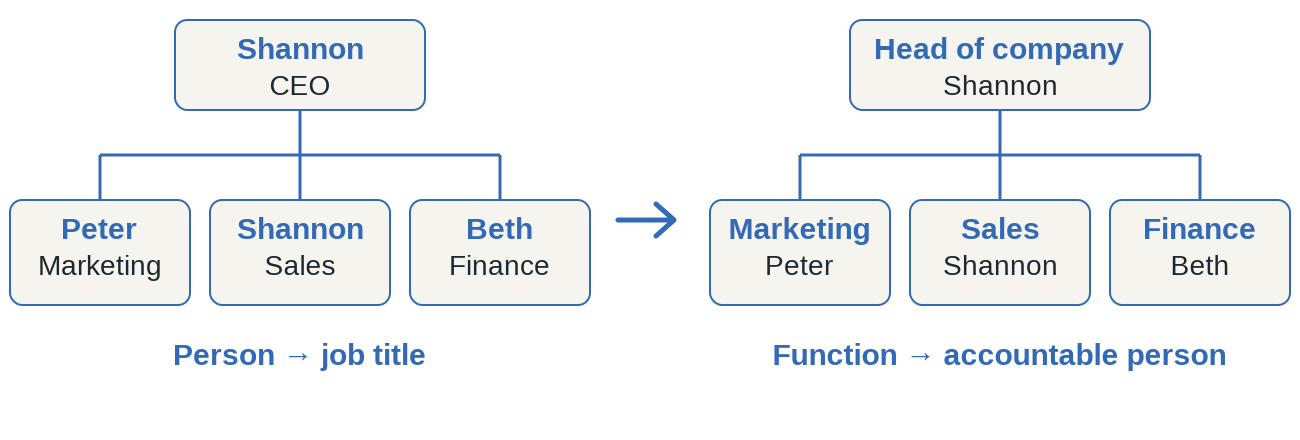
The 3 to 5 functions that make the company money.
If we didn’t do them, no cash would reach the bank.
 Profit per XJim Collins’s economic engine, from Good to Great. It is the one profit ratio that, raised steadily over time, does the most to drive your economics. Here, profit per subscription: profit divided by the average number of active subscriptions. Allison owns hitting the target, $300 a year.
 Profit per XJim Collins’s economic engine, from Good to Great. It is the one profit ratio that, raised steadily over time, does the most to drive your economics. Here, profit per subscription: profit divided by the average number of active subscriptions. Allison owns hitting the target, $300 a year.
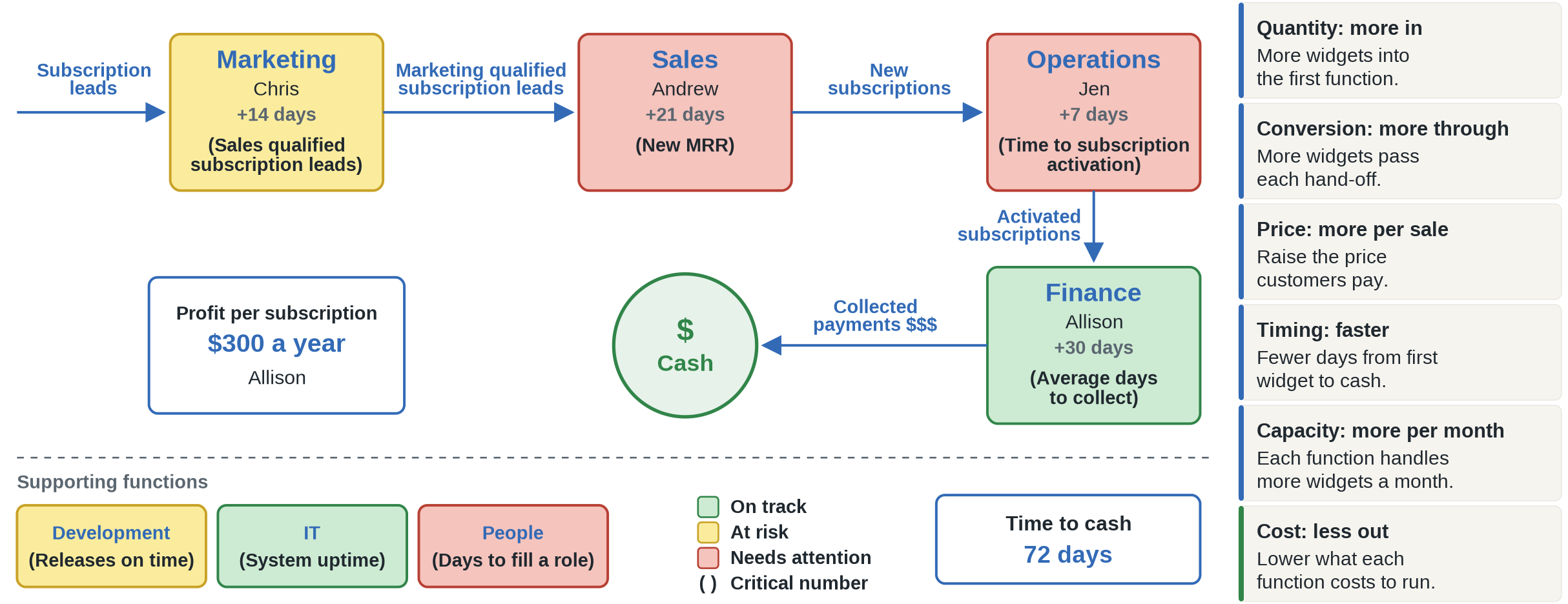 Profit per XJim Collins’s economic engine, from Good to Great. It is the one profit ratio that, raised steadily over time, does the most to drive your economics. Here, profit per subscription: profit divided by the average number of active subscriptions. Allison owns hitting the target, $300 a year.
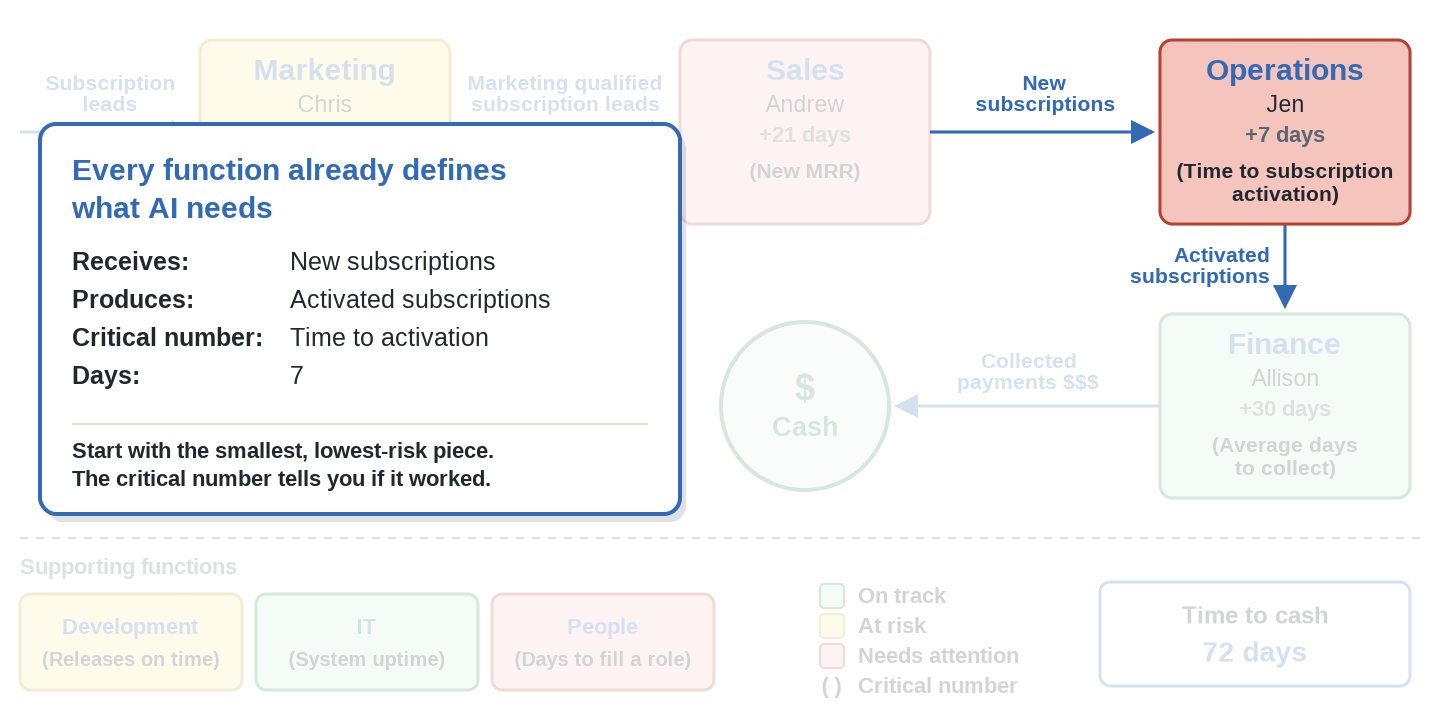
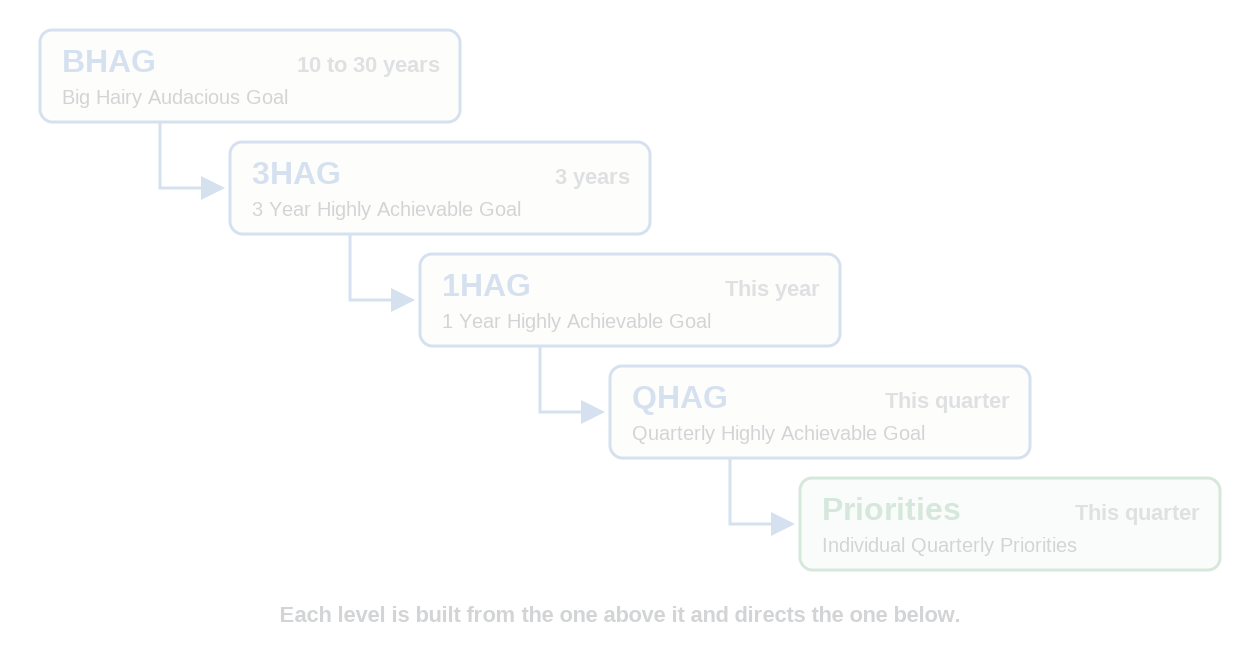
Your company’s ambition for the next 10 to 30 years.
Big enough to stretch everyone.
Tied to why you exist.
Words only. No numbers, no dates.

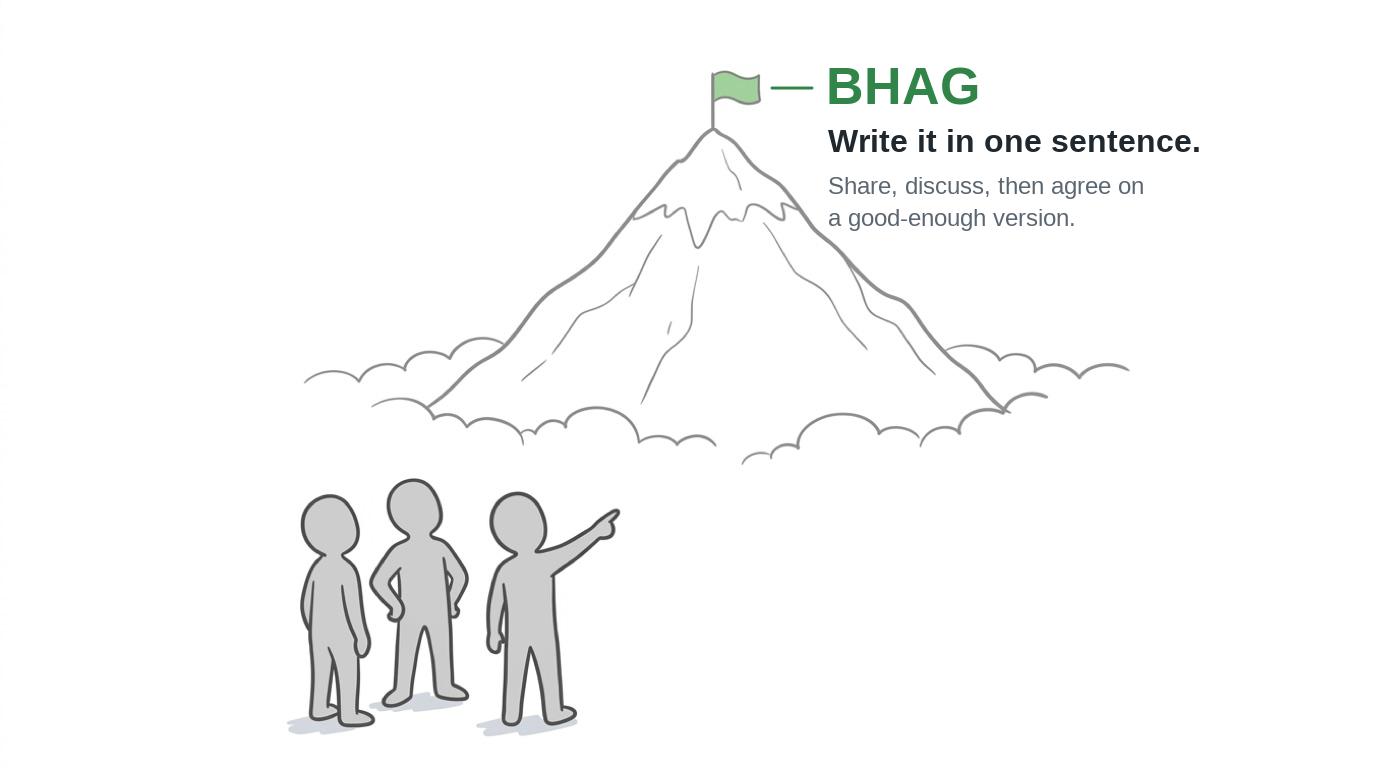
Write it in one sentence.
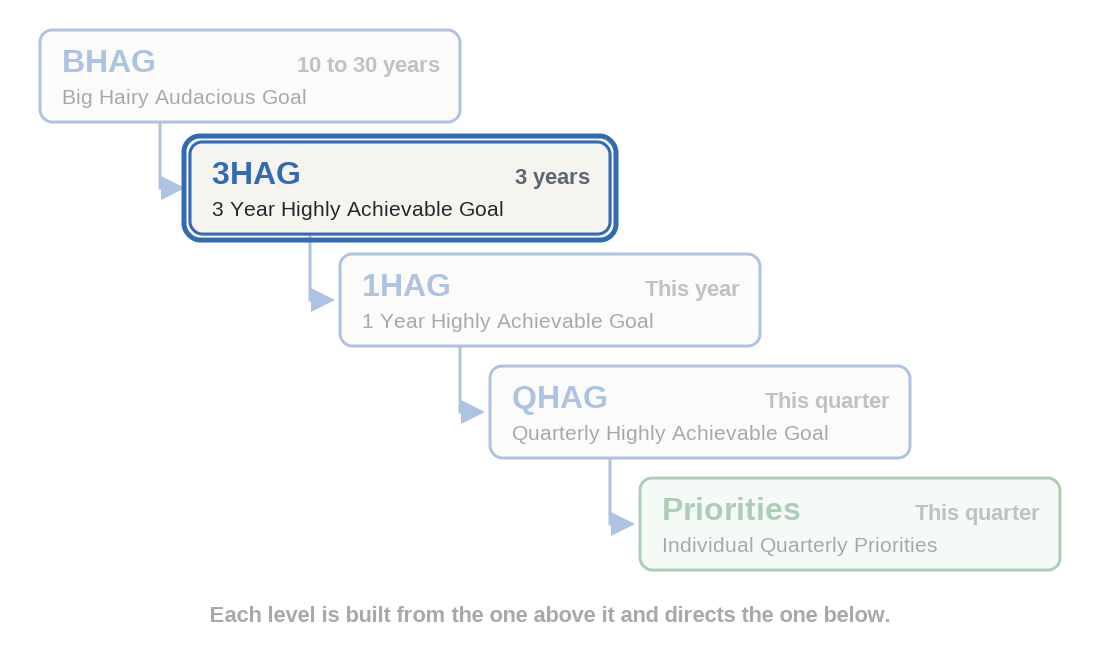
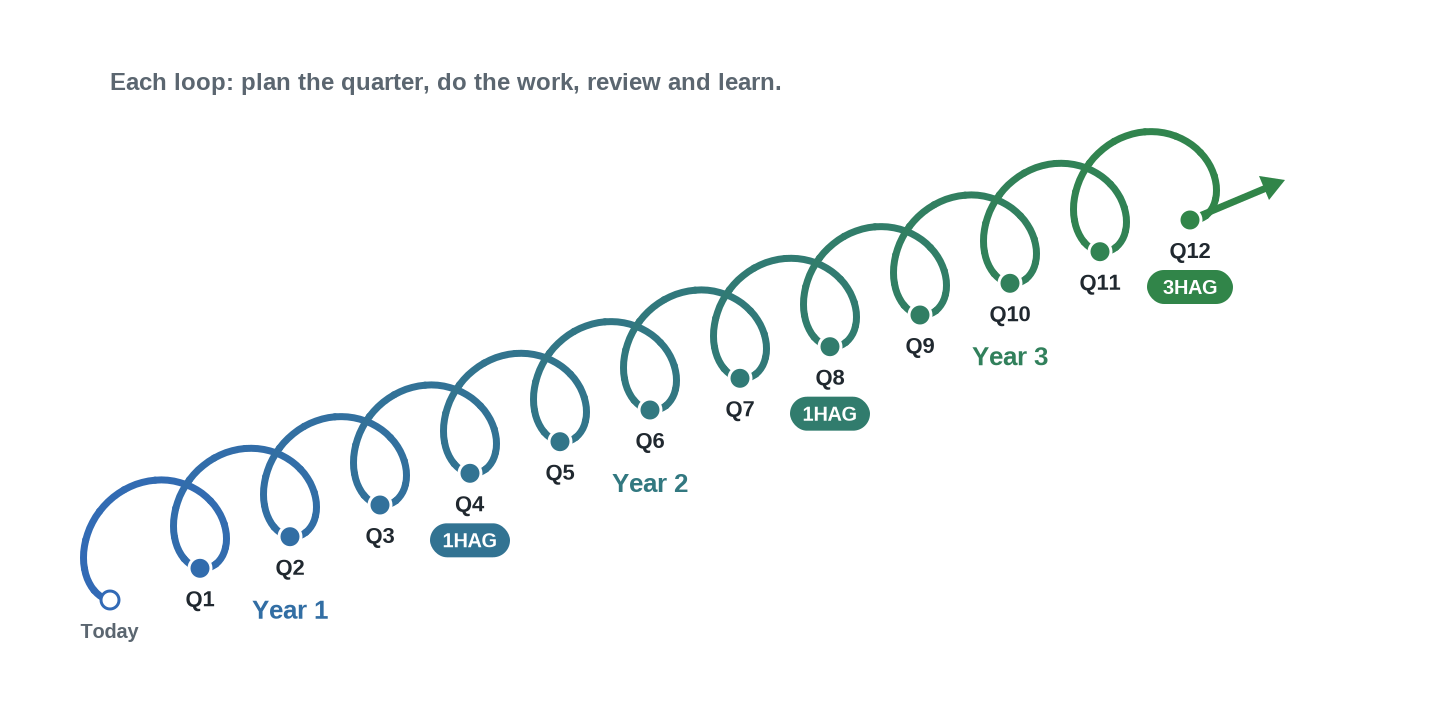
A 3-year stepping stone toward the BHAG.
Connect the future company to the capabilities and targets needed to get there.
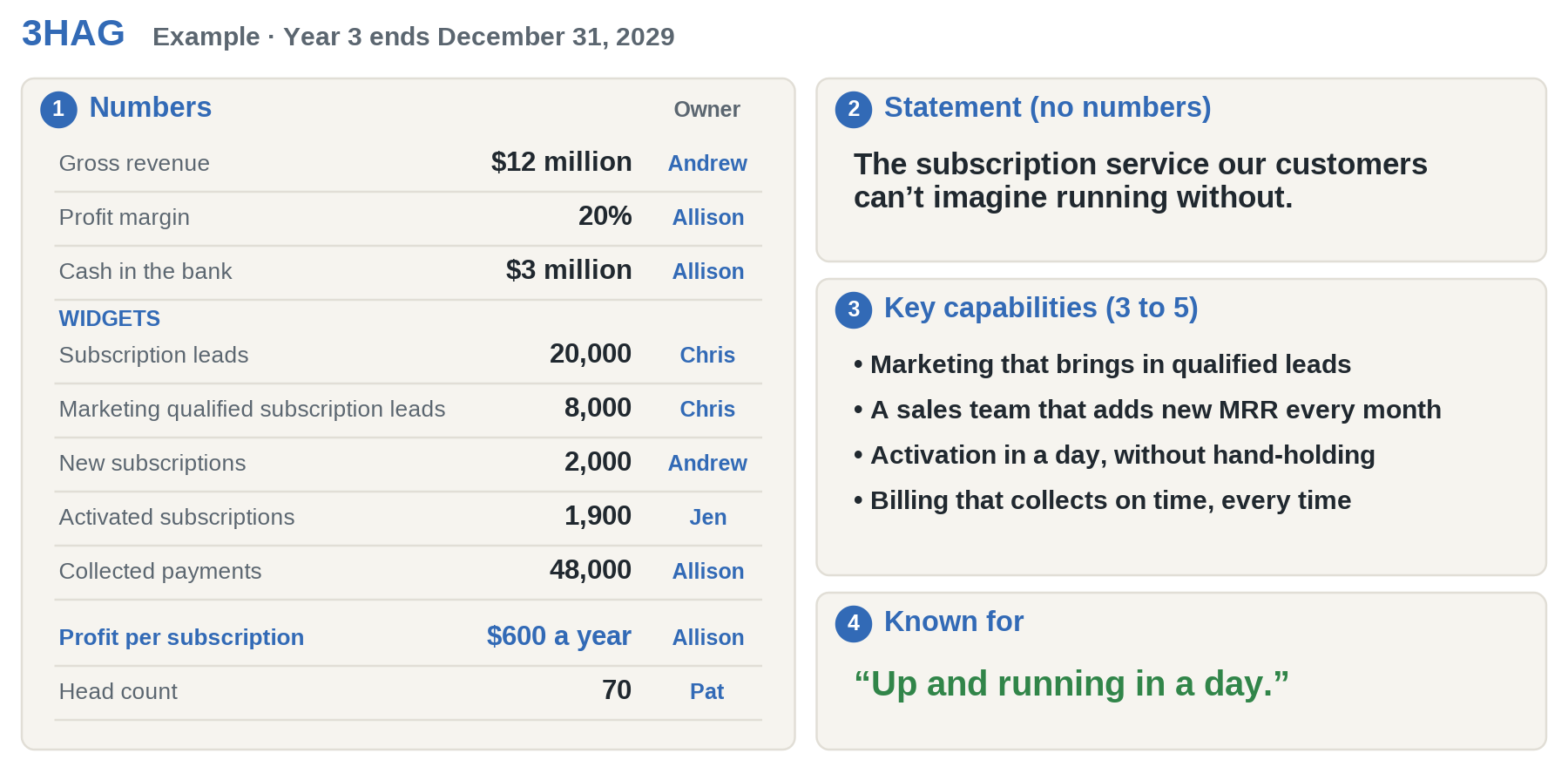 StatementOne sentence that describes the company you will become in 3 years. No numbers.Key capabilitiesThe 3 to 5 things that must be in place to make the numbers and the statement true.Known forWhat people should think when they hear your company name, 3 years from now.Profit per XJim Collins’s economic engine, from Good to Great. It is the one profit ratio that, raised steadily over time, does the most to drive your economics. Here, profit per subscription: profit divided by the average number of active subscriptions. Allison owns hitting the target.
Pick the Year 3 end date.
Gross revenue, margin and year-end cash, for Year 3 alone.
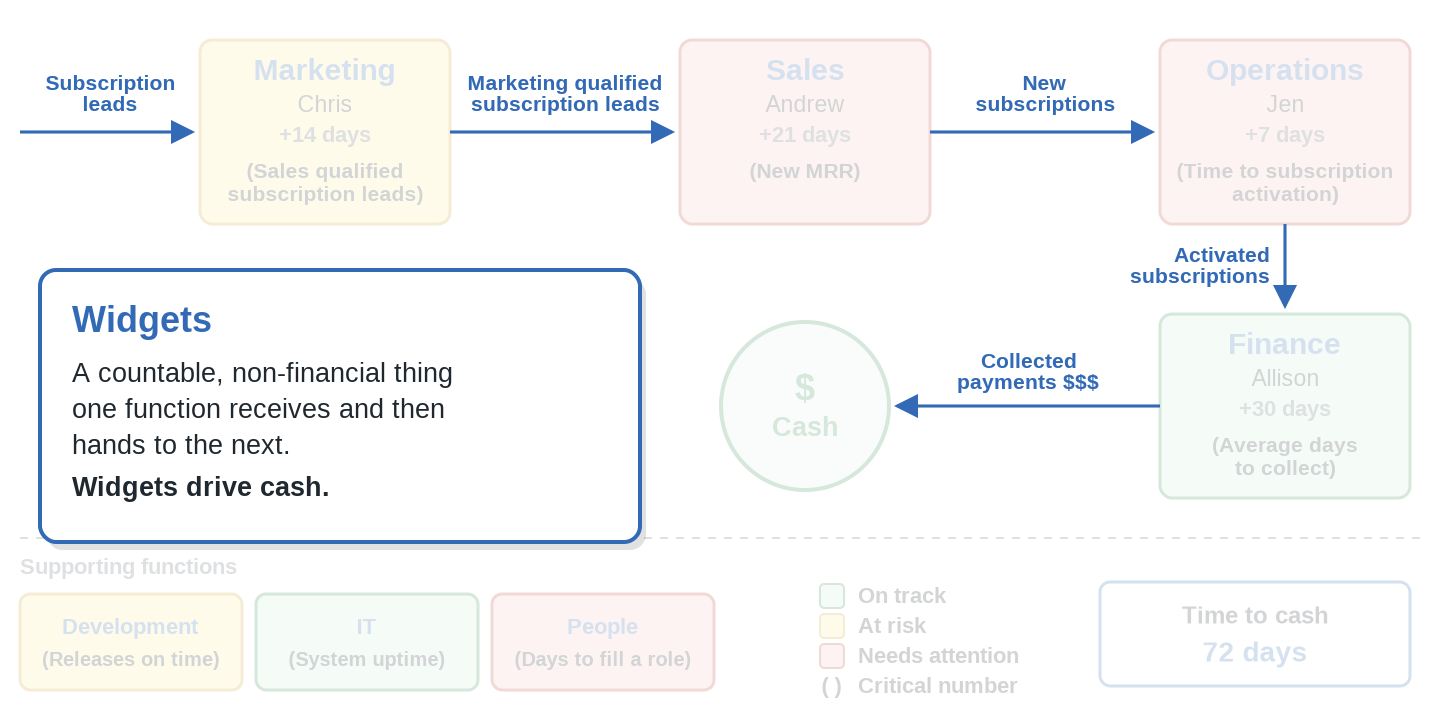
Name the widget for each hand-off on your KFFM. Estimate the quantity where you can.
Name an owner for every number.
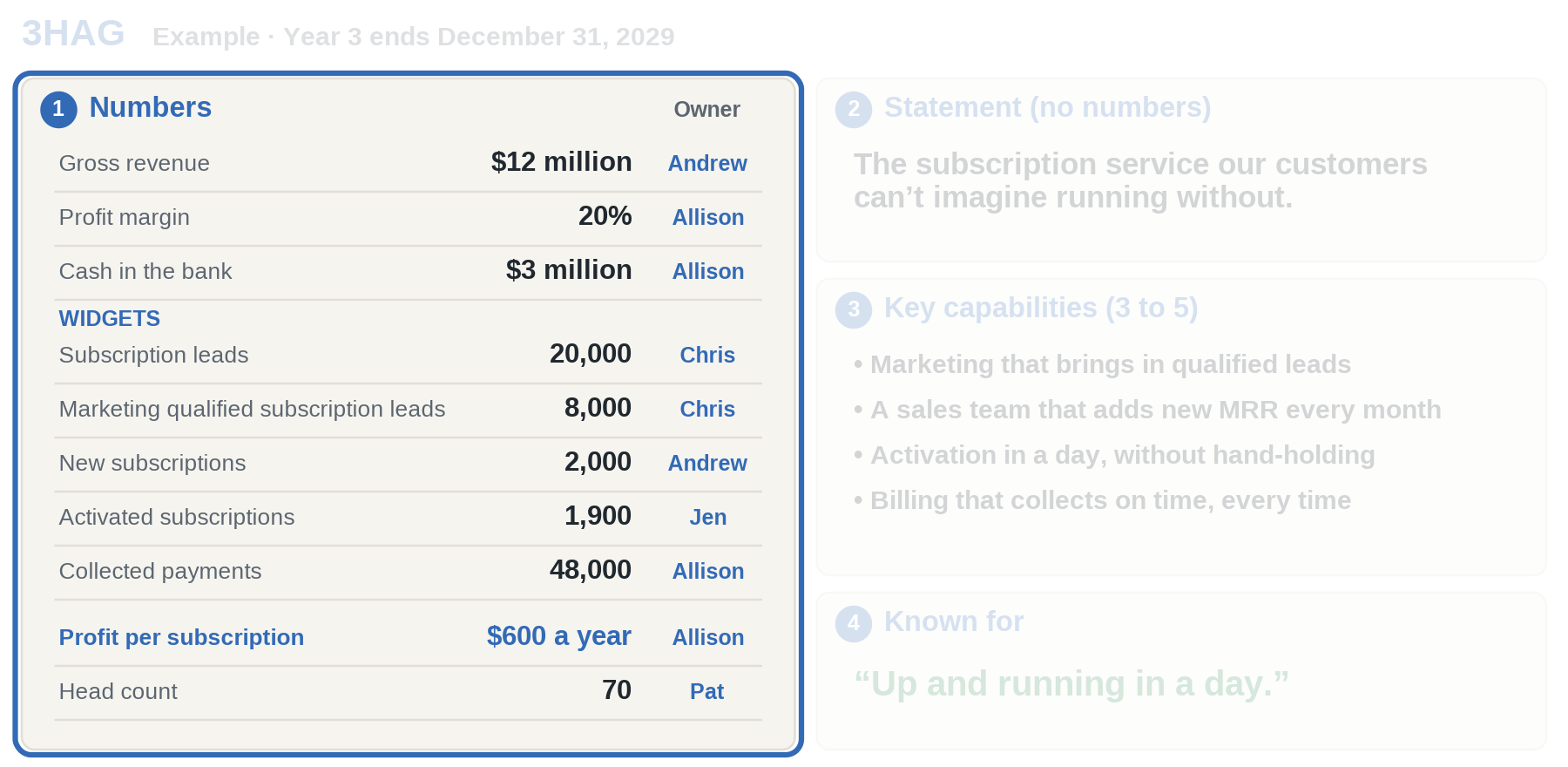 Profit per XJim Collins’s economic engine, from Good to Great. It is the one profit ratio that, raised steadily over time, does the most to drive your economics. Here, profit per subscription: profit divided by the average number of active subscriptions. Allison owns hitting the target.
Write one sentence that describes the company you will become.
Keep numbers in the targets.
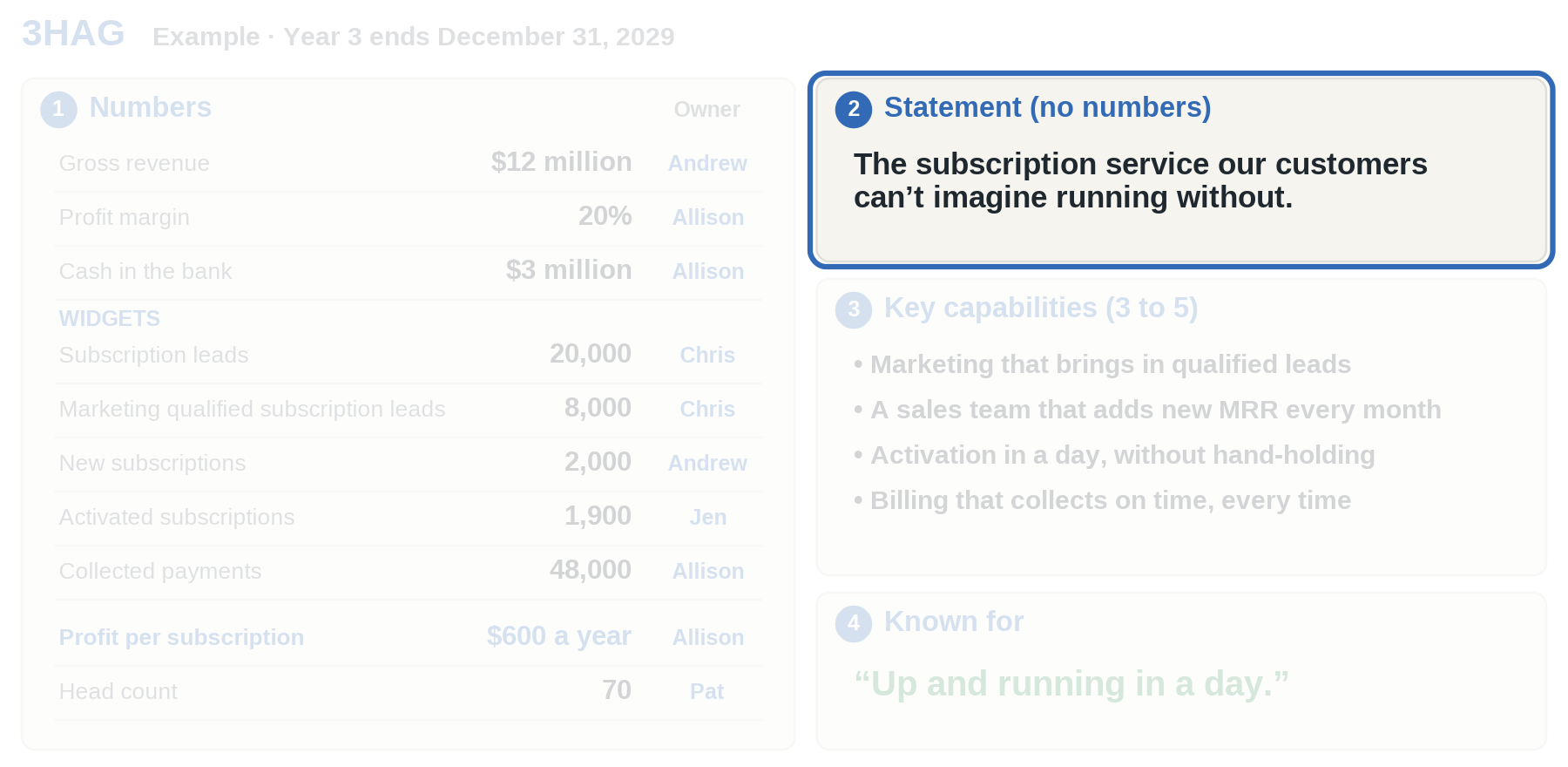 StatementOne sentence that describes the company you will become in 3 years. No numbers.
What must be in place to make the numbers and the statement true?
If revenue tripled, what would we need to be able to do?
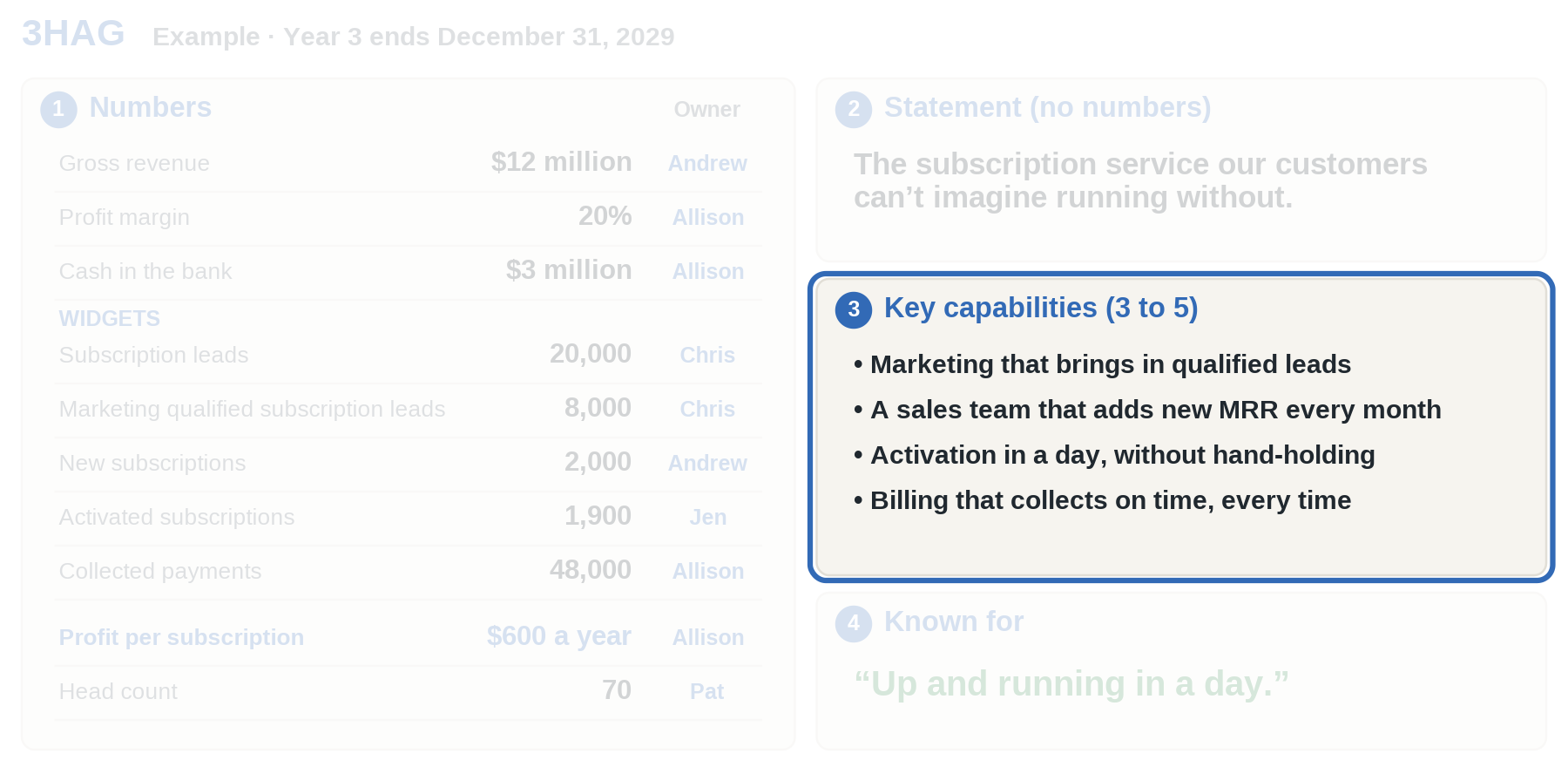 Key capabilitiesThe 3 to 5 things that must be in place to make the numbers and the statement true.
In 3 years, when someone says your company name, what should people think?
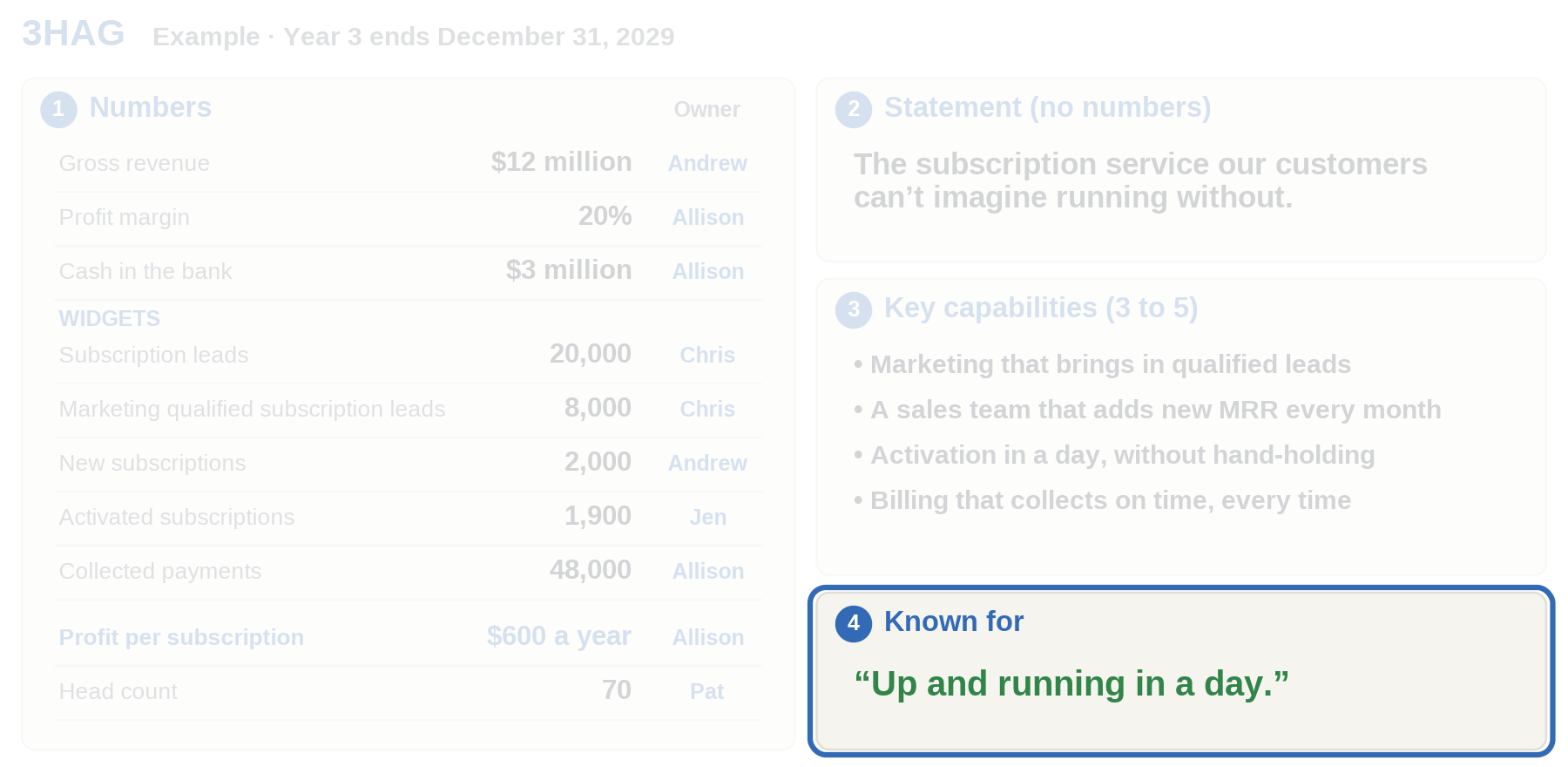 Known forWhat people should think when they hear your company name, 3 years from now.
Read it aloud before you move on.
The numbers are set: date, revenue, cash and widgets.
The statement and known for describe the future company.
3 to 5 capabilities make it possible.
Every number has an owner.
The widgets support the revenue.
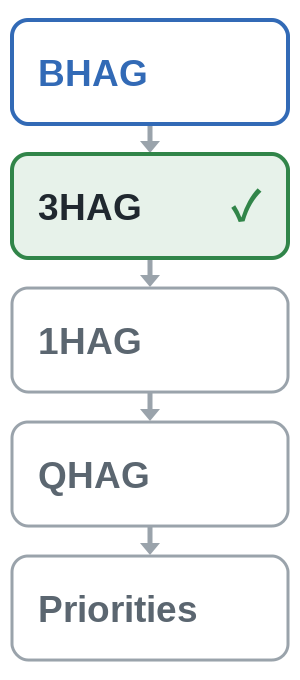
One phrase. 5 words or fewer.


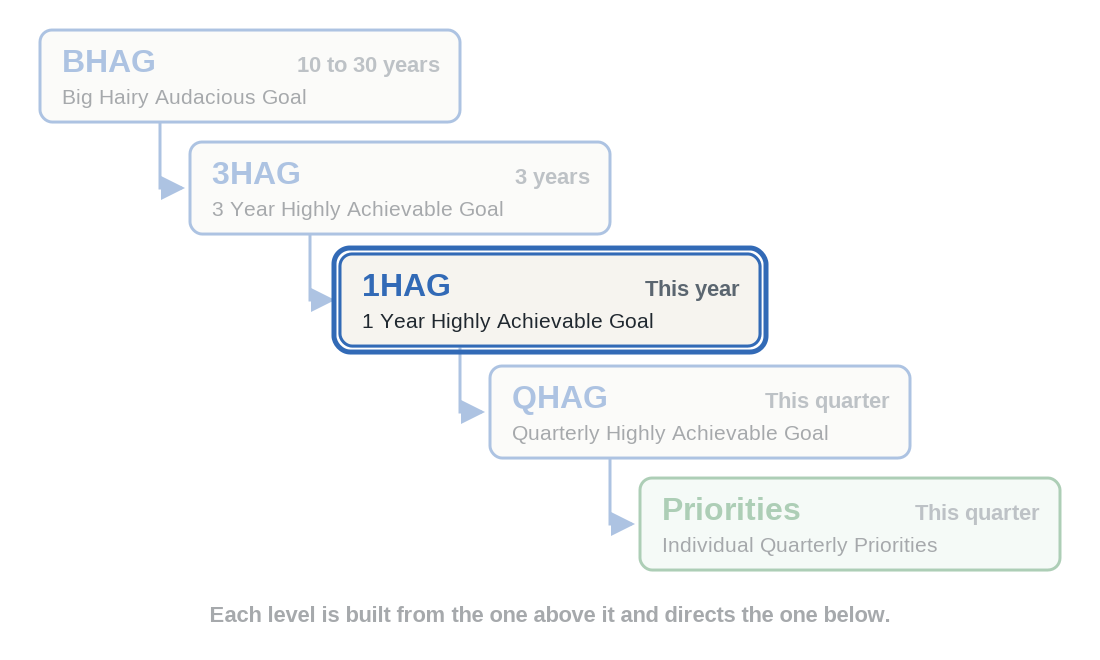
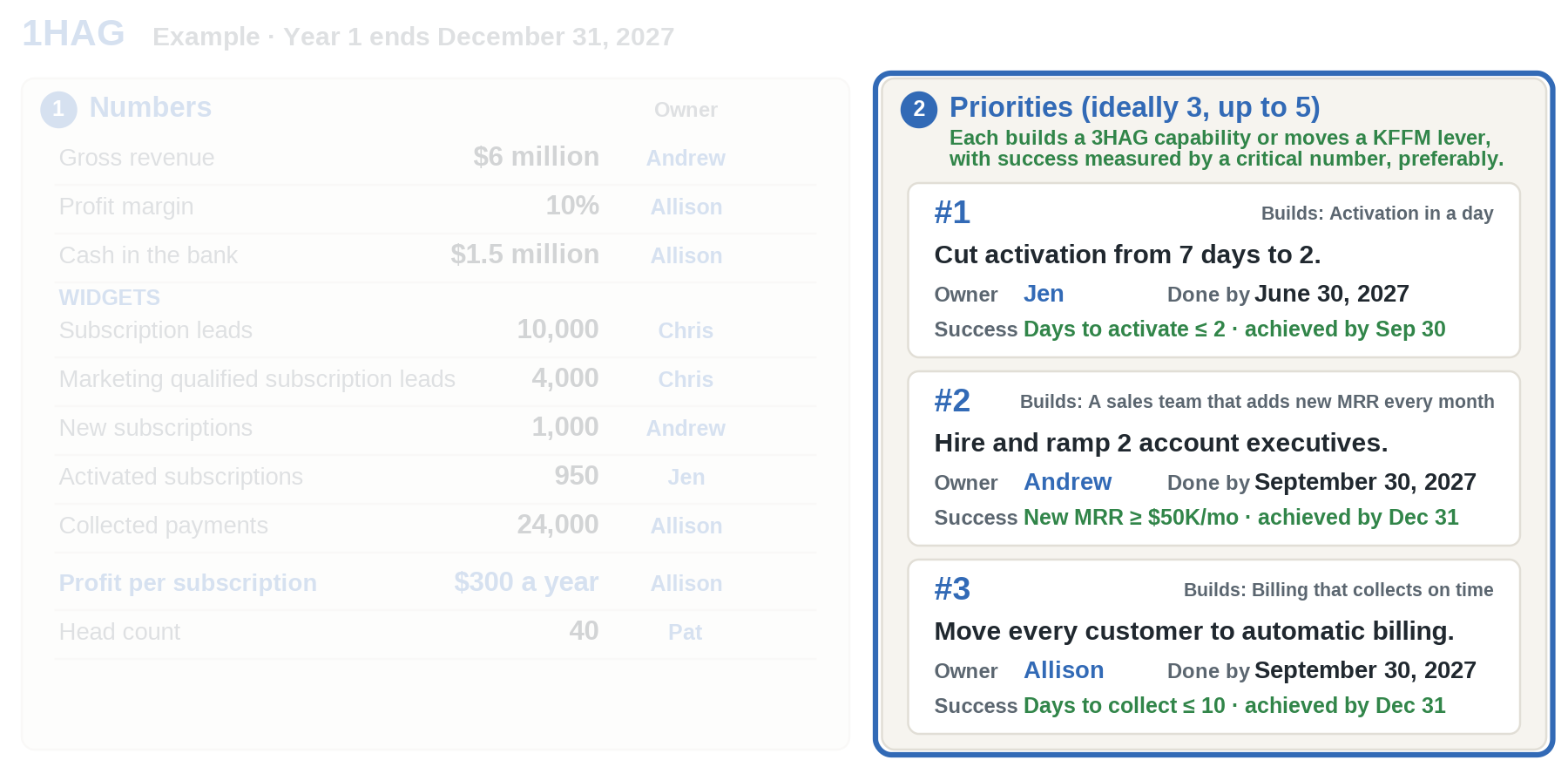
This year’s step toward the 3HAG.
Set this year’s targets and the few priorities that move the 3-year plan forward.
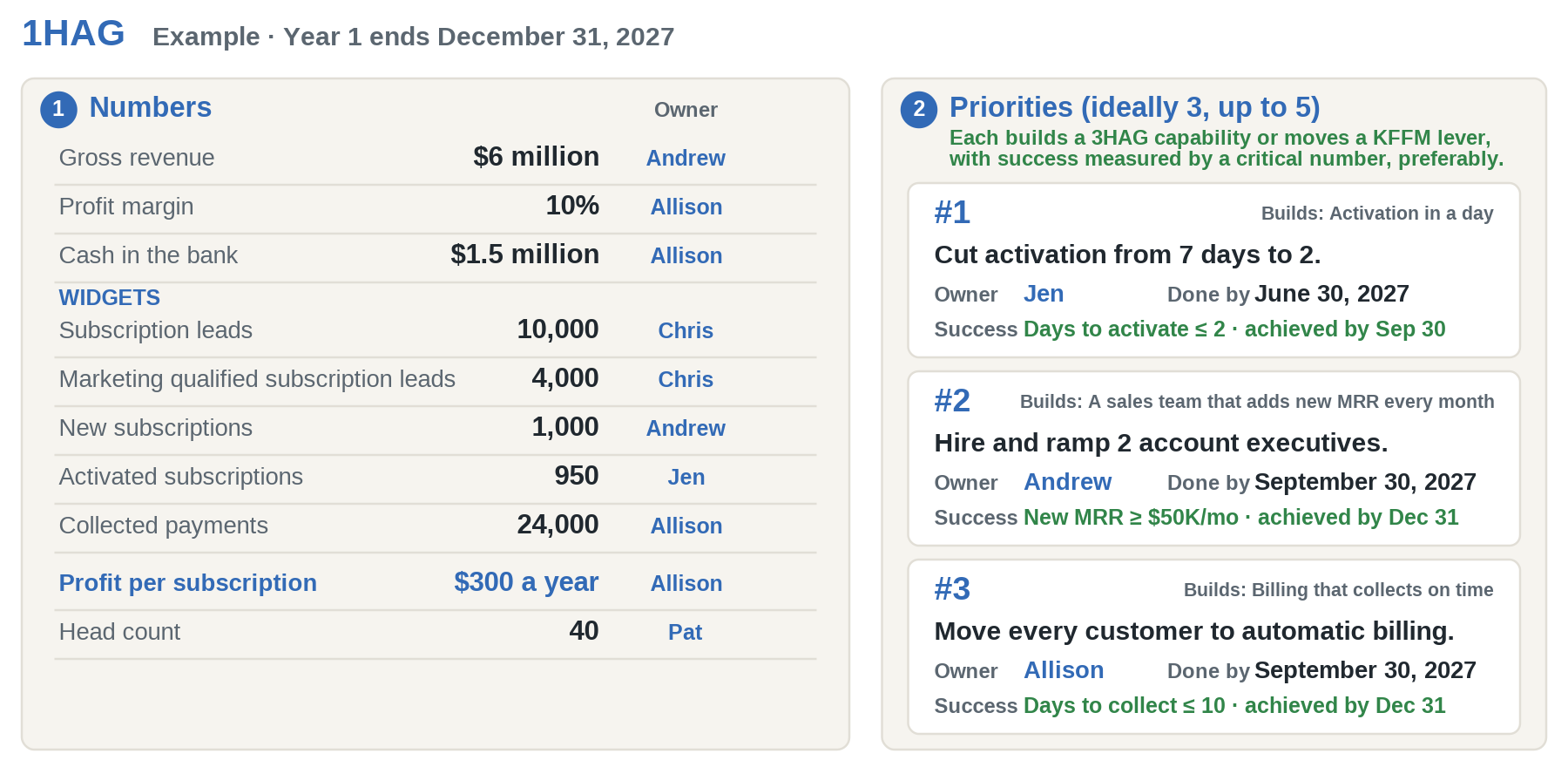 Profit per XJim Collins’s economic engine, from Good to Great. It is the one profit ratio that, raised steadily over time, does the most to drive your economics. Here, profit per subscription: profit divided by the average number of active subscriptions. Allison owns hitting the target.
Confirm the fiscal year and its end date.
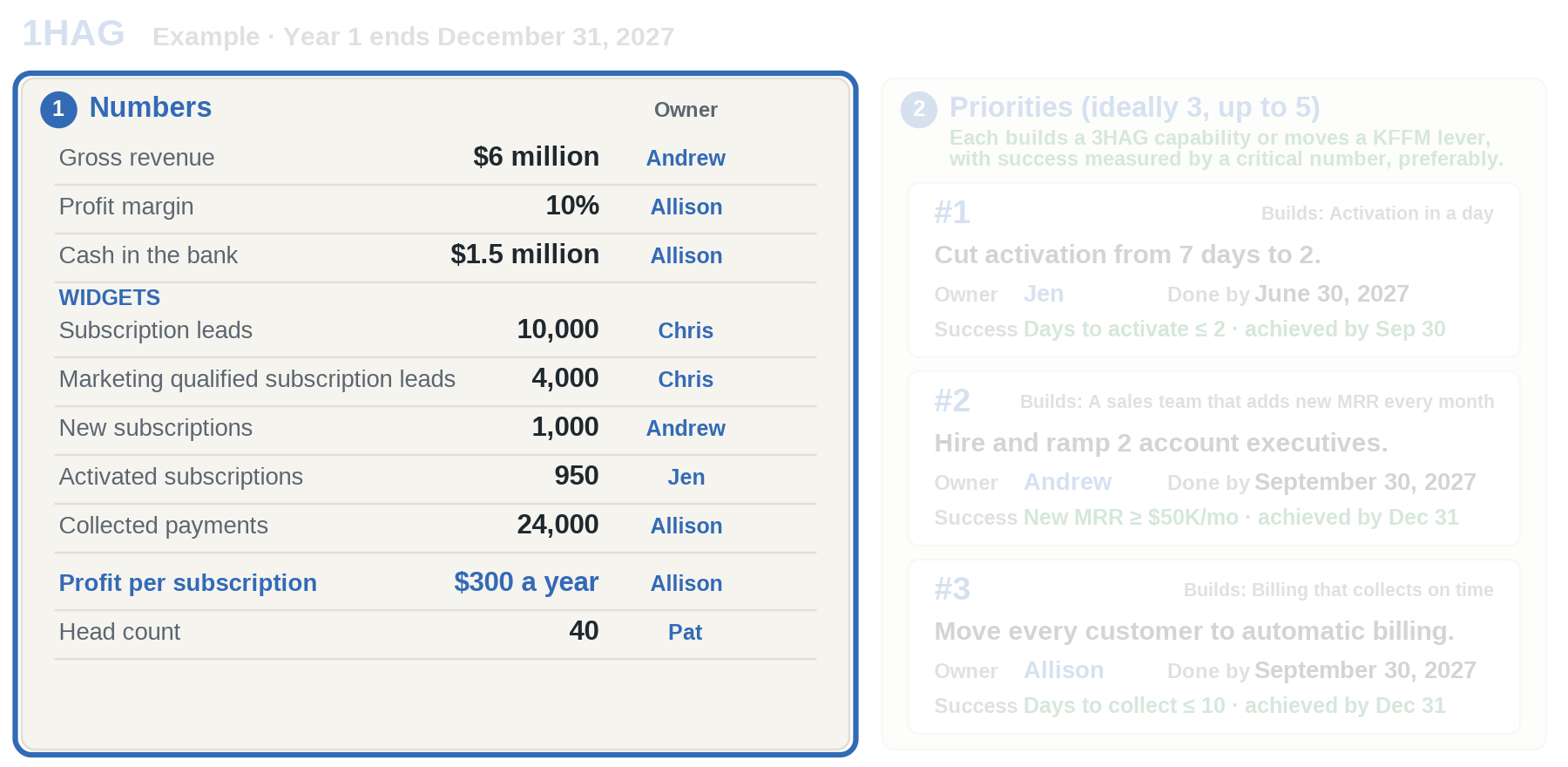
Gross revenue, margin and ending cash.
One widget for each hand-off on your KFFM, plus head count.
Name an owner for every number.
Is each target big enough to get you to your 3HAG targets?
 Profit per XJim Collins’s economic engine, from Good to Great. It is the one profit ratio that, raised steadily over time, does the most to drive your economics. Here, profit per subscription: profit divided by the average number of active subscriptions. Allison owns hitting the target.
Start from your 3HAG key capabilities.
For each capability: what must this year deliver to build it?
Add a priority that moves a KFFM lever if cash needs it.
List every candidate.
Read it aloud before you move on.
Every number and priority has one owner with capacity.
Each priority builds a 3HAG capability or moves a KFFM lever.
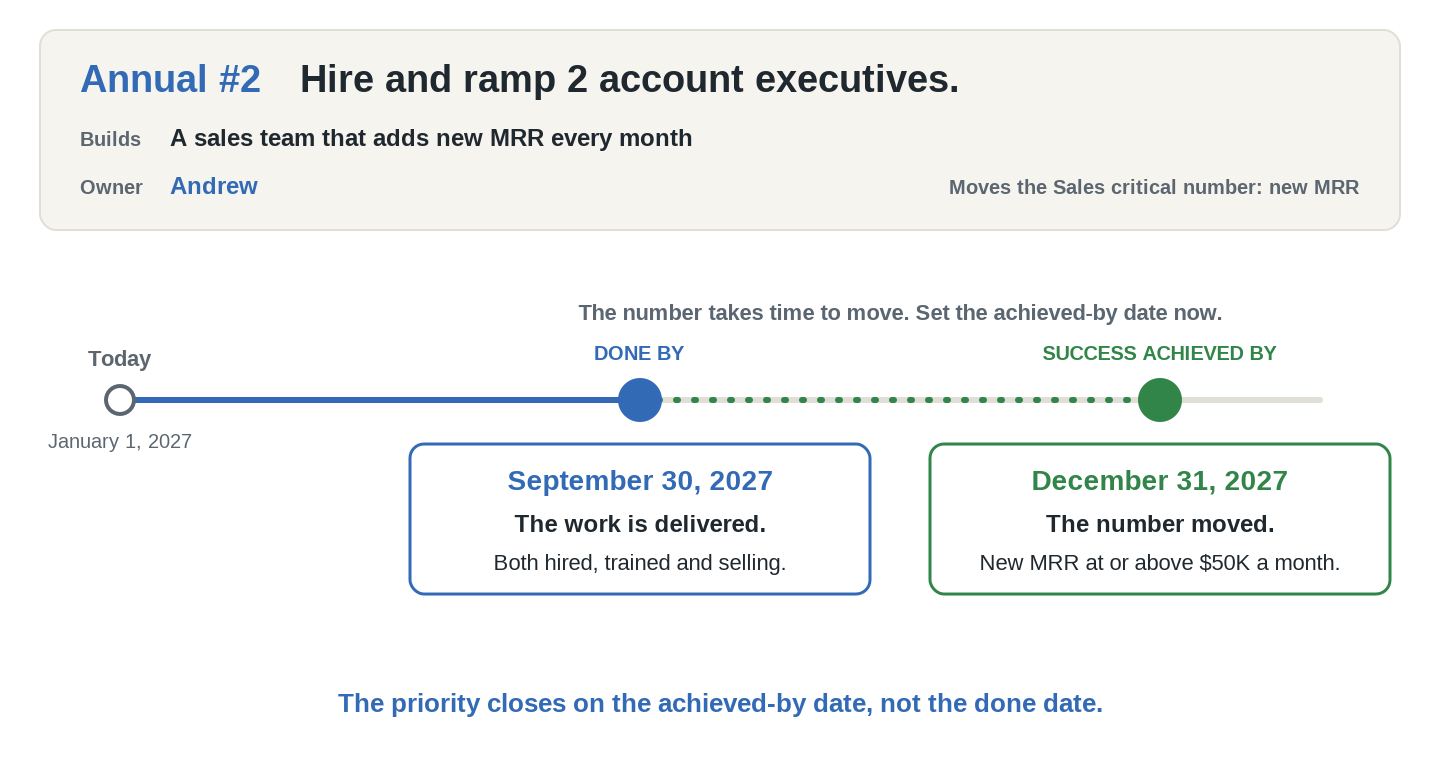
Each measure has a target and an achieved-by date.
Each priority moves its number enough, and soon enough to see.
The targets keep you on track for the 3HAG.
The widgets support the revenue, and head count is set.
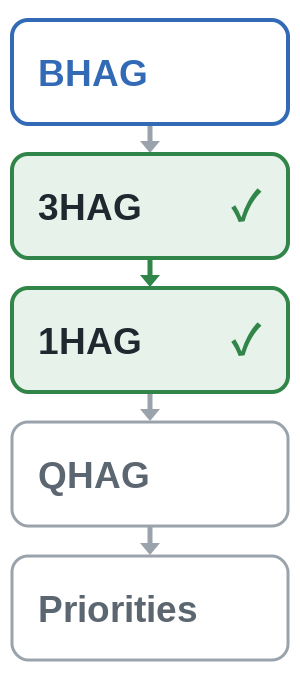
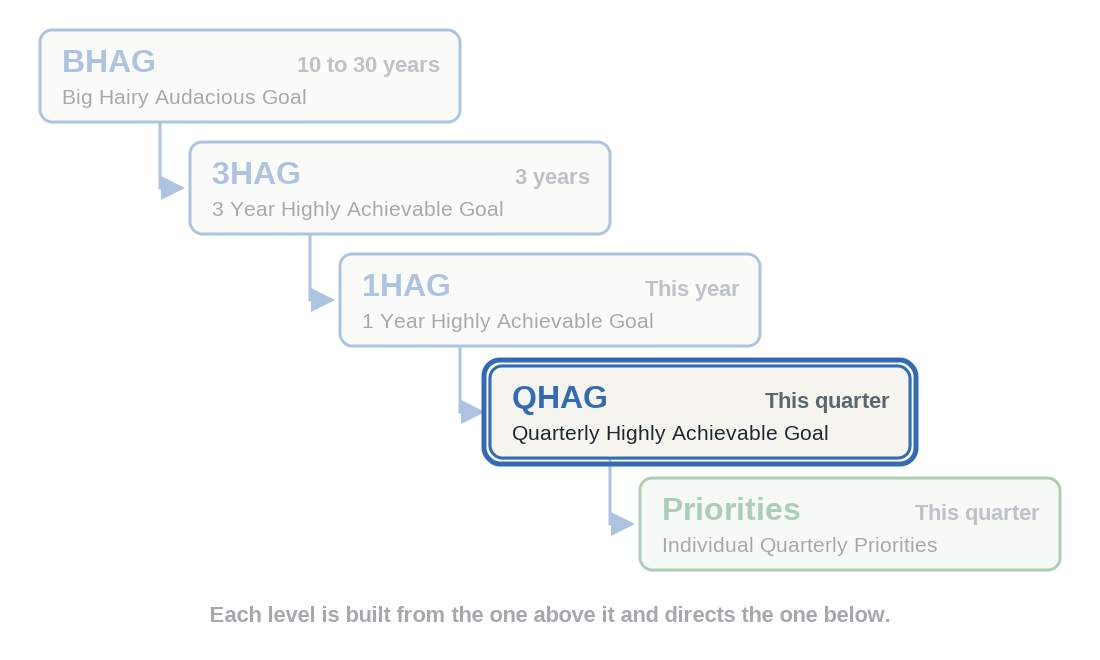
This quarter’s step toward the 1HAG.
Set this quarter’s targets, month by month, and the priorities that deliver the annual plan.
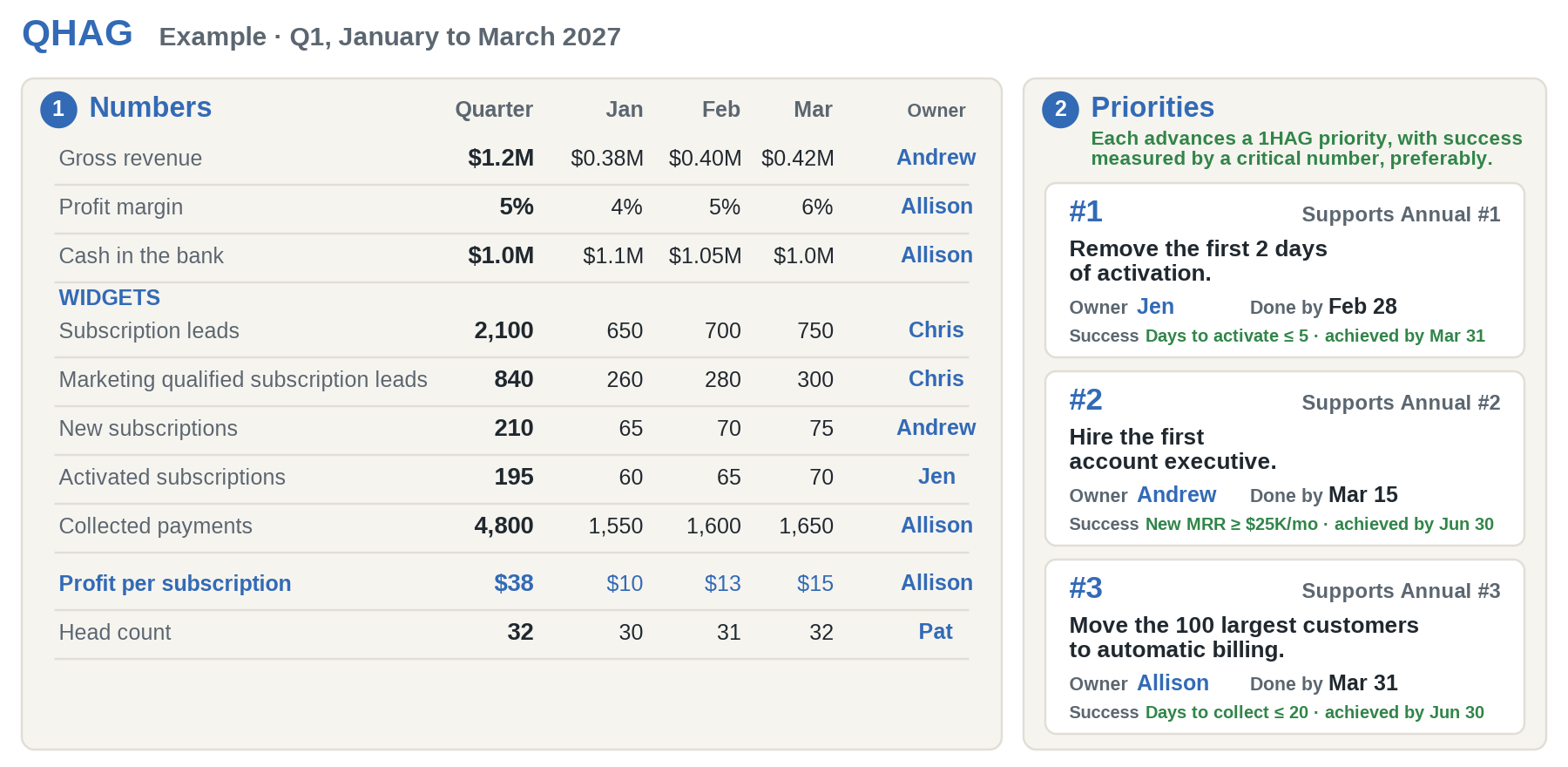 Profit per XJim Collins’s economic engine, from Good to Great. It is the one profit ratio that, raised steadily over time, does the most to drive your economics. Here, profit per subscription: profit divided by the average number of active subscriptions. Allison owns hitting the target.
Confirm the quarter and its end date.
Gross revenue, margin, ending cash, each widget and head count, month by month.
Name an owner for every number.
No data yet? Set your best estimate, then track it.
Is each target big enough to keep you on track for your 1HAG?
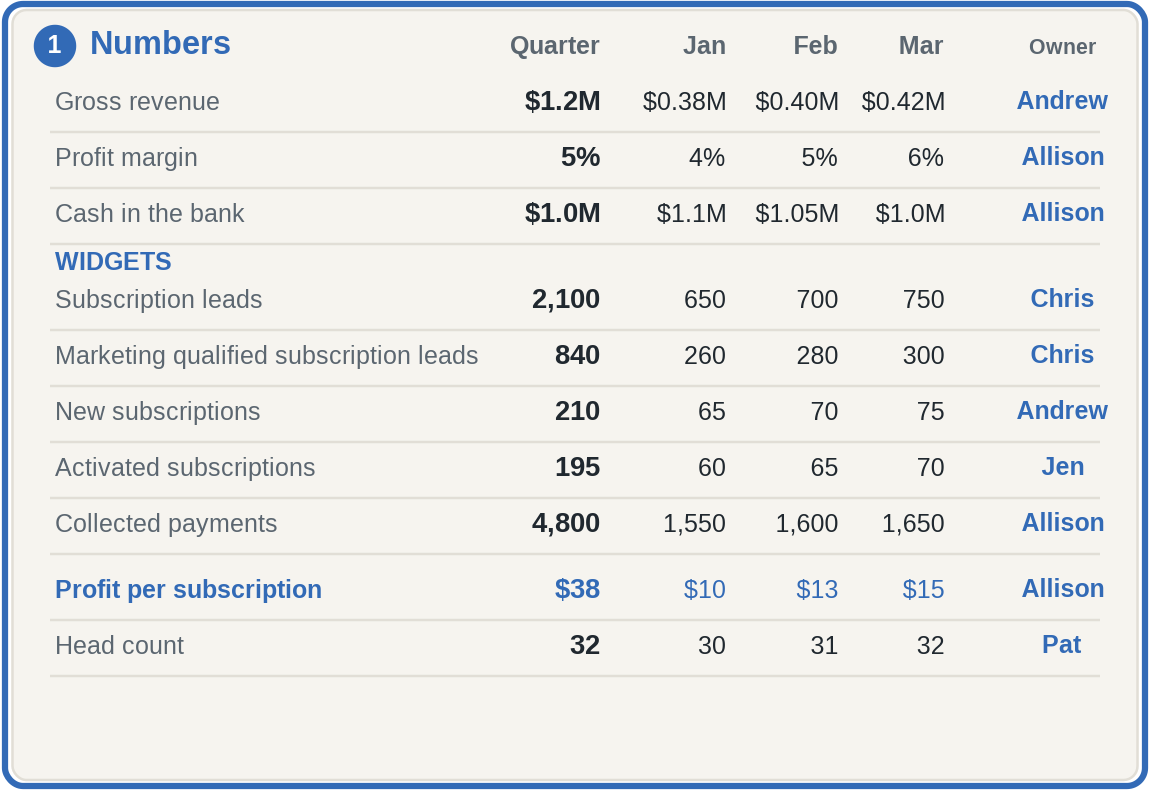 Profit per XJim Collins’s economic engine, from Good to Great. It is the one profit ratio that, raised steadily over time, does the most to drive your economics. Here, profit per subscription: profit divided by the average number of active subscriptions. Allison owns hitting the target.
What must be accomplished now to deliver the annual plan?
List candidates from your 1HAG priorities. Test each with the six questionssix questionsWhat does it build or move?How much will it move a critical number?How soon will we see it?Who can own it and succeed?What will it cost?What could go wrong?, then rank.
Agree on the owner, done-by date, measure of success and achieved-by date.
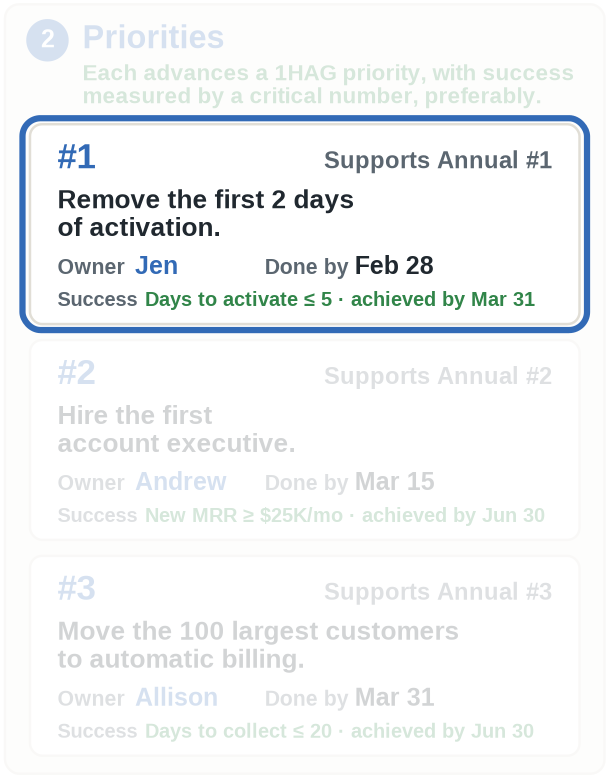
Ideally 3, up to 5 company priorities in total, including #1.
Connect each to an annual priority. Give each an owner, a done-by date, a measure of success and an achieved-by date.
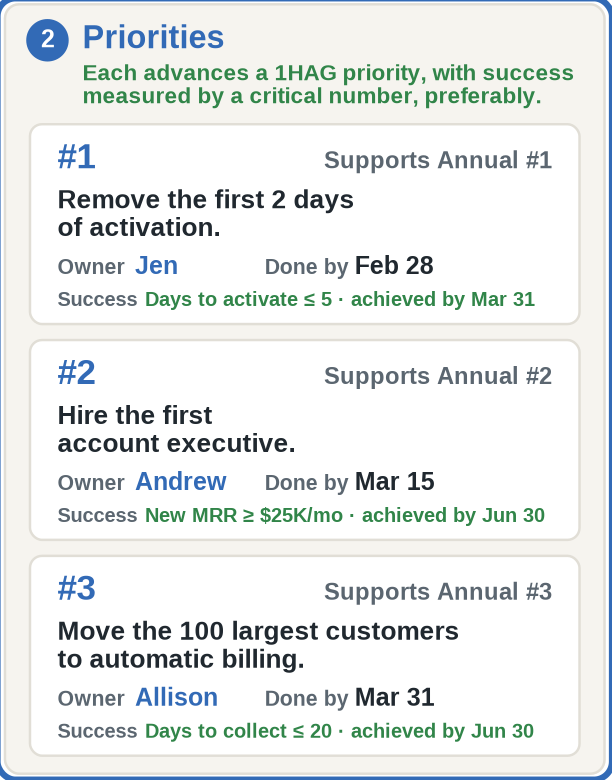
Read it aloud before you move on.
Every number and priority has one owner with capacity.
Each priority advances a 1HAG priority.
Each priority has a target and an achieved-by date.
Each priority moves its number enough, and soon enough to see.
The targets keep you on track for the 1HAG.
The months add up to the quarter, and head count is set.
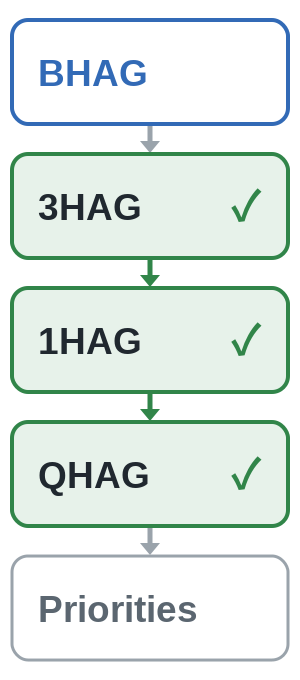
Each person’s step toward the QHAG.
Commit to the few priorities that deliver the QHAG. Each has an owner, a done-by date and a measure of success.
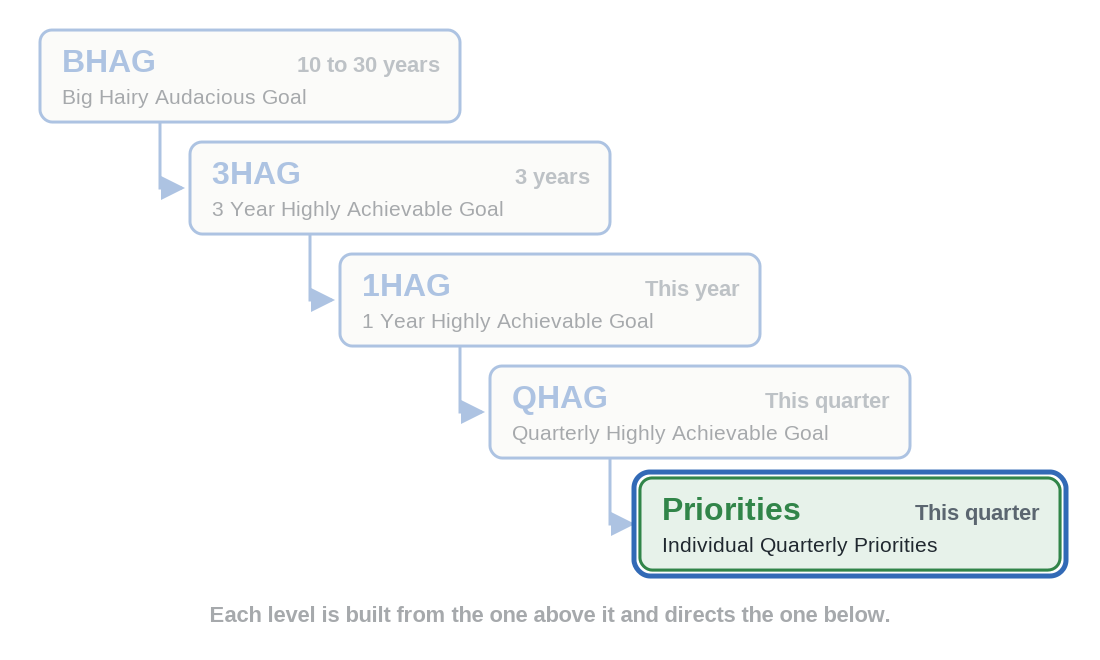
Name company priority #1 and its owner. They go first.
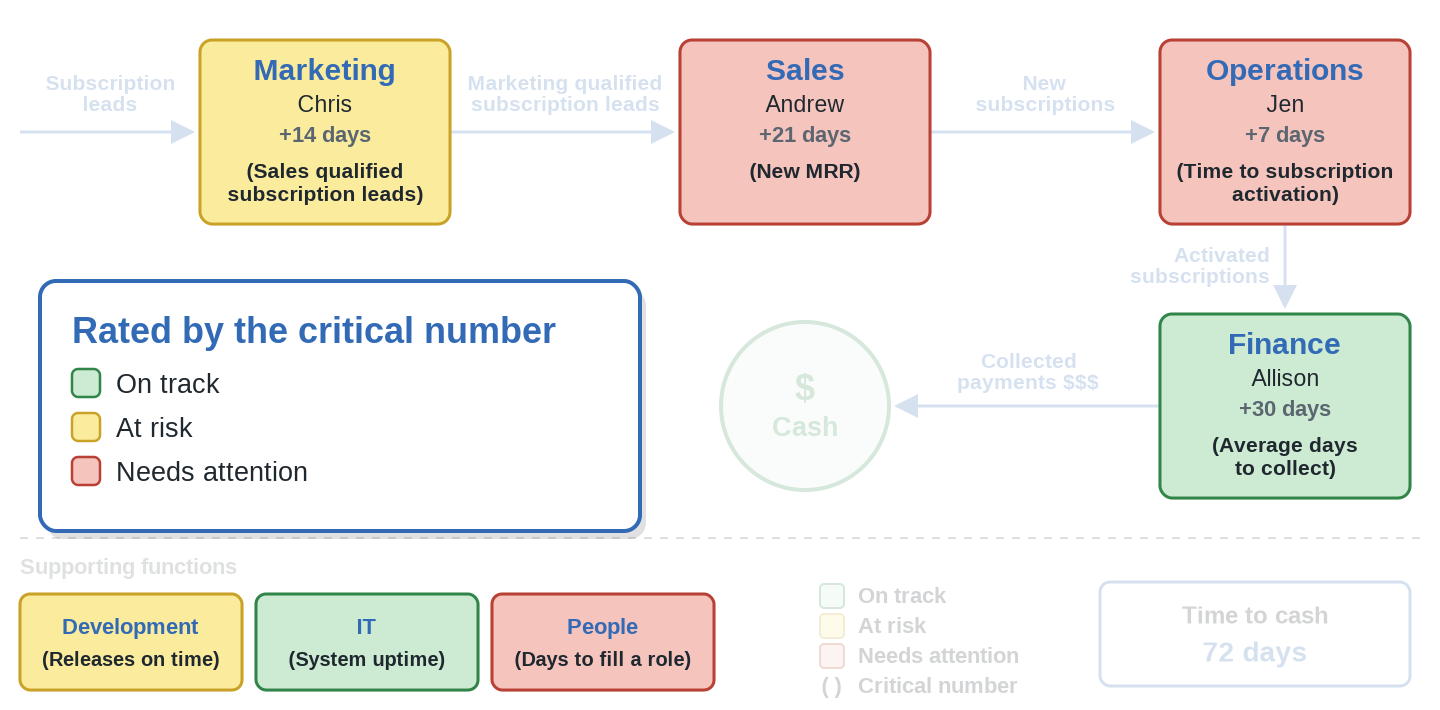
Read your critical number, priorities and professional development.
Peers ask: can you get all that done?
Every number and priority has one owner with capacity.
The 1HAG and the QHAG each have ideally 3, up to 5 priorities.
Every priority has a done-by date, a measure of success and an achieved-by date.
Each 1HAG priority builds a 3HAG capability or moves a KFFM lever.
Each QHAG priority advances a 1HAG priority.
Each individual priority supports a QHAG priority or the owner’s critical number.
Each priority moves its number enough, and soon enough to see.
The 1HAG targets keep you on track for the 3HAG, and the QHAG targets keep the 1HAG on track.
The widget targets support the revenue.
Head count is set on the 1HAG and QHAG.
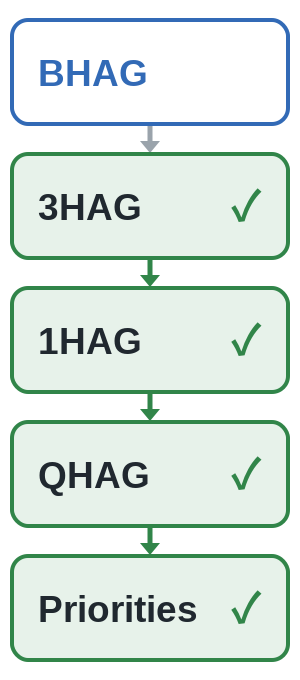
Daily, weekly and quarterly.
Run them in Metronome, using the standing agendas.
Each owner updates their numbers and priorities in Metronome.
Agree on the deadline, such as the day before.
Everyone reviews the updates before the meeting starts.
For each answer: met, partly met or still open?
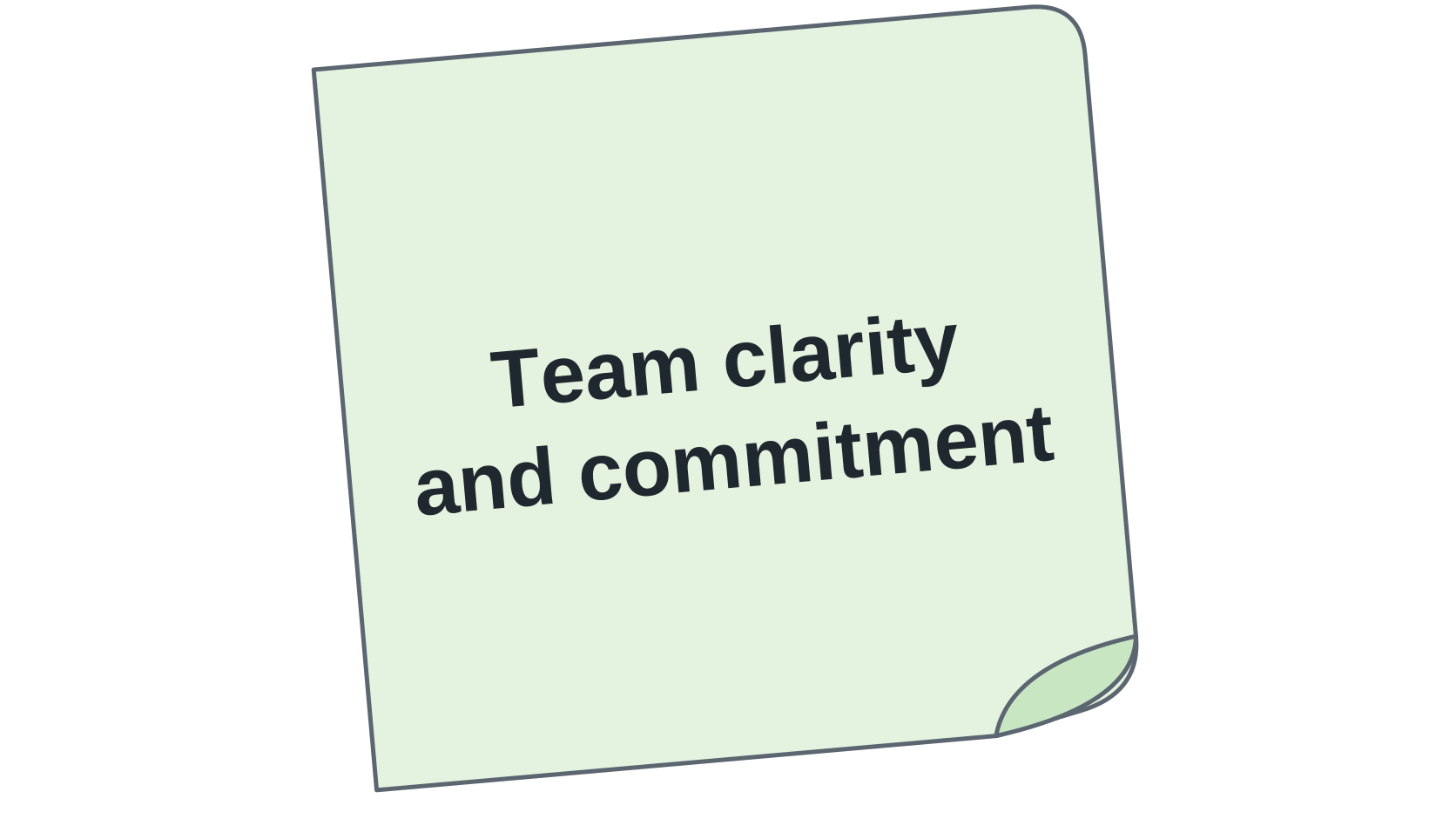
One phrase. 5 words or fewer.
Scan the code to open the full deck on your phone.